Before You Visit Pompeii, Read This First — It’s Even More Incredible Than You Imagine
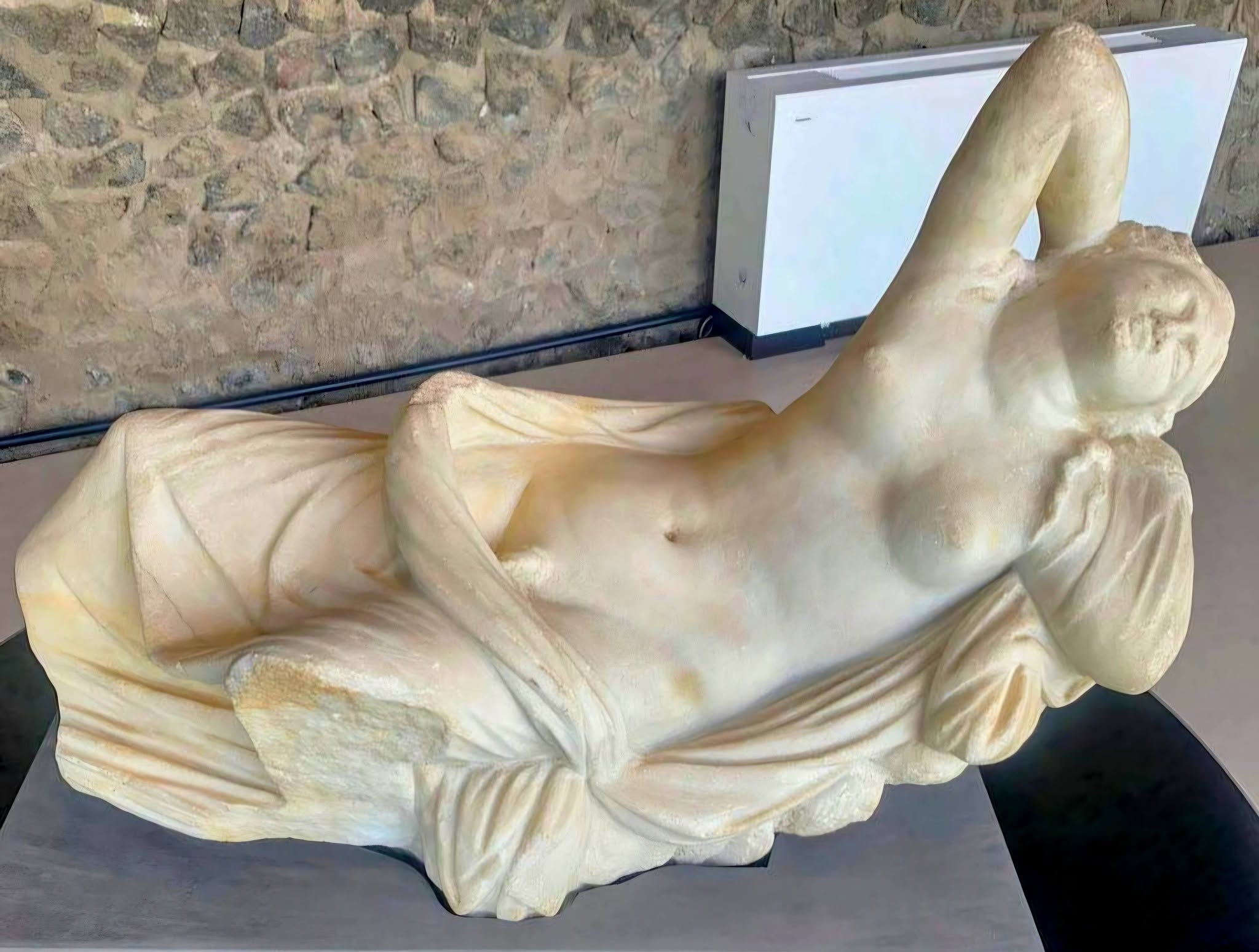
Pompeii is one of the most extraordinary archaeological sites in the world — a Roman city frozen in time by the eruption of Mount Vesuvius in AD 79. Visiting Pompeii means walking cobblestone streets that real Romans walked, standing in theatres where crowds once roared, and coming face to face with the haunting plaster casts of those who didn’t make it out.
I visited Pompeii as part of a broader southern Italy trip — weaving through Naples, the Amalfi Coast, and eventually Rome — and I made sure to give Pompeii a proper amount of time. I’d read about it for years. I thought I knew what to expect. And then I walked through the main gate, and everything I’d imagined fell short of the real thing.
This guide will walk you through everything you need to know to visit Pompeii: what to see, how to get there from Naples or Rome, which tours are worth booking, tickets, tips, and how to make the most of every hour inside the archaeological park.
Is Visiting Pompeii Worth It?
Yes — without question. Pompeii is one of the most important and moving historical sites in the world, and no photograph or documentary fully prepares you for being there in person.
More than 2.5 million people visit Pompeii each year, and that number keeps growing. The reason is simple: nowhere else on earth offers this kind of immersion into ancient Roman daily life. The streets, homes, temples, baths, theatres, and even the graffiti scratched into walls — it’s all here, remarkably preserved, waiting to be walked through.
The biggest surprise for me wasn’t the size of Pompeii but the ordinary details. The wheel ruts, graffiti, bakeries, and stepping stones made it feel less like a collection of ruins and more like a city that had simply been paused in time.
If you’re traveling through southern Italy and wondering whether to make the effort — make it. The Pompeii visit is one of those experiences that stays with you long after you’ve left.
What to Know Before You Visit Pompeii
What Is Pompeii Famous For?
Pompeii is famous as a Roman city buried by the eruption of Mount Vesuvius in AD 79, preserving streets, buildings, and human remains under volcanic ash for nearly 1,700 years before being rediscovered in the 18th century.
What makes it extraordinary isn’t just its age — it’s the completeness. Because the city was sealed so suddenly, everyday objects were preserved in place: loaves of bread still in ovens, wine jars in shops, political graffiti on walls. You’re not looking at ruins so much as a paused moment in time.
- The Forum — the political and religious centre of the city
- The Amphitheatre — one of the oldest surviving Roman arenas in the world
- The Villa of the Mysteries — famous for its stunning Dionysian frescoes
- The plaster casts — haunting human forms cast from voids left in the ash
- Via dell’Abbondanza — the main street lined with ancient shops and homes
Where Is Pompeii?
Pompeii is located in the Campania region of southern Italy, approximately 24 km (15 miles) southeast of Naples and around 13 km from the slopes of Mount Vesuvius. The archaeological park sits just outside the modern town of Pompeii.
The official address of the archaeological park is: Via Villa dei Misteri 2, 80045 Pompeii NA, Italy.
It’s easy to reach from Naples, Sorrento, and Rome, making it one of the most popular day trips in southern Italy. If you’re planning a broader Italian itinerary, check out my Rome travel guides — Pompeii pairs perfectly with a Rome base.
📌 Pompeii At a Glance
- Location: Campania, southern Italy, near Naples and Mount Vesuvius
- Best time to visit: April–June and September–October
- Time needed: Half day (minimum) to full day
- Main highlights: Forum, Amphitheatre, Villa of the Mysteries, Garden of Fugitives
- Crowds: High in summer; manageable in shoulder seasons
- Tickets: Around €22 (book online in advance)
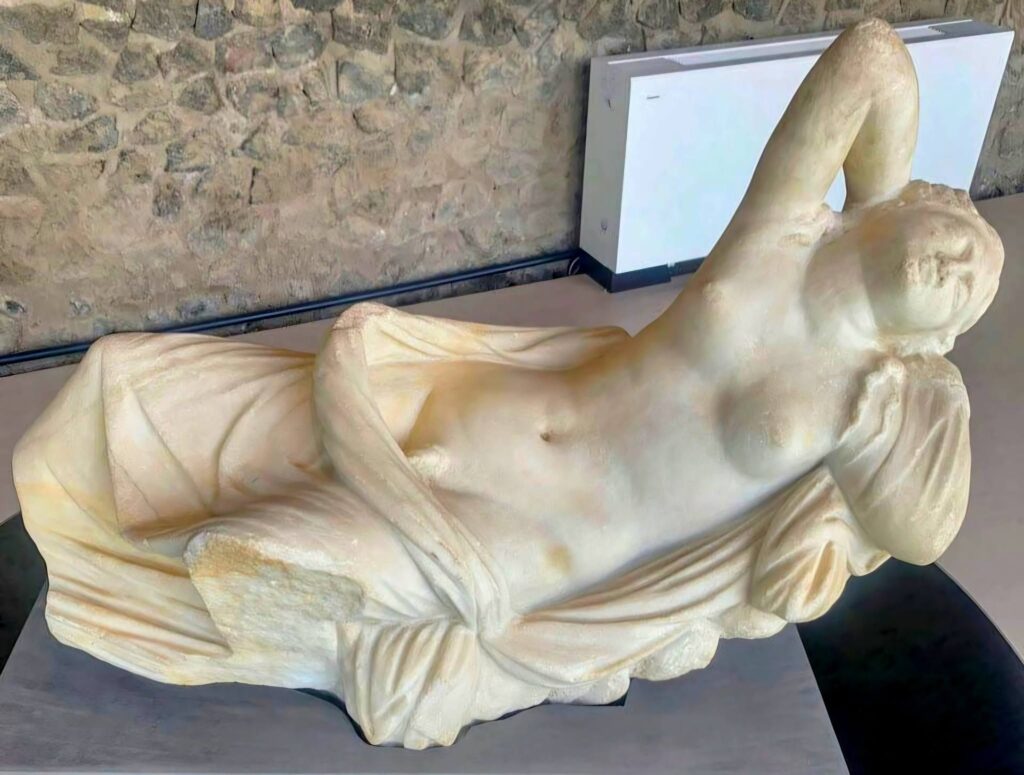
🎟️ Pompeii Tickets & Opening Hours
Pompeii Entrance Tickets
- Standard adult ticket: approximately €22
- Reduced tickets: available for EU citizens aged 18–25; children under 18 are free
- Free entry: on the first Sunday of every month (can be very crowded)
- Book online: strongly recommended — long queues at the on-site ticket office are common
👉 Book your Pompeii entry ticket with audio guide here — this includes skip-the-line access and a downloadable audio guide, which I’d consider essential for a solo visit.
Pompeii Opening Hours
The archaeological park is open daily, generally from 9:00 am to 7:00 pm (last entry at 5:30 pm). Hours can vary slightly by season, so always check the official Pompeii website before your visit.
Can You Visit Pompeii for Free?
Yes — on the first Sunday of every month, entry to the Pompeii archaeological park is free for all visitors. The trade-off is that these days attract significantly larger crowds, so arrive at opening time if you’re going on a free Sunday.
🚪Which Pompeii Entrance Should You Use?
Pompeii has three main entrances, and choosing the right one depends on how you’re arriving and which part of the site you want to explore first. Most visitors default to the main gate without realising there are other options — knowing the difference can save you time and help you start your visit in a much more logical spot. Here’s a breakdown of each entrance so you can plan your route before you arrive.
Porta Marina Entrance
Porta Marina is the main entrance to Pompeii and the one most visitors use. It sits on the western edge of the archaeological park, a short five-minute walk from the Pompei Scavi – Villa dei Misteri train station on the Circumvesuviana line. If you’re arriving by train from Naples or Sorrento, this is the entrance you’ll naturally arrive at — and it’s a perfectly logical starting point.
Entering through Porta Marina puts you immediately on the path toward the Forum, the civic heart of the city, making it the best starting point for a west-to-east route through the park. The ticket office, information point, luggage storage, and the main facilities are all located here.
- Best for: Train arrivals from Naples or Sorrento, first-time visitors, those starting at the Forum
- Closest train stop: Pompei Scavi – Villa dei Misteri (Circumvesuviana)
- Note: This is the busiest entrance — arrive early to avoid queues, or book tickets online in advance
Piazza Anfiteatro Entrance
The Piazza Anfiteatro entrance sits on the eastern side of the archaeological park, near — as the name suggests — the Amphitheatre and the Palaestra Grande. It’s far less used than Porta Marina, which means shorter or nonexistent queues even during busy periods. If you’re arriving by car and parking on the eastern side of the site, or if you specifically want to start your visit at the Amphitheatre and work your way back toward the Forum, this entrance makes excellent practical sense.
Starting from the eastern end also means you tackle the furthest, least-visited corners of the park while your energy is highest, and you arrive at the Forum — typically the most crowded area — later in the day when some of the tour groups have thinned out.
- Best for: Car arrivals, those wanting to start at the Amphitheatre, avoiding crowds
- Closest landmarks: Amphitheatre, Palaestra Grande, Garden of Fugitives
- Note: Fewer facilities here than at Porta Marina — use the main entrance services first if needed
Piazza Esedra Entrance
The Piazza Esedra entrance is located on the northern side of the archaeological park and is the least used of the three main entry points. It’s positioned near the Forum Baths and the central part of the site, making it a genuinely useful option if you’re arriving from the modern town of Pompeii rather than the train station, or if you’re staying in accommodation on that side of the site.
Because it attracts far fewer visitors than Porta Marina, the Piazza Esedra entrance is worth considering if you’re visiting during peak season and want to start your day without the bottleneck that can form at the main gate. It’s also a good option for those who want to spend the majority of their time in the central areas of the park — the baths, the residential streets, and the Forum district — without walking the full length of the site.
- Best for: Those staying in the modern town of Pompeii, visitors focused on the central park area, peak-season crowd avoidance
- Closest landmarks: Forum Baths, central residential streets
- Note: Check current opening status before arriving — this entrance is occasionally closed or has restricted hours
🚆 How to Get to Pompeii
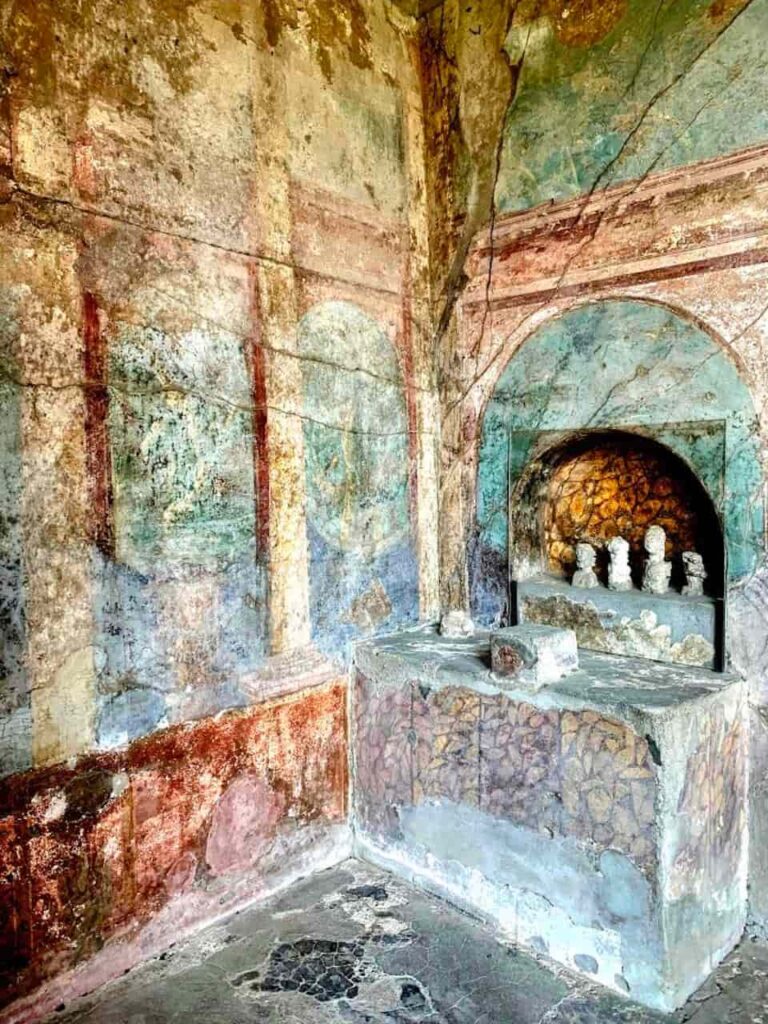
Pompeii from Naples (Napoli to Pompeii Train)
The Naples to Pompeii train is the easiest and most popular way to make the trip. Here’s how it works.
The Circumvesuviana commuter rail line runs directly from Napoli Centrale (Naples Central Station) to Pompei Scavi – Villa dei Misteri station, which sits just outside the main entrance to the archaeological site.
- Journey time: approximately 35–40 minutes
- Trains: run roughly every 30 minutes throughout the day
- Cost: around €3–4 each way
- Station to use in Naples: Napoli Centrale (lower level, Circumvesuviana platforms)
- Stop: Pompei Scavi – Villa dei Misteri (not just “Pompei” — make sure you get the right stop)
This is genuinely the simplest way to do a Pompeii from Naples day trip. You don’t need to book in advance — just show up, buy a ticket, and board. The walk from the train station to the archaeological park entrance is about 5 minutes.
How to get from Naples to Pompeii without the train: Private transfers and taxis are available, and several organized tours pick up directly from Naples hotels — more on those below.
💡 Pro tip: Get to Naples Centrale early and allow extra time at the Circumvesuviana platforms — they’re separate from the main train hall and can be confusing to find the first time.
Pompeii from Rome
A Pompeii from Rome day trip is absolutely doable, though it’s a longer journey and requires more planning to make it worthwhile.
The most comfortable option is taking a high-speed Frecciarossa train from Roma Termini to Napoli Centrale (approximately 1 hour 10 minutes), then transferring to the Circumvesuviana to Pompeii (another 35–40 minutes). Total journey: around 1 hour 45 minutes to 2 hours each way.
- Pompeii from Rome by train: Total journey time around 1 hour 45 minutes each way
- Pompeii train from Rome: Book Frecciarossa tickets in advance on Trenitalia or Italo — prices rise closer to the date
- Trip to Pompeii from Rome by organised tour: Several excellent options take care of all logistics — see the tours section below
The Pompeii from Rome day trip works best if you leave Rome early (by 7–8 am) and return in the evening. It’s a full, rewarding day but not a rushed one if you plan properly.
If you’re based in Rome and want to plan your wider itinerary, my Three Days in Rome guide and best day trips from Rome guide are both great starting points.
From Sorrento
The Circumvesuviana also connects Sorrento to Pompeii in approximately 30 minutes. If you’re staying on the Sorrentine Peninsula, this is the most convenient option — and it means you can visit Pompeii as a half-day trip and spend the rest of the day in Sorrento or heading toward the Amalfi Coast.
🗺️ Suggested Pompeii Itineraries
Short on time? Here’s a practical route that covers Pompeii’s essential highlights in a logical, walkable order.
🟡 Half Day (4–5 Hours) — The Essentials
If you only have a morning or afternoon, focus on the most impactful sites.
- Enter via the Porta Marina gate
- Walk through the Forum — the civic and spiritual heart of the city
- Visit the Sanctuary of Apollo and the Forum Baths
- Head down Via dell’Abbondanza — Pompeii’s main street
- Visit the House of the Faun and the Lupanar
- End at the Garden of Fugitives for an emotional final stop
👉 This route takes roughly 4–5 hours at a relaxed pace.
🟢 Full Day (6–8 Hours) — The Complete Experience
If you have more time, go deeper into the residential and outer areas.
- All of the above, plus:
- Villa of the Mysteries (outside the main walls — walk there or take a short drive)
- Stabian Baths and the Palaestra
- Great Theatre and Odeon
- House of Vettii and House of the Tragic Poet
- The Antiquarium museum on-site
👉 A full day lets you slow down, explore at your own pace, and actually absorb the history.
🔵 Quick Tips
- Enter early — crowds build quickly after 10 am
- Wear comfortable, sturdy shoes (cobblestones are uneven)
- Bring water — there are limited refreshments inside
- Book tickets online to skip the entrance queue
- Audio guide or guided tour strongly recommended
⏳ How Much Time Do You Need at Pompeii?
Plan for a minimum of 3–4 hours; a full day is ideal if you want to explore properly without rushing.
The archaeological park covers around 66 hectares (163 acres) — it’s genuinely vast. A half-day visit (4 hours) will get you through the most important highlights at a comfortable pace. A full day gives you time to explore the quieter corners, visit the Villa of the Mysteries, sit in the theatre, and actually absorb the atmosphere rather than just check off sites.
Most visitors underestimate how big Pompeii is. Don’t make that mistake — build in more time than you think you need.
Pompeii Map
Getting oriented before you step through the gates makes a real difference at Pompeii. The site is vast — far larger than most first-time visitors expect — and without a sense of the layout, it’s easy to miss major sites, double back unnecessarily, or run out of energy before you reach the far eastern end. Use the map below to plan your route in advance, and keep it open on your phone as you walk.
Printable Map
The official Pompeii Archaeological Park provides a free map at the entrance, available in multiple languages. You can also download and print the official site map before your visit from the official Pompeii website. Having a printed copy is genuinely useful — phone batteries drain quickly in the heat, and signal inside the park can be patchy. Mark your priority sites before you arrive, and note which entrance each one is closest to. If you’ve booked an audio guide, it will correspond to numbered stops on the official map, making it easy to follow along as you move through the site.
Recommended Walking Route
This route is designed to flow logically from west to east through the park, hitting all the major highlights in an order that minimises backtracking and saves the most emotionally powerful stops — the Garden of Fugitives and the Villa of the Mysteries — for last. At a comfortable pace with time to explore each site properly, this route takes a full day. If you’re doing a half-day visit, follow the same sequence and stop when your time runs out — the sites are ordered by importance, so you’ll always have seen the best first.
1. Porta Marina Entrance
Start here. It’s the closest gate to the train station and puts you directly on the path toward the Forum. Pick up your map, get your audio guide synced, and take a moment to absorb the fact that you’re about to walk into a city that hasn’t changed since AD 79.
2. Forum
Your first and most important stop. The Forum is the civic, religious, and commercial heart of Pompeii — stand at the southern end and look north toward Vesuvius for the most iconic view in the entire site. Spend at least 20–30 minutes here.
3. Sanctuary of Apollo
Directly adjacent to the Forum on the western side. One of the oldest religious structures in Pompeii, with beautiful column remnants and bronze statue copies. A short stop — 10–15 minutes — but an important one for understanding pre-Roman Pompeii.
4. Forum Baths
A short walk north of the Forum. One of the most complete bath complexes in the site, with remarkable stucco decoration and the original hypocaust heating system still visible. Allow 20–30 minutes to explore both the men’s and women’s sections properly.
5. House of the Tragic Poet
A short detour into the residential streets north of the Forum. Don’t walk past the entrance without looking down — the Cave Canem mosaic at the threshold is one of the most famous images in all of Pompeii. Allow 15–20 minutes.
6. House of the Small Fountain
A quiet, charming residential stop just a short walk from the Tragic Poet. The ornate mosaic fountain in the garden and the surrounding painted landscape frescoes make this one of the most visually delicate spaces in the site. Allow 15–20 minutes.
7. House of the Faun
One of the grandest private residences in the entire city, occupying a full city block. Look for the dancing faun statue (a copy — the original is in Naples), and take time with the mosaic floors. Allow 20–25 minutes.
8. Via dell’Abbondanza
Head east along Pompeii’s main street. Walk the full length slowly, reading the shop signs, looking at the stepping stones, and noticing the wheel ruts carved into the stone by centuries of Roman cart traffic. Some of the best incidental details in all of Pompeii are found along this road.
9. Fullery of Stephanus
Keep your eyes open along Via dell’Abbondanza for this easy-to-miss but fascinating stop. The ancient laundry’s stone treading vats and process fresco bring Roman working life vividly to the surface. Allow 15 minutes.
10. Lupanar
A short detour off the main street into the residential grid. Pompeii’s most famous brothel is compact but fascinating — the original frescoes above the doorways are intact and the ancient graffiti adds an unexpectedly intimate layer. Usually busy — move through at a natural pace.
11. Stabian Baths
The oldest bath complex in Pompeii and architecturally the most complete. The open-air swimming pool, vaulted changing rooms, and well-preserved stucco work make this a highlight even for visitors who’ve already seen the Forum Baths. Allow 20–30 minutes.
12. Temple of Isis
Head toward the theatre district and stop at the Temple of Isis on the way. The Egyptian architectural details and sacred water basin are unlike anything else in the site. Allow 15–20 minutes — and note that the Great Theatre is right next door.
13. Great Theatre & Odeon
Sit in the tiered seating of both the Great Theatre and the smaller Odeon and take a proper break here. It’s one of the most atmospheric spots in the park, and a good place to eat a snack and rest your feet before pushing on to the eastern end. Allow 20–30 minutes.
14. House of Vettii
One of the most celebrated homes in Pompeii, famous for its extraordinary mythological frescoes. Recently restored and now fully open. Allow at least 25–30 minutes — the frescoes in the triclinium alone are worth lingering over.
15. House of Julia Felix
Continue east toward the Amphitheatre and stop at this remarkable property — part private home, part commercial bathhouse and garden rental. The Forum scene frescoes and the elegant garden colonnade are both highlights. Allow 20–25 minutes.
16. The Palaestra
Directly adjacent to the Amphitheatre, the vast exercise ground and its on-site exhibition building — which contains important plaster casts and contextual displays — make this a natural pairing with the arena next door. Allow 20 minutes.
17. Amphitheatre
The eastern anchor of the route and one of the oldest surviving Roman amphitheatres in the world. Walk into the arena, look up at the tiered seating banks, and imagine 20,000 spectators. The exterior arches are beautifully preserved. Allow 20–25 minutes.
18. House of Venus in the Shell
A short walk south from the Amphitheatre. The magnificent garden fresco of Venus reclining in a shell is one of the most beautiful and photogenic images in all of Pompeii. Allow 15–20 minutes — and visit in morning light if possible for the best colours.
19. Garden of the Fugitives
Save this one for when you have time and emotional space to give it. The plaster casts of the thirteen victims found here are among the most affecting things you will see anywhere in Italy. Don’t rush this stop.
20. Villa of the Mysteries
The final stop — and arguably the most spectacular. Exit through the Porta Ercolano gate on the northwestern edge of the park and walk about 400 metres to the Villa of the Mysteries. The Dionysian Frieze fresco cycle is one of the finest surviving examples of Roman painting in the world. End your visit here, then make your way back along the outside of the park walls to the Porta Marina entrance or the train station.
💡 Pro tip: If your energy is running low by the time you reach the Amphitheatre area, consider visiting the Villa of the Mysteries first thing in the morning before starting this route — it’s just a short walk from the Porta Marina entrance and deserves to be seen when you’re fresh.
🏛️ Best Things to See When You Visit Pompeii
⭐ Top Pompeii Highlights (Quick List)
- The Forum
- Sanctuary of Apollo
- Forum Baths
- Via dell’Abbondanza
- House of the Faun
- Lupanar
- Stabian Baths
- Great Theatre & Odeon
- Temple of Isis
- House of the Vettii
- House of the Tragic Poet
- House of the Small Fountain
- Fullery of Stephanus
- House of Julia Felix
- The Palaestra
- Amphitheatre
- Garden of the Fugitives
- House of Venus in the Shell
- The Antiquarium
- Villa of the Mysteries
1. The Forum of Pompeii
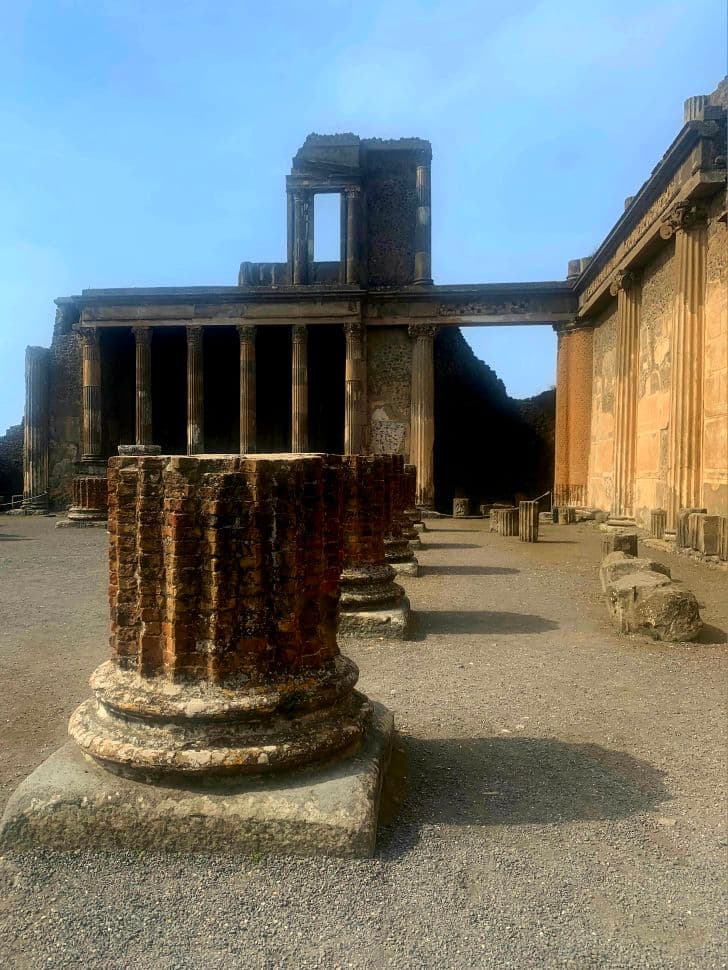
The Forum is where every visit to Pompeii should begin. It was the beating heart of the ancient city — the place where political life, commerce, religious ritual, and everyday socializing all converged in a single open square. Standing in it today, with Mount Vesuvius looming on the horizon exactly as it did for the Romans, is one of those travel moments that physically stops you in your tracks.
The Forum is surrounded by the remnants of temples, public buildings, and market spaces. Look for the Temple of Jupiter at the northern end, the Basilica on the western side (the oldest surviving building in the city), and the market halls to the east. Even in their ruined state, the scale of the Forum makes it clear just how ambitious and organized this city was.
When I visited, I arrived just after opening time, and standing in the Forum before the large tour groups arrived was one of the most memorable moments of the day. If you can, aim to be there before 9:30 am.
- Don’t miss: The row of headless statues along the edge of the square — their identities were once inscribed on the bases
- Best time to visit: First thing in the morning, before tour groups arrive
- Photo tip: Shoot from the southern end toward Vesuvius for the most iconic view
2. The Sanctuary of Apollo
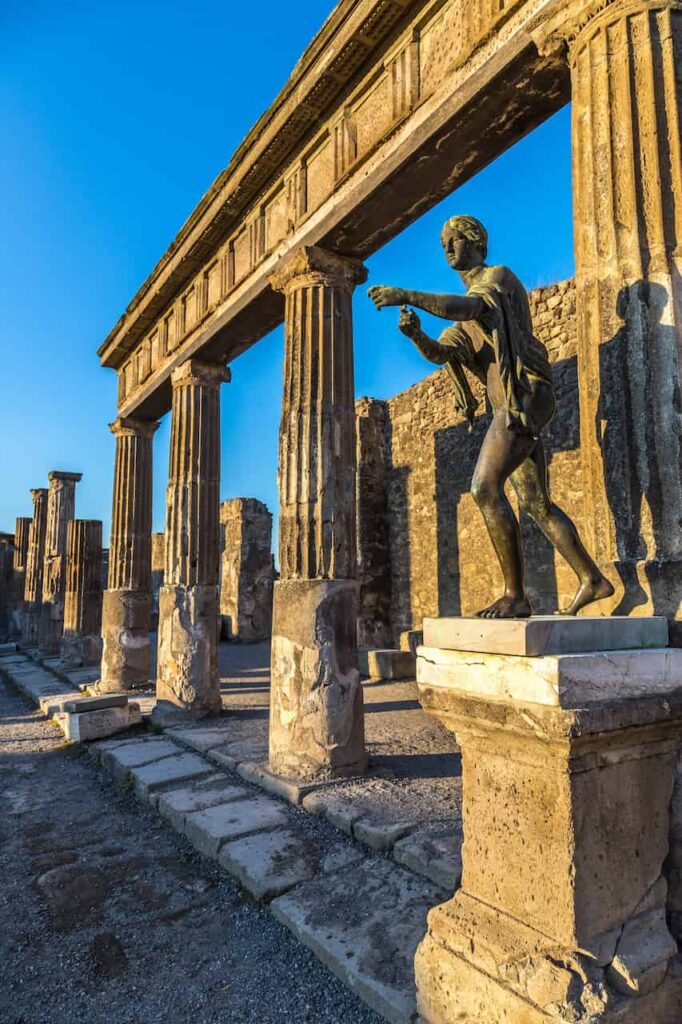
A short walk from the Forum, the Sanctuary of Apollo is one of the oldest religious sites in Pompeii — predating Roman rule and dating back to the city’s earlier Samnite period. It was dedicated to Apollo, the god of the sun, music, and prophecy, and in its prime would have been one of the most visually striking spaces in the city.
The columns still partially standing around the perimeter give a sense of how enclosed and sacred this space felt. Bronze copies of the original Apollo and Diana statues stand in the sanctuary (the originals are in the Naples Archaeological Museum), and the view from here across toward the Forum is excellent.
- Gives important context for how pre-Roman religious life influenced later Roman Pompeii
- The bronze statues are copies — the originals were moved to Naples for preservation
- Quieter than the Forum and worth pausing in for several minutes
3. Forum Baths
The Forum Baths are one of the most complete surviving bath complexes in Pompeii, and they’re deeply revealing about how central bathing culture was to Roman daily life. This wasn’t just about hygiene — the baths were social spaces, places to do business, exchange news, and spend the afternoon.
Walking through the changing rooms (apodyterium), the warm room (tepidarium), and the hot room (caldarium), you can still see the terracotta pipes of the underfloor heating system (hypocaust) that kept the baths warm. The stucco decorations in the men’s section are remarkably intact, and the large bronze basin in the tepidarium is a highlight.
- The men’s and women’s sections are both accessible
- Look for the stone shelving niches where bathers stored their clothes
- The octagonal domed ceiling in the frigidarium is beautifully preserved
4. The Lupanar (Pompeii’s Famous Brothel)
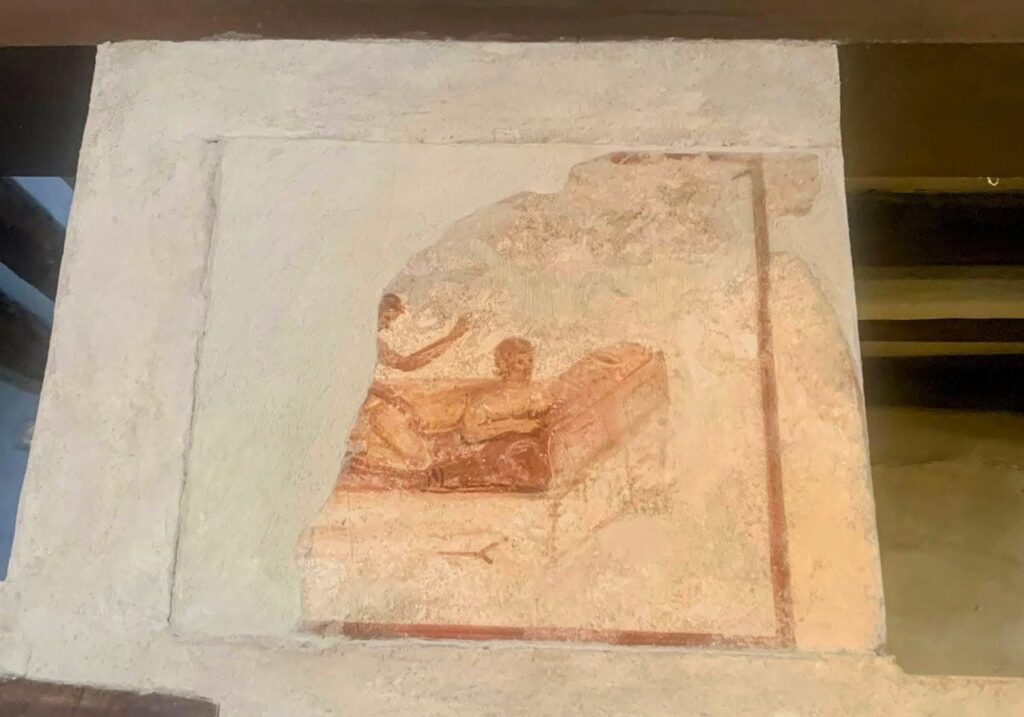
The Lupanar is one of the most visited — and most talked-about — spots in Pompeii, and it genuinely deserves its reputation. It’s not salacious tourism; it’s an honest window into the complexity of Roman society. The building was purpose-built for commercial sex work, and it’s the only structure in Pompeii that was clearly designed as a brothel from the ground up.
The rooms are small, stone-bedded, and low-ceilinged. Above each doorway, erotic frescoes depict various scenes — thought to function as a kind of menu for clients who may not have spoken Latin. Ancient graffiti on the walls, left by both workers and clients, adds an unexpectedly intimate layer to the space.
- One of the most-visited single sites inside the park — go early or during midday when groups thin out
- The frescoes are original and largely intact
- The building is small, so the crowd inside moves quickly
5. Stabian Baths
The Stabian Baths are the oldest surviving bath complex in Pompeii — older than the Forum Baths and covering a larger footprint. They offer a fascinating comparison point: here you can see how the design and sophistication of public baths evolved over time.
The swimming pool (natatio) in the open courtyard is a highlight, as are the beautifully decorated stucco ceilings in the vaulted changing rooms. The separate men’s and women’s sections are both accessible, and the palaestra (exercise yard) attached to the complex gives a good sense of how baths were not just for washing, but for physical activity and socializing.
- Among the most architecturally complete spaces in the entire park
- The plasterwork and painted decoration in the dressing rooms is exceptional
- A great stop for understanding the Roman concept of public leisure
6. Villa of the Mysteries
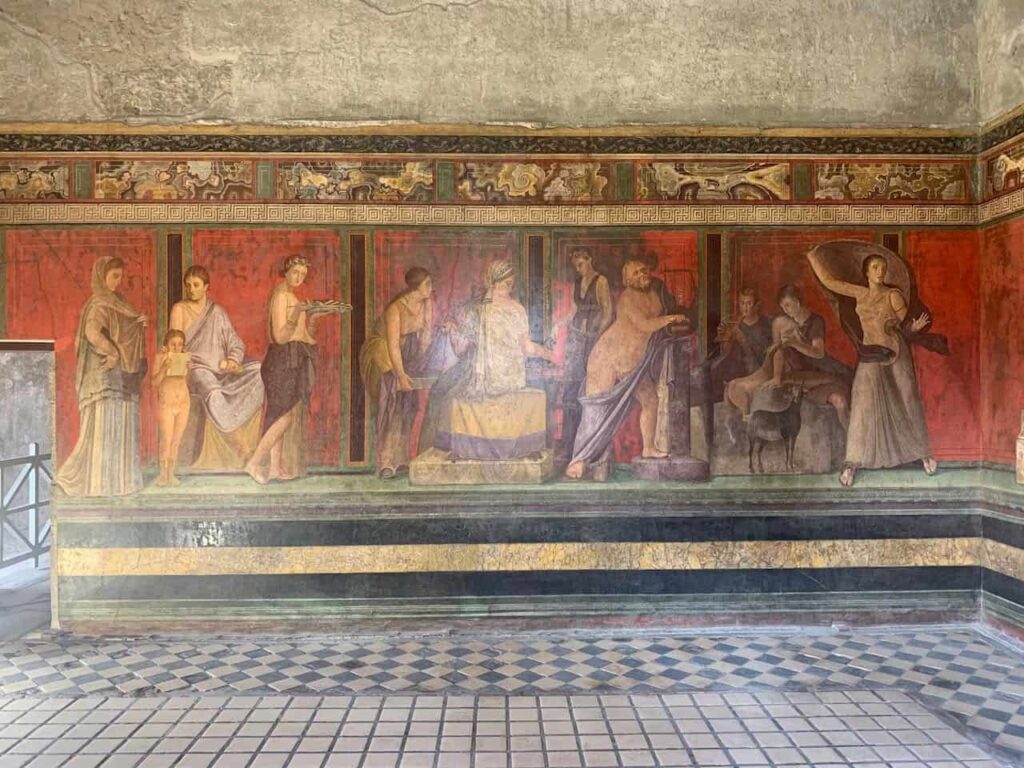
If you visit one place outside the main walled city, make it the Villa of the Mysteries. Located a short walk west of the Porta Ercolano gate, this large suburban villa is home to one of the most extraordinary fresco cycles to survive from the ancient world — and one of the most debated.
The Dionysian Frieze runs around the walls of a single room in vivid, near-life-size detail, depicting figures engaged in what appears to be a ritual initiation into the cult of Dionysus. The colours — deep crimsons, rich ochres, warm flesh tones — are astonishing. The meaning of the sequence has been argued over by scholars for centuries, which somehow makes standing in front of it even more compelling.
My recommendation: If you only have half a day, don’t skip the Villa of the Mysteries. It’s a longer walk, but the frescoes are among the most impressive Roman paintings I’ve seen anywhere in Italy.
- Walk or take a taxi — it’s about 400m from the Porta Ercolano gate
- The fresco room is the highlight, but the rest of the villa is also substantial and worth exploring
- One of the finest surviving examples of Roman wall painting anywhere in the world
7. The Amphitheatre of Pompeii
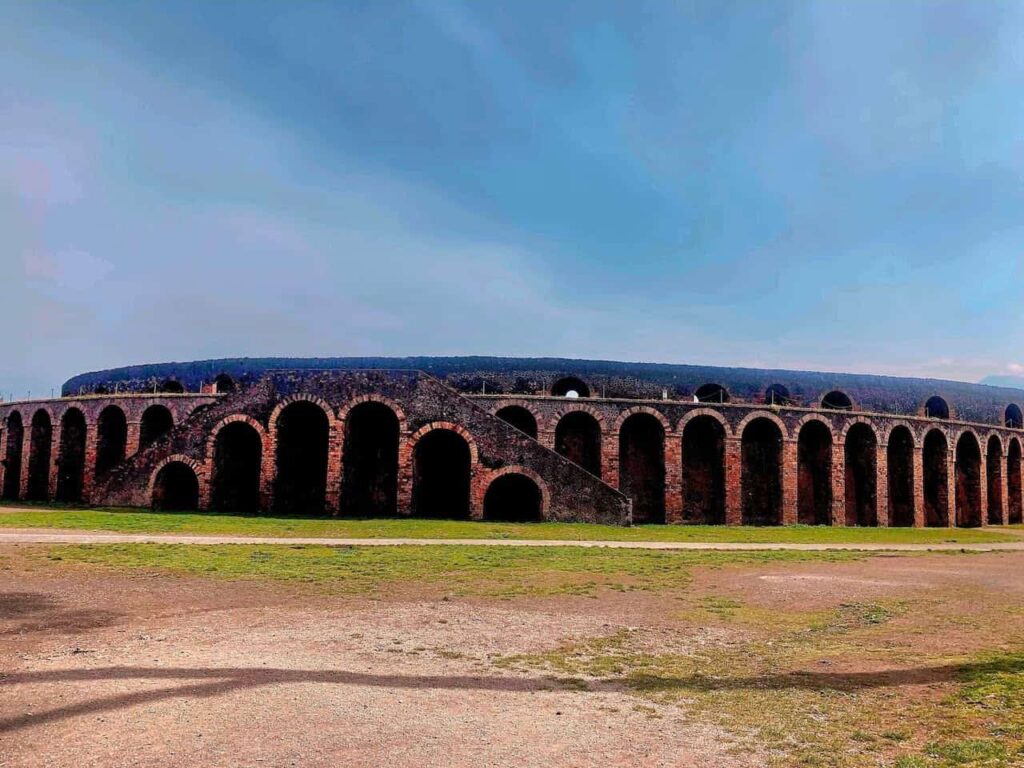
Pompeii’s Amphitheatre is the oldest surviving Roman amphitheatre in existence — built around 70 BC, roughly 140 years before the Colosseum in Rome. It held around 20,000 spectators and was used for gladiatorial contests, animal hunts, and public spectacles. Standing in the centre of the arena today, looking up at the terraced seating banks, the scale of Roman public entertainment becomes viscerally real.
What makes the Pompeii Amphitheatre particularly special is how complete it still is. The seating structure, the perimeter walls, and even the entrance passages are all largely intact. It’s at the eastern end of the park, so many visitors don’t make it this far — but it’s absolutely worth the walk.
- Located at the far eastern end of the park — plan your route so you pass through the Palaestra on the way
- The exterior arches and entrance tunnels are beautifully preserved
- Great for photographs, especially from the upper seating tiers
8. The Garden of Fugitives
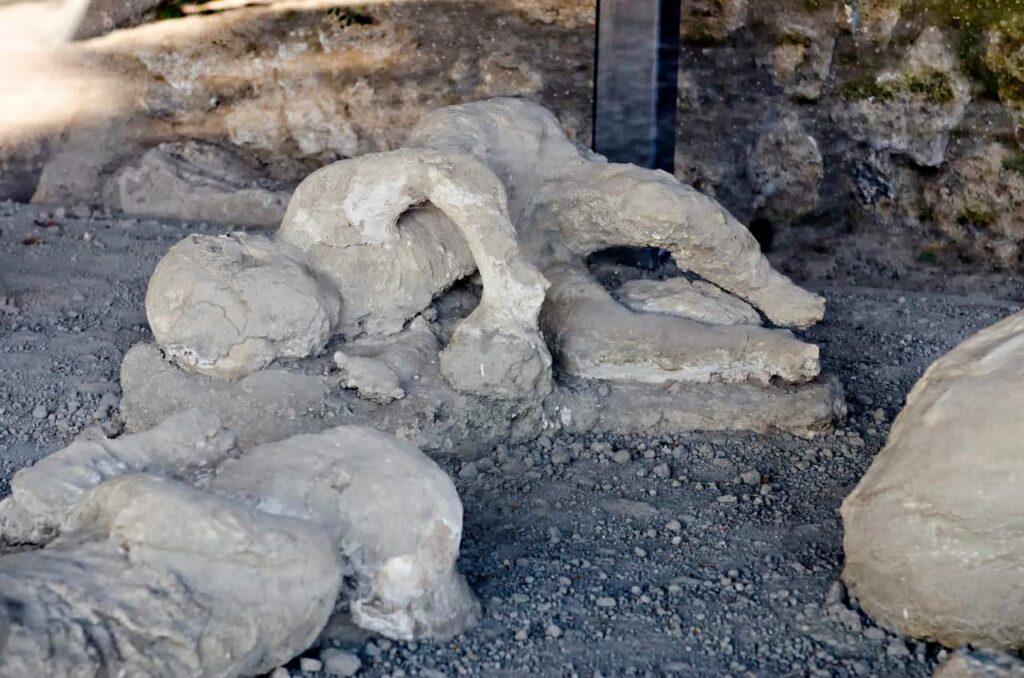
No site in Pompeii is more emotionally affecting than the Garden of Fugitives. This is where archaeologists discovered — and where you can now see — thirteen plaster casts of Pompeii’s victims: people who fled into the garden of a house on the southern edge of the city and were engulfed by the pyroclastic surge before they could escape.
The casts were made in the 19th century by pouring liquid plaster into the voids left in the hardened ash by the decomposed bodies. The results are hauntingly detailed — faces buried in arms, a child curled beside an adult, figures caught in postures of fear and desperation. It’s not dramatic in the theatrical sense. It’s quiet and devastating.
- Located near the Porta di Nocera gate at the southern end of the park
- Leave time to sit with this one — don’t rush through it
- A powerful reminder that Pompeii was not just an archaeological site but a human tragedy
9. House of the Faun
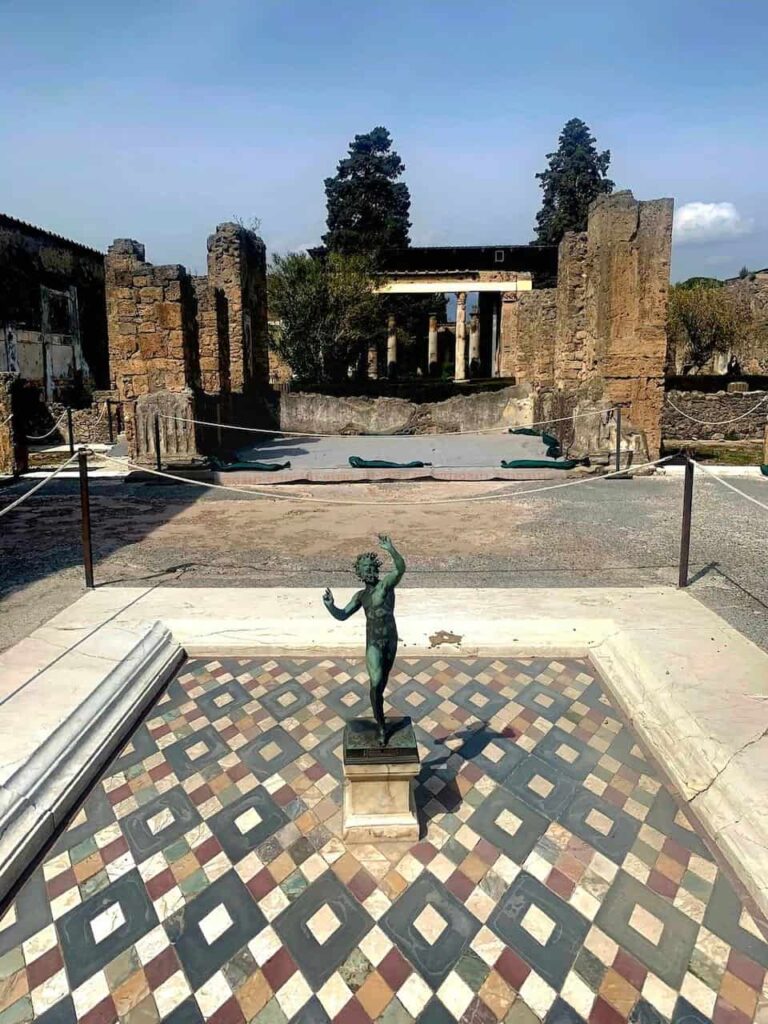
One of the grandest private residences in Pompeii, the House of the Faun takes its name from the charming bronze dancing faun statue found at its centre (now in the Naples Archaeological Museum — a copy stands in place here). The house is vast by any standard — it occupies an entire city block — and its layout gives a clear sense of just how wealthy Pompeii’s merchant elite could be.
The house is also where the famous Alexander Mosaic was discovered, depicting the Battle of Issus between Alexander the Great and Darius III. The original mosaic is in the Naples Archaeological Museum, but the floor space where it once lay is marked out, giving a sense of its scale.
- One of the largest private houses in the entire city
- Look for the intricate mosaic floors still visible in several rooms
- The double atrium layout is unusual and architecturally fascinating
10. Via dell’Abbondanza
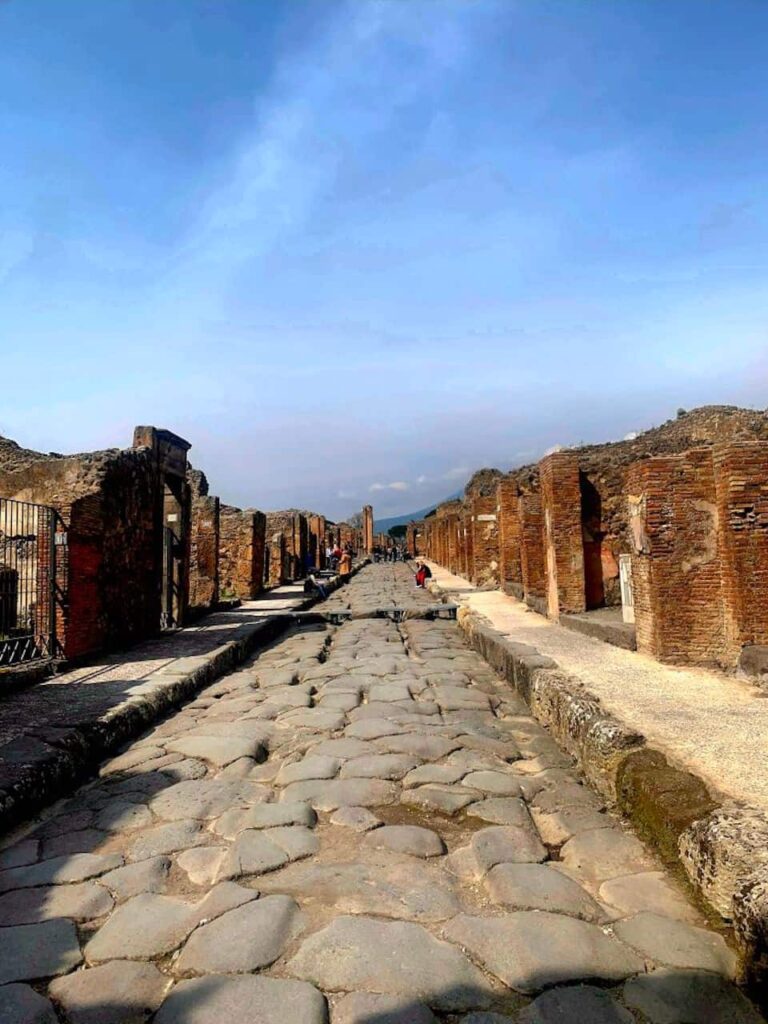
Via dell’Abbondanza was Pompeii’s main street — its commercial spine, its social artery, its equivalent of a high street. Walking its length today is one of the most evocative experiences the site offers, because the street still feels like a street: shops line both sides, stepping stones allow pedestrians to cross without getting muddy, and wheel ruts from Roman carts are clearly visible in the stone.
Look closely at the doorways as you walk — faded painted signs advertise ancient shops and businesses. Bread sellers, wine merchants, textile workers, and dye workshops all had addresses along this road. It’s not glamorous archaeology. It’s everyday life, fossilised.
- Runs the entire east-west length of the city — allow time to walk the full length
- The combination of stepping stones, wheel ruts, and faded signage is uniquely atmospheric
- Many of the best-preserved houses open off this road
11. House of Vettii
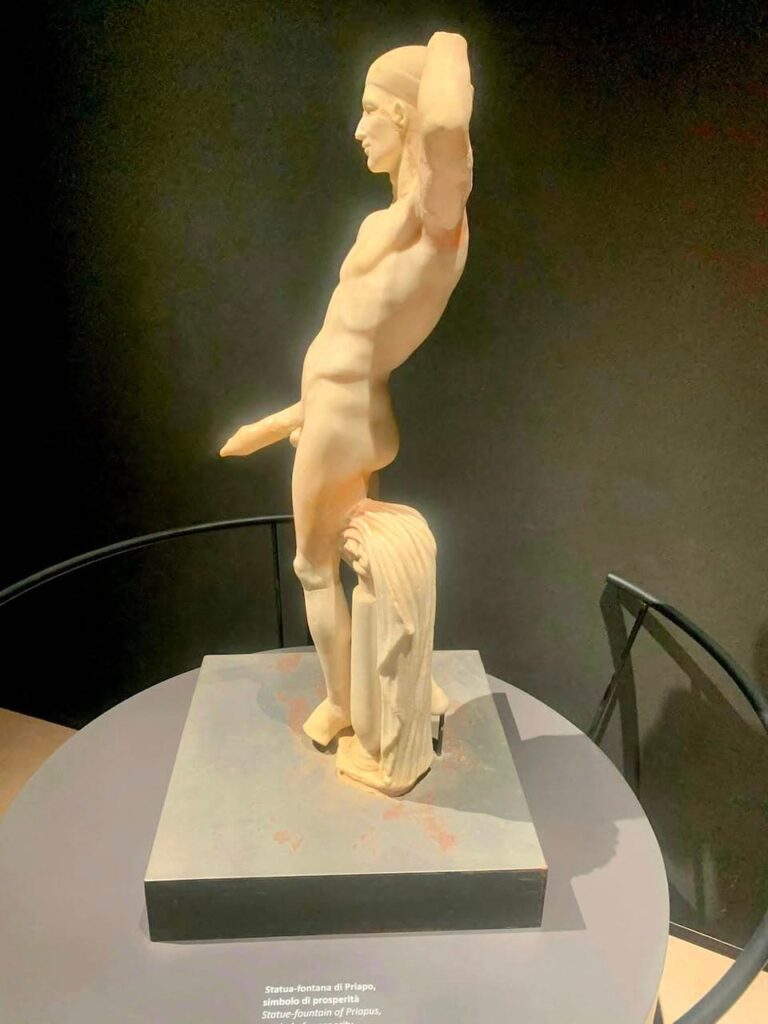
The House of Vettii is one of the most celebrated homes in Pompeii — owned by two wealthy freedmen, the Vetti brothers, who filled their home with spectacular frescoes. After extensive restoration work, it has recently reopened to the public, and the interior is breathtaking.
The mythological frescoes in the triclinium (dining room) depict scenes from Greek myth in vivid colour: Hercules strangling serpents, Pentheus being torn apart, Daedalus presenting his wings. They are some of the finest Roman paintings anywhere in the world. The garden, with its reconstructed fountains and flower beds laid out according to ancient pollen analysis, adds a rare sense of what a wealthy Pompeian home actually looked and felt like when it was lived in.
- Recently restored — check current access status before visiting
- The frescoes in the main dining room are genuinely world-class
- One of the few houses where the garden has been partially restored
12. Great Theatre and Odeon
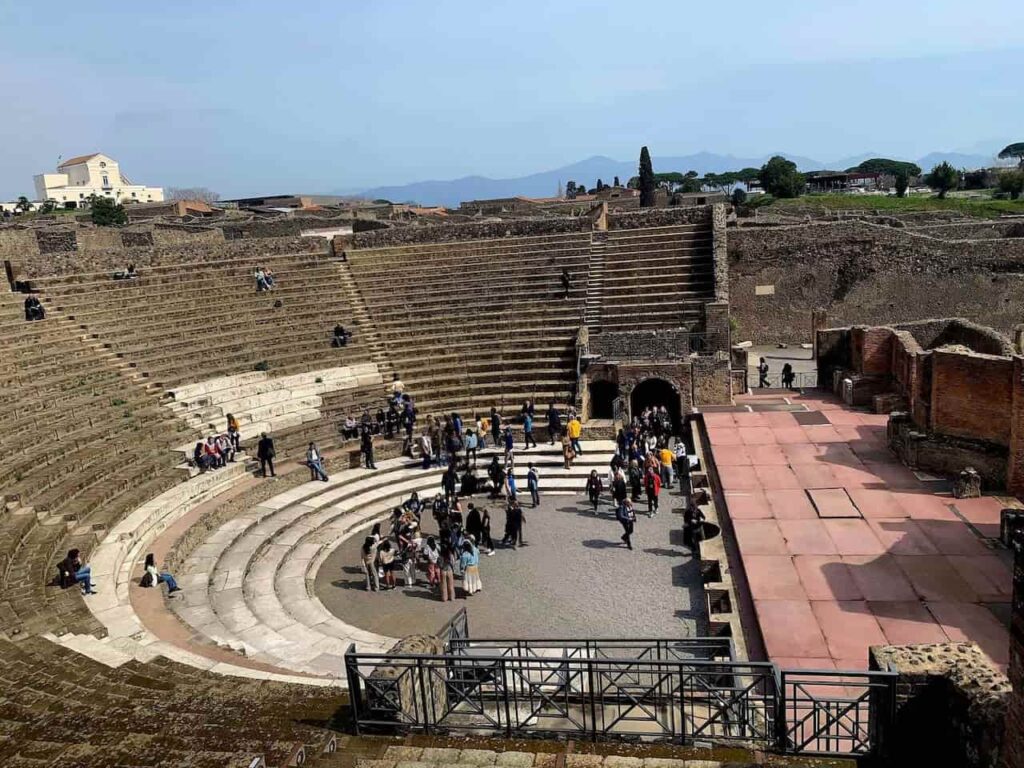
Pompeii had two performance spaces, and both are still standing. The Great Theatre (Teatro Grande) seated over 5,000 people and was used for theatrical performances, gladiatorial shows, and public events. The Odeon (Teatro Piccolo) next door was a covered, more intimate space used for poetry readings, music, and smaller performances.
You can sit in the tiered seating of both theatres and genuinely imagine the acoustics at work — the stone and curved design still carry sound remarkably well. The Temple of Isis sits directly behind the Great Theatre, making this corner of Pompeii one of its most architecturally dense and rewarding areas.
- The theatre district is in the southern part of the park, near the Stabian Baths
- The Odeon is smaller but better preserved
- The area around both theatres is quieter than the Forum — good for a peaceful break
13. The Antiquarium
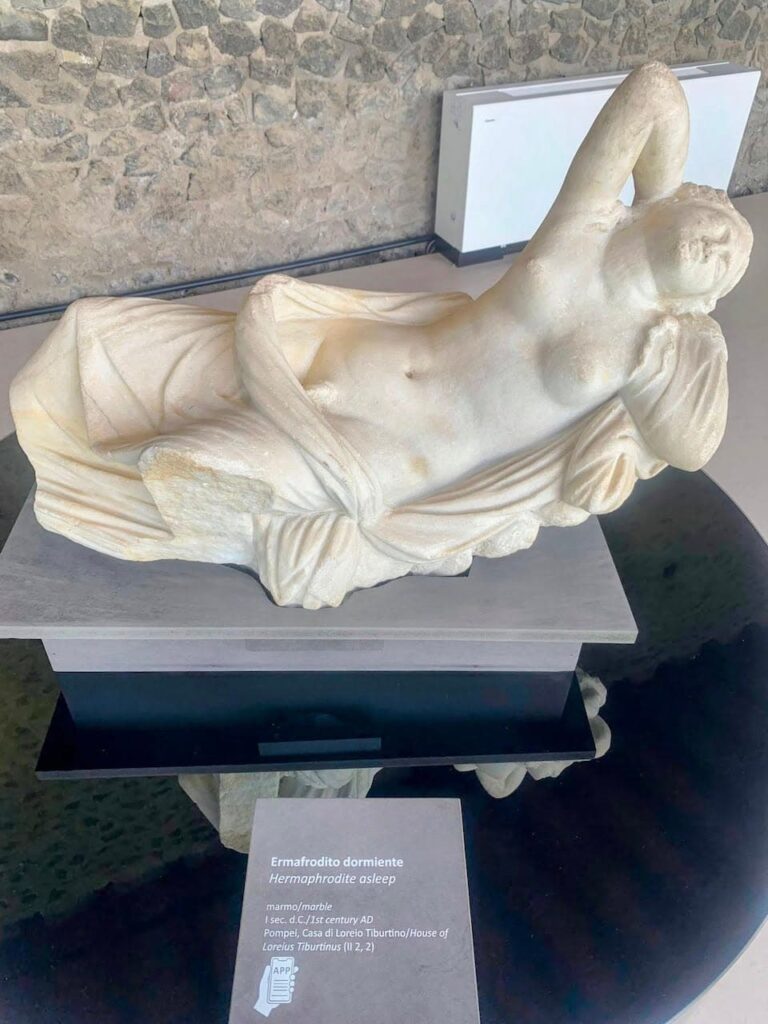
For those who want to deepen their understanding of Pompeii beyond what the ruins themselves show, the Antiquarium museum inside the park is an excellent stop. It houses artifacts recovered from the site — pottery, household objects, surgical instruments, food remains, jewelry, and some of the plaster casts — with good contextual information.
It’s compact and focused, and even an hour here adds significant depth to the experience of walking the streets. After seeing the houses and public buildings, coming here to see what was inside them brings everything together.
- Located near the Forum entrance area
- The plaster casts displayed here are among the most detailed in the park
- Worth visiting either at the start (for context) or end (to consolidate what you’ve seen) of your day
14. House of Venus in the Shell
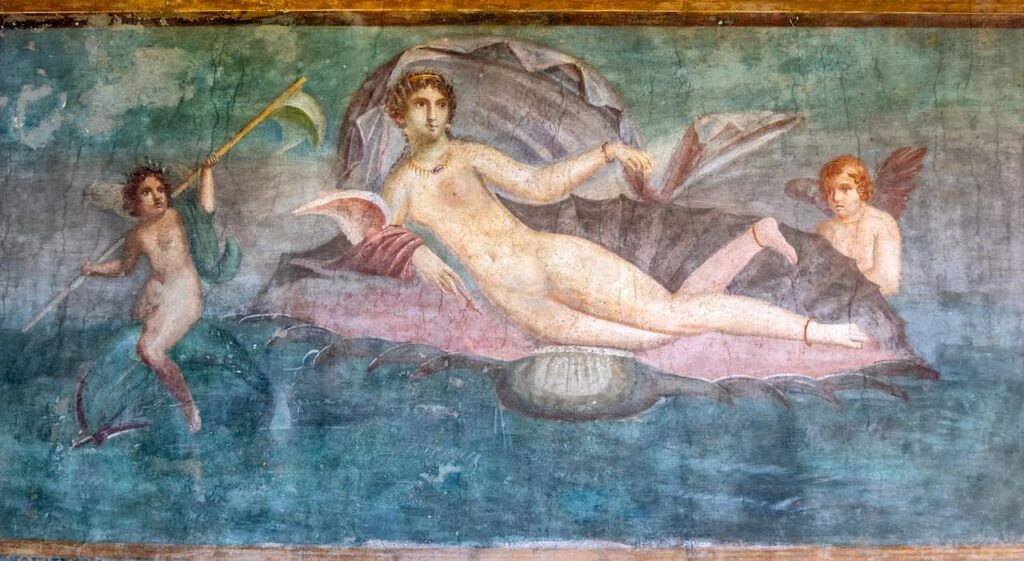
The House of Venus in the Shell takes its name from the magnificent garden fresco that dominates its rear wall — a large, vivid depiction of Venus reclining in an open shell, surrounded by cupids and flanked by painted garden scenes. It’s one of the most beautiful and most photographed frescoes in all of Pompeii, and rightly so. The colours — warm blues, soft greens, and flesh tones — have retained a remarkable vibrancy considering they’ve survived nearly two thousand years.
The house itself is a generous, well-proportioned residence with a large garden area that gives the fresco the space it deserves. Unlike some of Pompeii’s more famous houses, this one never feels overcrowded, and the garden setting makes it genuinely peaceful to stand in front of the artwork and take it in without being jostled.
- Located in the southern part of the park, near the Amphitheatre — easy to combine with that stop
- The Venus fresco is best seen in morning light
- One of the most photogenic spots in the entire archaeological park
- A quieter alternative to the busier houses along Via dell’Abbondanza
15. Fullery of Stephanus
The Fullery of Stephanus is one of the most fascinating and overlooked stops in Pompeii — a real working laundry from the ancient world, preserved almost exactly as it was on the day of the eruption. Fulleries were essential businesses in Roman Pompeii: clothes were brought here to be washed, dyed, and finished, using a process that involved treading fabric in vats of water mixed with urine (collected from public urinals around the city) to break down grease and dirt.
It sounds unglamorous, and it was — but the Fullery of Stephanus brings a side of Roman working life to the surface that the grand houses and temples don’t show you. The large stone vats where the treading took place are still clearly visible, as are the drying and pressing areas. A fresco near the entrance depicts the various stages of the fulling process, effectively serving as an ancient instruction manual.
- Located on Via dell’Abbondanza, making it an easy addition to a walk along the main street
- One of the best-preserved commercial workplaces in the entire site
- Gives important context for Roman trade, industry, and everyday working life
- Often walked past without a second glance — look for the entrance on the south side of the road
16. House of Julia Felix
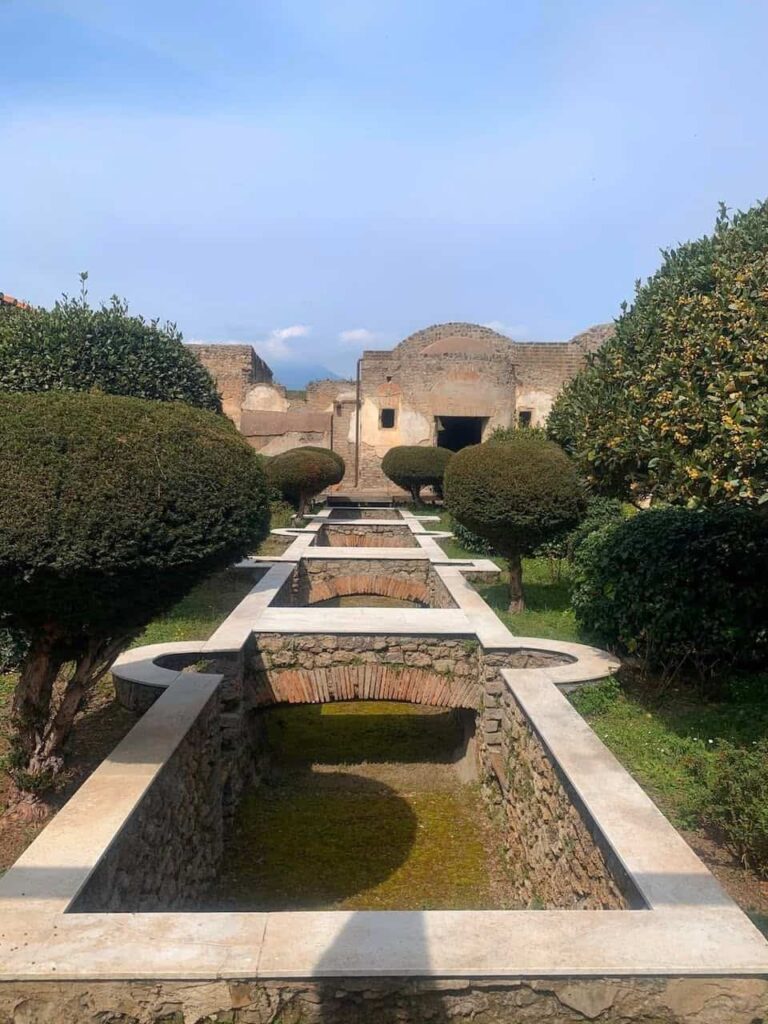
The House of Julia Felix is one of Pompeii’s most unusual and historically interesting properties — because it was both a private home and a commercial enterprise. Julia Felix, a wealthy and evidently entrepreneurial woman, opened her property to paying guests, operating what amounted to a combination of bathhouse, garden, and rental accommodation from within her own residence.
The property is large and beautifully laid out, with a long garden colonnade, an elegant triclinium, and a private bath suite that she rented to the public after the city’s main baths were closed for repairs. The frescoes here — particularly a remarkable series depicting scenes of everyday life in the Forum — are among the most historically valuable in Pompeii, offering a direct window into what the city looked like when it was alive.
- Located in the eastern section of the park, close to the Amphitheatre
- The garden colonnade is one of the most elegant spaces in any Pompeian house
- The Forum scene frescoes are historically invaluable — look for them carefully
- Julia Felix herself is a rare named female property owner from the ancient world, making this stop particularly interesting from a social history perspective
17. Temple of Isis
The Temple of Isis is one of Pompeii’s most intriguing religious sites — and one of its most surprising. Dedicated to the Egyptian goddess Isis, whose cult spread widely across the Roman world, the temple is a vivid reminder that Roman religious life was far more diverse and cosmopolitan than is often assumed. Isis was worshipped alongside Jupiter, Apollo, and the traditional Roman pantheon, and her temple in Pompeii was one of the best-funded and most elaborately decorated in the city.
The temple sits just behind the Great Theatre, making it a natural pairing with that stop. It was one of the first buildings to be excavated after Pompeii’s rediscovery in the 18th century, and its colourful frescoes and Egyptian-inspired decorative details caused a sensation in Europe at the time — directly inspiring a wave of Egyptomania in Neoclassical art and design. Many of the original artifacts and frescoes from the temple are now in the Naples Archaeological Museum.
- Located directly behind the Great Theatre — combine both in the same visit
- One of the earliest buildings excavated at Pompeii, in the 1760s
- The Egyptian architectural and decorative elements are unlike anything else in the site
- The sacred water basin used in Isis rituals is still visible in the temple precinct
18. House of the Tragic Poet
The House of the Tragic Poet is not the largest or grandest house in Pompeii, but it has one of the most famous thresholds in the ancient world. At its entrance, a detailed floor mosaic depicts a chained dog with the Latin inscription Cave Canem — Beware of the Dog — a warning to visitors that has become one of the most recognisable images from Pompeii and Roman domestic life more broadly.
The house itself is a modest but well-appointed middle-class residence, with frescoes depicting scenes from Greek mythology — including the sacrifice of Iphigenia and the discovery of Achilles on Skyros — that demonstrate the high level of artistic ambition even in relatively ordinary Pompeian homes. The name comes not from any known occupant but from a fresco, now in Naples, depicting a theatrical rehearsal.
- The Cave Canem mosaic at the entrance is one of the most photographed details in all of Pompeii
- A good example of a prosperous but non-elite Pompeian household
- The mythological frescoes give insight into the artistic tastes of the Roman middle class
- Compact and quick to visit — allow 15–20 minutes
19. The Palaestra
The Palaestra Grande is one of the largest open spaces in Pompeii — a vast exercise ground and social space where the city’s younger residents trained, competed, and gathered. Enclosed on three sides by a deep portico of columns and featuring a large swimming pool at its centre, the Palaestra was the Roman equivalent of a sports complex, and in a city as health-conscious and socially active as Pompeii, it would have been constantly in use.
Today the Palaestra sits adjacent to the Amphitheatre at the eastern end of the park, making it a natural pairing with that stop. One of the buildings within the complex now houses a permanent exhibition of Pompeii artifacts and plaster casts, including some of the most detailed and moving cast figures in the entire site. If you’ve already seen the Garden of Fugitives, the casts here add further depth to that experience.
- Located next to the Amphitheatre — visit both in the same sweep of the eastern park
- The on-site exhibition building contains important plaster casts and contextual displays
- The scale of the open exercise ground gives a real sense of how organised and civic-minded Roman daily life was
- The large central pool is clearly visible and remarkably intact
20. House of the Small Fountain
The House of the Small Fountain — Casa della Fontana Piccola — is one of Pompeii’s most charming and underappreciated residential stops. Smaller and quieter than the grand residences like the House of the Faun or the House of Vettii, it offers something those houses don’t: an intimate, almost domestic sense of what it felt like to live well in ancient Pompeii without being enormously wealthy.
The house takes its name from the ornate nymphaeum fountain in its garden — a beautifully decorated feature faced with colourful glass mosaic tesserae and shells, with a small bronze figure at its centre. The surrounding garden frescoes depict lush painted landscapes, effectively extending the visual sense of the garden beyond its physical walls. It’s a quietly beautiful corner of the site, and one that rewards those who slow down and look carefully rather than rushing past.
- A peaceful, less-visited stop — good for a quiet moment away from the main crowd flow
- The mosaic fountain is one of the finest decorative features in any Pompeian garden
- The combination of real garden space and painted garden frescoes is a clever and distinctly Roman design trick
- Allow 15–20 minutes — it’s compact but worth lingering in
🎫 Best Tours for Visiting Pompeii
Whether you’re visiting Pompeii from Naples or doing a Pompeii day trip from Rome, a guided tour adds enormous depth to the experience. Here are the best options depending on your situation.
Best Pompeii Tours from Naples
1. Pompeii Entry Ticket with Audio Guide— The most flexible option for independent travelers. You get skip-the-line entry and a professional audio guide that walks you through the site at your own pace. Perfect if you want the context of a guide but the freedom to linger where you want. 👉 Book here: Pompeii Entry Ticket with Audio Guide
2. Pompeii Guided Tour with an Archaeologist —This is the option for those who really want to understand what they’re looking at. A professional archaeologist guides a small group through the site, providing the kind of expert interpretation you simply won’t get from a sign or audio guide. The insights into Roman social history, architectural details, and the story of the eruption are genuinely revelatory. 👉 Book here: Pompeii Entry Ticket and Guided Tour with an Archaeologist
3. Naples, Pompeii & Mount Vesuvius Small Group Tour with Lunch — If you want to combine Pompeii with a hike up Vesuvius and see the volcano that caused all of this, this small-group tour from Naples covers both in a single well-organised day, including lunch. It’s a lot in one day, but it’s one of the most comprehensive ways to understand the full story of the eruption. 👉 Book here: Naples, Pompeii & Mt Vesuvius Small Group Tour with Lunch
4. Pompeii & Herculaneum Shore Excursion with Archaeologist — For cruise passengers arriving at the port of Naples, this expert-led excursion covers both Pompeii and Herculaneum — the smaller but equally fascinating site buried by the same eruption. Having an archaeologist guide makes the comparison between the two sites incredibly rich. 👉 Book here: Pompeii & Herculaneum Shore Excursion with Archaeologist
Best Pompeii Tours from Rome
5. Rome to Pompeii, Amalfi Coast & Positano — Small Group Day Trip — This is an ambitious and spectacular day trip from Rome that combines Pompeii with the Amalfi Coast and Positano. A small-group tour with an expert guide, it’s a long day but covers an extraordinary amount of southern Italy’s best scenery and history. If you only have one day to see Pompeii from Rome, this is one of the most rewarding ways to do it. 👉 Book here: Pompeii, Amalfi Coast & Positano Day Trip from Rome
6. Rome to Pompeii Guided Tour with Wine and Lunch by High-Speed Train — For a more focused Pompeii trip from Rome, this tour handles the logistics of the high-speed train from Rome, a guided tour of the site, and includes a proper sit-down lunch with wine. It’s polished, comfortable, and lets you see Pompeii with expert commentary without worrying about connections. 👉 Book here: Rome to Pompeii Guided Tour with Wine and Lunch by High-Speed Train
🌤️ Best Time to Visit Pompeii
The best time to visit Pompeii is April–June and September–October, when the weather is pleasant and the crowds are significantly smaller than summer.
Here’s how the seasons break down:
- Spring (April–June): Ideal. Mild temperatures, beautiful light, and manageable crowds. This is when Pompeii is at its most enjoyable.
- Summer (July–August): Extremely hot and very crowded. If you go in summer, arrive at opening time and bring plenty of water.
- Autumn (September–October): Arguably the best time. Harvest atmosphere across southern Italy, golden light, and thinning crowds.
- Winter (November–March): Quieter and cooler — you may have whole sections of the park to yourself. Some facilities may have reduced hours.
💡 Pro tip: Whatever season you go, arrive as close to the 9 am opening as possible. The difference in crowd levels between 9 am and 11 am is enormous.
🧳 Practical Tips for Visiting Pompeii
What to Wear
Pompeii’s cobblestone streets are uneven, sometimes steep, and hard on feet. Comfortable, closed-toe shoes with a good sole are non-negotiable. Sandals are not recommended. In summer, lightweight, breathable clothing is essential — and a hat and sunscreen are not optional; they’re necessary. The site is largely open with little shade.
What to Bring
- Water: Bring more than you think you need. It’s hot, it’s a long walk, and there are limited options inside the park.
- Sunscreen and hat: As above — the sun exposure inside Pompeii is relentless in warmer months.
- Snacks: There is a cafe inside the park near the Forum, but options are limited. Eating outside the park at lunchtime and re-entering is an option worth considering.
- Camera: Every corner of Pompeii offers something worth photographing. But take some moments just to look.
Is Pompeii Safe to Visit?
Yes, completely. Pompeii Archaeological Park is one of Italy’s best-managed major tourist sites, with clear signage, on-site security, first-aid facilities, and accessible paths in most areas. The streets and buildings are extensively studied and monitored, though some areas may be closed for conservation or ongoing excavation work at any given time.
Is Pompeii Accessible?
Some parts of the site are accessible to visitors with limited mobility, and a map of accessible routes is available at the entrance. However, the cobblestone streets and uneven terrain do make much of Pompeii challenging for wheelchairs and pushchairs. Call ahead or check the official website for current accessibility information.
🏨 Where to Stay When Visiting Pompeii
Stay in Naples
Naples is the most practical base for visiting Pompeii — the Circumvesuviana train runs directly from Napoli Centrale to the site gates in under 40 minutes. Staying here also gives you access to one of Italy’s most exciting food cities, the National Archaeological Museum (which houses Pompeii’s greatest treasures), and ferry connections to Capri. For a full breakdown of the best neighbourhoods and hotels, the Where to Stay in Naples guide covers everything you need before you book.
Recommended: Hotel Piazza Bellini — a stylish boutique hotel in the historic centre, well-connected to the Circumvesuviana platforms and surrounded by great food.
Stay in Sorrento
Sorrento is a smaller, more relaxed alternative — right on the Bay of Naples, with the Circumvesuviana connecting it to Pompeii in around 30 minutes. If you’re combining Pompeii with the Amalfi Coast or Capri, Sorrento makes more sense as a base than Naples.
Recommended: Hotel Antiche Mura — a mid-range hotel with a pool inside the old town walls, easy walking distance to the train station and Piazza Tasso.
Stay in the Modern Town of Pompeii
If your sole focus is the archaeological site and you want to arrive at opening time before the crowds, staying in the modern town of Pompeii is the most convenient option. It’s quieter and less expensive than Naples or Sorrento, with the trade-off being far less to do in the evenings.
Recommended: Hotel Forum Pompeii — clean, comfortable, and just a few minutes’ walk from both the Porta Marina entrance and the train station.
🗺️ Pompeii Day Trips
Combine Pompeii with Herculaneum
Herculaneum is often overshadowed by Pompeii but is arguably more intimate and even better preserved in some ways. Because it was buried under deeper lava flows (rather than ash), organic materials like wooden beams, furniture, and fabric survived. A day visiting both Pompeii and Herculaneum — the latter is a quick train stop on the same Circumvesuviana line — is one of the richest days you can have in southern Italy.
Recommended tour: The Pompeii & Herculaneum Shore Excursion with Archaeologist covers both sites with an expert archaeologist guide — the best possible way to understand the differences between the two and get the most from each.
Combine Pompeii with Mount Vesuvius
If you visit Pompeii without climbing Vesuvius, you’re only getting half the story. The volcano that destroyed the city in AD 79 is still active, and the hike to the crater rim takes about 30 minutes from the bus drop-off. The view from the top — down into the crater and across the Bay of Naples — is extraordinary. Tours that combine Pompeii and Vesuvius in a single day are widely available from Naples.
Recommended tour: The Naples, Pompeii & Mt Vesuvius Small Group Tour with Lunch covers all three in a single well-paced day from Naples, including a sit-down lunch — the most efficient and enjoyable way to combine both sites without the logistics stress.
Pompeii and the Amalfi Coast
Many travelers combine a Pompeii visit with the Amalfi Coast, and the logistics work well. You can visit Pompeii in the morning and be in Positano or Ravello by the afternoon — or do it in reverse. The tour from Rome listed above covers all three in a single day.
Recommended tour: The Pompeii, Amalfi Coast & Positano Small Group Day Trip from Rome handles all the logistics — Pompeii, the coastal drive, and Positano — in a single expertly guided day. Ideal for Rome-based travelers who want to see both without renting a car.
For those planning to explore more of Italy, check out my Rome Destinations page for expert guides to the Eternal City and the visiting the Colosseum guide and Vatican guide — both essential Roman experiences that pair naturally with a Pompeii day trip.
Frequently Asked Questions
Can You Visit Pompeii Without a Tour?
Yes, you can absolutely visit Pompeii independently — and many people do. The site has clear signage throughout, and an audio guide (available at the entrance or bookable in advance) does an excellent job of bringing the ruins to life at your own pace. That said, a guided tour with a knowledgeable archaeologist adds a layer of depth and storytelling that independent exploration simply can’t replicate. If it’s your first visit and you want to truly understand what you’re looking at, a guided tour is worth every cent. If you’re a seasoned history traveler who prefers to wander freely, go solo with the audio guide and a good map.
Is Pompeii Worth Visiting?
Without a doubt — yes. Pompeii is one of the most extraordinary historical sites in the world, and no photograph, documentary, or description fully prepares you for actually being there. Walking streets that Romans walked 2,000 years ago, standing in theatres where crowds once roared, and coming face to face with the plaster casts of the victims is a genuinely moving experience. It’s not just a ruin — it’s a paused moment in time. Whether you’re a history enthusiast or a casual traveler, visiting Pompeii leaves a lasting impression that stays with you long after you’ve left Italy.
How Much Walking Is There at Pompeii?
Quite a lot. The archaeological park covers around 66 hectares (163 acres), and even a focused half-day visit will involve several kilometres of walking — on uneven cobblestone streets, across open plazas, and occasionally up sloped terrain. A full-day visit can easily reach 8–10 km of walking. Comfortable, closed-toe shoes with good support are absolutely essential. Do not underestimate this — sandals, flat-soled shoes, and heels will make your visit genuinely uncomfortable. Build in time to sit and rest, especially in summer when the heat adds to the fatigue.
Can You Bring Food Into Pompeii?
Yes, you can bring food and drinks into the archaeological park. In fact, it’s a good idea. There is a café inside the park near the Forum area, but options are limited, and prices reflect the captive audience. Bringing a packed lunch, snacks, and — most importantly — plenty of water means you can eat when and where you want without losing time queuing. There are shaded seating areas near the café and some benches scattered through the site. Eating your lunch in the shadow of a 2,000-year-old wall is, it has to be said, a rather special experience.
Is One Day Enough for Pompeii?
One full day is enough to see Pompeii’s major highlights comfortably, including the Forum, Villa of the Mysteries, Amphitheatre, Garden of Fugitives, and the main residential streets. If you’re doing a half-day visit — arriving at midday or leaving by early afternoon — you’ll need to be selective and prioritise. Two days would allow you to explore every corner of the site at a genuinely leisurely pace, but most visitors find one well-planned day deeply satisfying. The key is arriving early, having a rough route in mind, and not spending so long at any single site that you run out of time for the ones at the far ends of the park.
Which Entrance Should You Use at Pompeii?
Most visitors should use the Porta Marina entrance. For a full comparison of Porta Marina, Piazza Anfiteatro, and Piazza Esedra, see the “Which Pompeii Entrance Should You Use?” section above.
Can You Visit Pompeii and Vesuvius in One Day?
Yes — and it’s one of the most rewarding ways to experience the full story of the eruption. Several organised tours from Naples combine both in a single well-paced day, typically visiting Pompeii in the morning and heading up Vesuvius in the afternoon (or vice versa). The hike to the crater rim of Vesuvius takes about 30 minutes from the bus drop-off point and is manageable for most reasonably fit visitors. Doing both independently by public transport is possible but requires careful timing. An organised small-group tour is the easiest and most efficient way to fit both into one day without stress.
Should You Book Pompeii Tickets in Advance?
Yes — always book your Pompeii tickets in advance, especially between April and October. The queues at the on-site ticket office can be very long, particularly on weekends and during peak summer months, and they eat directly into your visiting time. Booking online in advance guarantees your entry slot, often includes skip-the-line access, and in many cases comes bundled with an audio guide. The ticket price is the same whether you book online or at the gate, so there’s genuinely no reason not to book ahead. On free-entry Sundays (the first Sunday of each month), advance booking is even more important as the site fills up quickly.
Is Pompeii Suitable for Children?
Yes — Pompeii can be a fantastic experience for children, particularly those with an interest in history, ancient civilisations, or simply exploring somewhere that feels genuinely different from everyday life. The open-air nature of the site, the visible wheel ruts, the stepping stones, the amphitheatre, and the plaster casts all tend to capture children’s imaginations powerfully. A word of caution: the Lupanar (the ancient brothel) contains explicit frescoes, so you may want to skip that stop with young children or visit it separately. The Garden of Fugitives is moving and thought-provoking — gauge your child’s emotional readiness before visiting.
Can You Visit Pompeii in the Rain?
Yes, and it can actually be a surprisingly good experience. Rain keeps the crowds down significantly, the light on the stone takes on a beautiful quality, and the site feels more atmospheric and less touristy. The main practical consideration is footwear — cobblestones become slippery when wet, so waterproof shoes with a good grip are important. Bring a compact rain jacket or umbrella. Most of the site is open-air, but some of the covered spaces — baths, smaller houses, the Antiquarium museum — offer natural shelter if you need to wait out a heavy shower. Don’t let a rainy forecast put you off a Pompeii visit.
Visiting Pompeii — Final Thoughts
I’ve been to a lot of historical sites across Europe. The Colosseum, Forum Romanum, Versailles, the Prague Castle, the Alhambra, the Old City of Dubrovnik. All extraordinary, all worth every visit. But visiting Pompeii is different in a way that’s hard to articulate until you’re actually there.
It’s the ordinariness that gets you. That was the biggest surprise for me. Before visiting, I expected grand ruins and dramatic history. What stayed with me instead were the ordinary details—the wheel ruts worn into the streets, faded shop signs, graffiti scratched into walls, and homes that still feel remarkably lived in. Those small details made Pompeii feel less like an archaeological site and more like a real city frozen in time.
Pompeii isn’t just history. It’s life — Roman life, ordinary life — caught mid-breath by one of the worst natural disasters in the ancient world. And two thousand years later, you can walk those streets and feel it.
Give it time. Book a guided tour or at least an audio guide. Arrive early. Wear good shoes. Bring water. And then just — walk.
You’ll be glad you did.
🔗 More Italy Travel Guides
Planning your Italy trip? Here are more guides:
- 👉 Amalfi Coast Itinerary — pair your Pompeii day trip with the coast: 3–10 day route options
- 👉 Visiting the Colosseum — Complete Guide — Everything you need to know to visit Rome’s most iconic landmark — tickets, tours, skip-the-line tips, and the best time to go.
- 👉 Visiting the Vatican — Tickets, Tips & Itinerary — A complete guide to the Vatican Museums, Sistine Chapel, and St Peter’s Basilica — including how to book tickets and avoid the longest queues.
- 👉 Three Days in Rome Itinerary — A practical, day-by-day itinerary covering Rome’s essential highlights — from the Forum to Trastevere — without the overwhelm.
- 👉 Best Day Trips from Rome — Pompeii is just one of many brilliant day trips from Rome — this guide covers the best options by train, car, and organised tour.
- 👉 Cortona Italy Travel Guide — One of Tuscany’s most atmospheric hilltop towns — medieval alleys, sweeping valley views, and far fewer crowds than the big-name destinations.
- 👉 Arezzo Italy Travel Guide — A living, breathing Tuscan city with world-class Renaissance frescoes, a legendary antique market, and an authenticity that Florence long since lost.
- 👉 Best Places to Visit in Tuscany — From iconic hill towns to hidden valleys — a complete guide to planning a Tuscany trip that goes well beyond the tourist trail.
- 👉 Traditional Food in Tuscany — Pici pasta, wild boar ragù, Chianina beef, and the best Tuscan wines — everything you should be eating and drinking in the region.