15 Best Things to Do in Alberobello, Italy (Local Tips + Hidden Gems)
The first time you round a corner in Alberobello and see hundreds of cone-roofed trulli tumbling down a hillside, you’ll probably stop mid-step. I did. It looks less like a real town and more like a movie set built for hobbits — except the stone huts have been standing here since the 1700s, and people still live in some of them.
I visited Alberobello during a road trip across Puglia, and it remains one of the most photographed, most written-about, and most genuinely strange-in-the-best-way towns I’ve seen in Italy. This guide covers the best things to do in Alberobello, where it is, how long you need, and every practical detail I wish I’d known before I went.
If you’re planning a longer trip through the region, I’ve also written a full Puglia road trip itinerary, a guide to the best places to visit in Puglia, and a list of the best things to do in Puglia if you want the bigger picture before zooming in on Alberobello.

Quick Answers: Alberobello at a Glance
If you’re short on time, here’s the essential version.
- Where is Alberobello? In the Valle d’Itria, Puglia (Apulia), about 34 miles (55 km) from Bari and 50 miles (80 km) from Brindisi.
- How long do you need? 3–4 hours for the highlights, a full day if you want to slow down, one night if you want to sleep in a trullo.
- Best time to visit: May, June, September, and October — warm days, fewer crowds.
- Best way to get there: Rent a car at Bari Airport — it’s about a 50-minute drive.
- Top experience: Sleeping in an authentic trullo rather than just visiting on a day trip.
- Skip-the-planning option: Join a guided day tour from Bari that also covers Matera.
Where Is Alberobello, Italy?
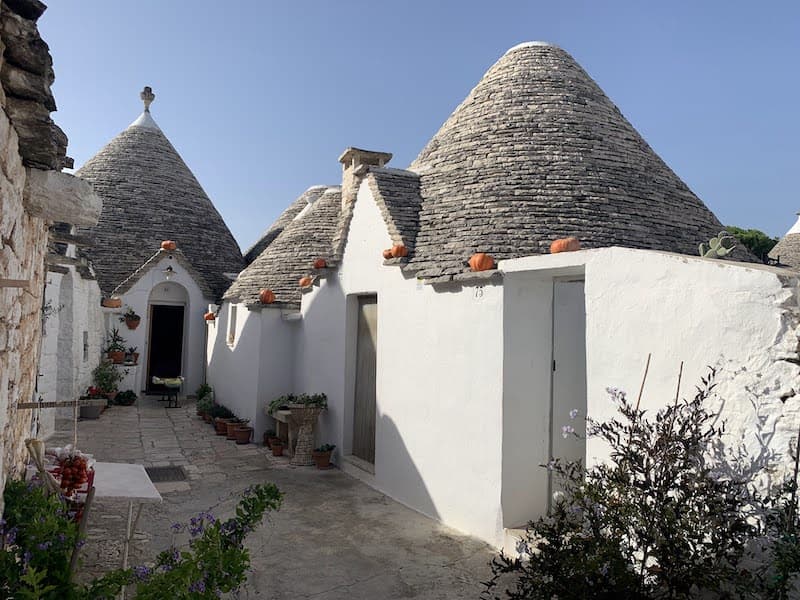
Alberobello sits in the Valle d’Itria, in the province of Bari, in the Puglia region — the “heel” of Italy’s boot. Locals and travel writers alike sometimes call the region by its older name, Apulia, so you’ll see both “Alberobello Puglia” and “Alberobello Apulia Italy” used to describe the same place.
To put it on the map for you: Alberobello is roughly 34 miles (55 km) from Bari, 50 miles (80 km) from Brindisi, and about 42 miles (68 km) from Matera, just across the regional border in Basilicata. That makes it an easy, popular day trip from Bari and a natural stop if you’re also visiting Matera or exploring the rest of the Valle d’Itria.
Alberobello map tip: the town is genuinely tiny and walkable. Drop a pin on Google Maps for Rione Monti and Rione Aia Piccola, the two historic trulli neighborhoods, and you’ll see they sit right next to each other — a two-minute walk apart. Everything worth seeing is within that small core.
Why Is Alberobello Famous?
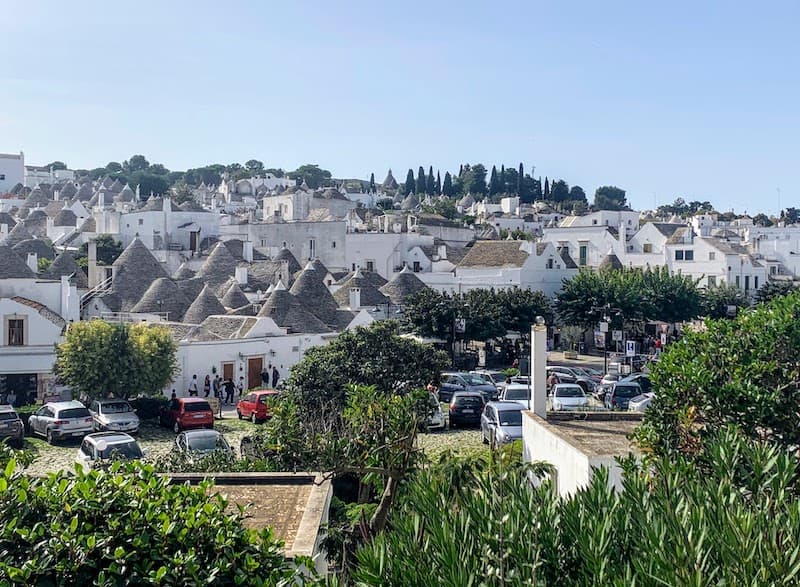
Alberobello is famous for its trulli — small, whitewashed limestone houses with distinctive conical roofs, built without mortar. The technique dates back to the 18th century, when the Count of Acquaviva, who controlled the area, allowed peasants to build homes from dry stone rather than mortar so they could be dismantled quickly and avoid property taxes owed to the Kingdom of Naples. The result is one of the most unusual town centers in Italy, and UNESCO declared the trulli of Alberobello a World Heritage Site in 1996.
That history is exactly why the best things to do in Alberobello revolve around simply walking the streets, looking up, and appreciating a building style that exists almost nowhere else on earth.
Map of Alberobello Attractions
The 15 Best Things to Do in Alberobello, Italy
Here’s my full rundown of what to do in Alberobello, roughly in the order I’d recommend tackling them.
1. Take a guided tour of Alberobello
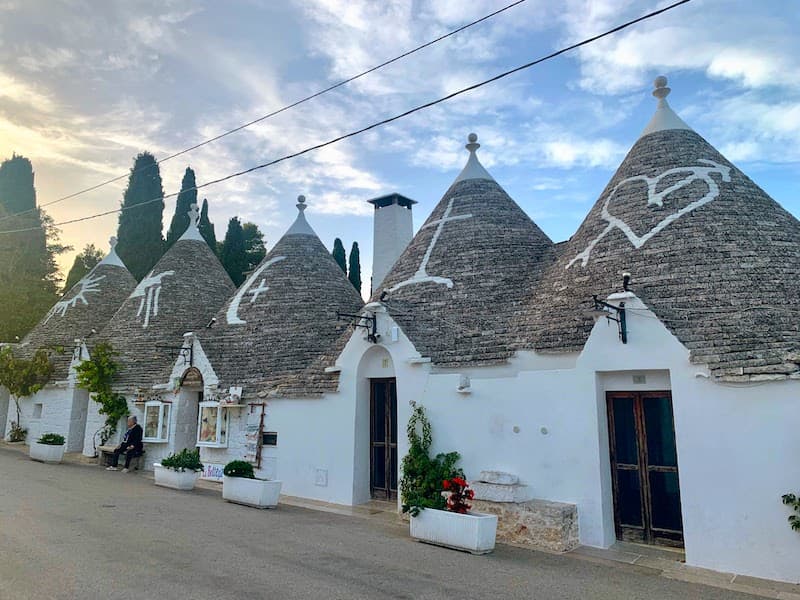
If you only have one day in Alberobello, start with a guided walk rather than wandering in blind — I wish I had. On my visit, I spent the first hour wandering Rione Monti without context, then joined a group later and realized how much I’d missed: which trulli were still lived in, why some roofs had painted symbols on them, and why the neighborhood’s layout follows the slope of the hill rather than a grid.
A 2-hour walking tour in Alberobello covers the origins of the trulli, the stories behind the major landmarks, and, on most departures, a short olive oil tasting. Puglia produces roughly 40% of Italy’s olive oil, so this isn’t a tourist add-on — it’s a genuine introduction to the region’s economy. Guides are local, English-speaking, and small-group sizes mean you can actually ask questions instead of just following a flag through the crowds.
If you’re looking for something a little different, I’d also recommend an e-bike tour. I explored Alberobello by e-bike and loved how quickly we could move between the historic neighborhoods and quieter back streets while still stopping for photos and stories along the way. Most tours also include a traditional focaccia tasting and a glass of local wine, making it a fun way to combine sightseeing with some of Puglia’s best flavors. If you’re comfortable riding a bike, it’s one of the most enjoyable ways to experience Alberobello beyond the main tourist routes.
2. Admire the trulli from the Belvedere Santa Lucia viewpoint

This is where I stood for a full ten minutes doing nothing but staring — the Belvedere Santa Lucia terrace, tucked right next to the Chiesa di Santa Lucia, opens onto a sweep of hundreds of conical rooftops across Rione Monti, all gray stone against whitewashed walls. It’s the single best panoramic shot in Alberobello, and it’s also where most guided walking tours begin, so you’ll likely pass through it twice: once for photos, once for orientation.
I’d suggest visiting in the early morning if you can, before 9 a.m., when the light is softer and the crowds haven’t arrived yet — by mid-morning this spot gets genuinely packed with tour groups angling for the same shot. It’s free, always open, and takes less than fifteen minutes, which makes it an easy first or last stop regardless of how the rest of your day is planned.
3. Wander Rione Monti
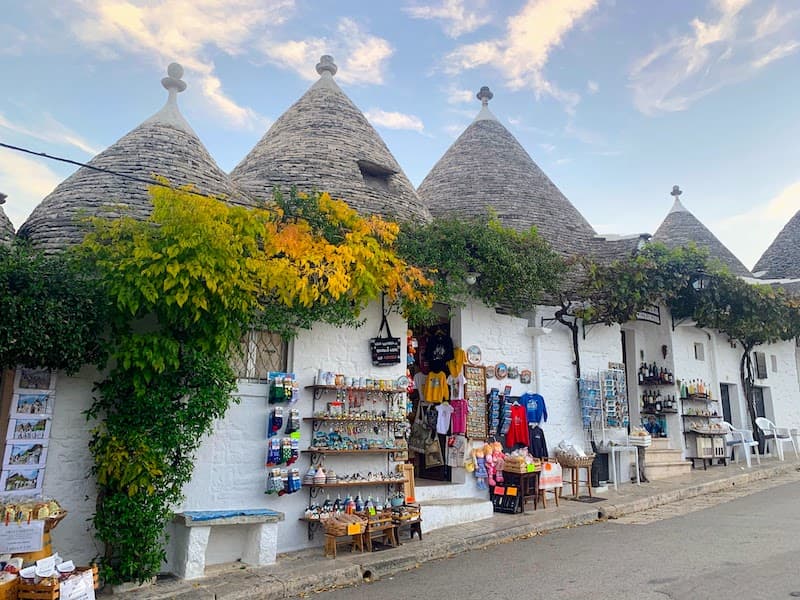
Rione Monti is the neighborhood that shows up on every postcard of Alberobello — roughly 1,000 trulli packed onto one hillside, most of them now converted into souvenir shops, small galleries, wine bars, or the occasional working craft studio. Yes, it’s the busiest part of town, and yes, by midday you’ll be sharing the narrow lanes with plenty of other visitors. I found the trade-off worth it: this is genuinely where the density and variety of trulli architecture is most striking, with rooflines stacking on top of each other in ways that are hard to appreciate from photos alone.
My tip, from having done this walk at three different times of day, is to cover Monti twice — once in the mid-morning for the shops and energy, and once closer to sunset when the crowds thin and the stone catches a warmer light. Both visits feel like different towns entirely.
4. Explore the quieter Rione Aia Piccola
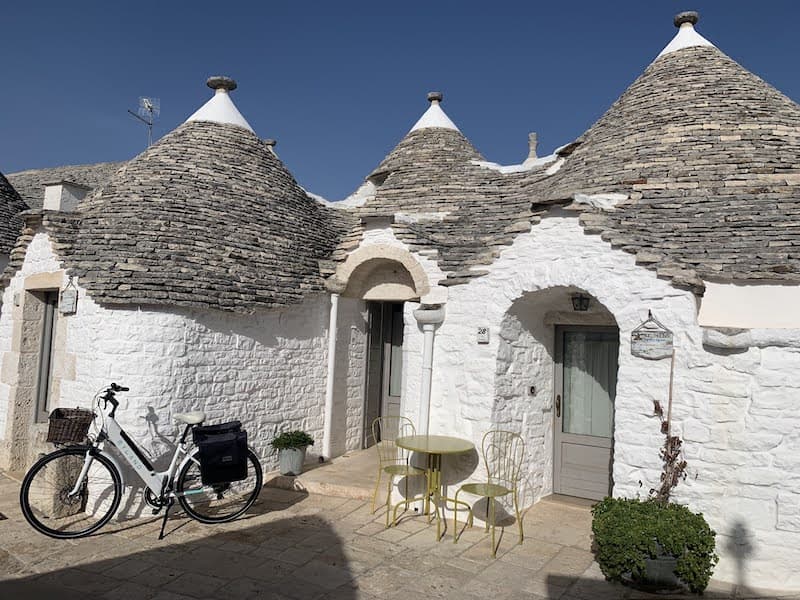
Aia Piccola sits directly across from Monti, and the contrast surprised me the first time I walked over: fewer shopfronts, laundry actually hanging between buildings, and locals nodding hello rather than working a souvenir counter.
I stayed in a trullo here myself, at Trulli Soave, and it changed how I experienced the whole town — instead of retreating to a generic hotel after a day of sightseeing, I was still surrounded by the same architecture, just without the tour groups. Some trulli in this quarter have been converted into holiday rentals, but they’re mixed in among homes where families have lived for generations, so the neighborhood never feels staged. It’s a two-minute walk from the busiest streets of Monti, which means you get proximity without the noise. If your itinerary allows for only one “extra” stop beyond the main sights, I’d put this ahead of most museums in town.
5. Visit Trullo Sovrano
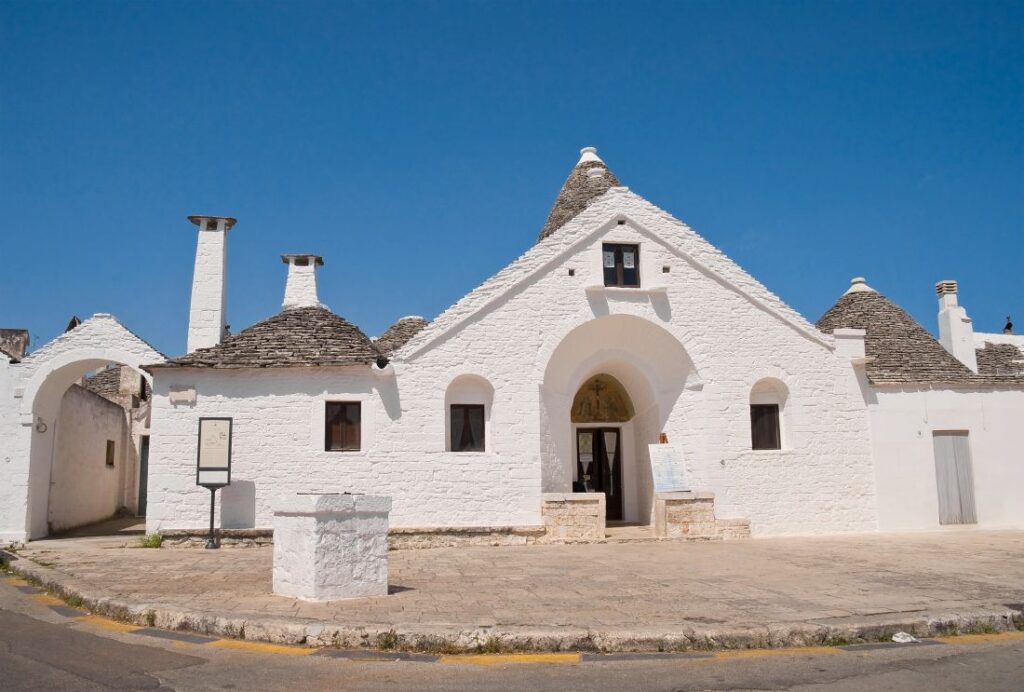
Trullo Sovrano is the only trullo in Alberobello built with a raised second floor, and stepping inside gives you a clearer sense of how these homes actually functioned than any amount of exterior sightseeing can. The rooms are laid out around a main hall, with a period bedroom, dining room, and a working kitchen complete with an old pantry and press — small details, like the smoke-blackened stone above the hearth, that make the building feel lived-in rather than staged for tourists.
I also hadn’t realized how little natural light reached some of the interior rooms. It makes the thick whitewashed walls and small windows suddenly make practical sense rather than just looking picturesque.
What I found most interesting on my visit was the timeline it lays out: the first trulli in Alberobello date to peasant settlements avoiding property tax in the 18th century, and Trullo Sovrano marks how far the architecture evolved from those original dry-stone huts. It’s a short visit, maybe 20–30 minutes, and it sits close enough to the Basilica of Saints Cosmas and Damiano that pairing the two in one stop is easy. Check out the official site of Trullo Sovrano for tickets and opening times.
6. See Trullo Siamese, the only “twin” trullo in town
Trullo Siamese earns its nickname honestly: it’s two separate trulli fused under a single connected roofline, with two doors and, notably, no windows at all on the original structure. Local legend attributes the odd layout to a family feud between two brothers who split the house down the middle rather than share it properly — a story worth asking your guide about, since versions of it differ slightly depending on who’s telling it.
Today the building operates as a souvenir shop, and entry is free, so there’s no reason to skip it even if you’re not buying anything. I’ll admit it’s a quick stop — five minutes, tops — but it’s one of the most photographed single buildings in Alberobello for good reason, and it’s a nice contrast to the more uniform, single-cone trulli that make up most of the town’s skyline.
7. Stop by Casa D’Amore
Casa D’Amore — the “House of Love” — matters more than its modest facade suggests. It was the first building in Alberobello constructed with actual mortar rather than the traditional dry-stone method, built right after the King of Naples finally permitted permanent construction in the town. Standing in front of it, you’re looking at the literal turning point where Alberobello stopped being a collection of temporary, tax-avoiding peasant huts and started becoming an actual town.
Today the building serves as the tourist information office, and I’d genuinely recommend making it your first stop of the day rather than an afterthought — the staff handed me a printed map with opening hours for the smaller museums that Google didn’t have listed, which saved me a wasted trip to Trullo Sovrano on a day it was closed for a private event. It’s a two-minute stop with a real practical payoff.
8. Visit the Sant’Antonio trullo church
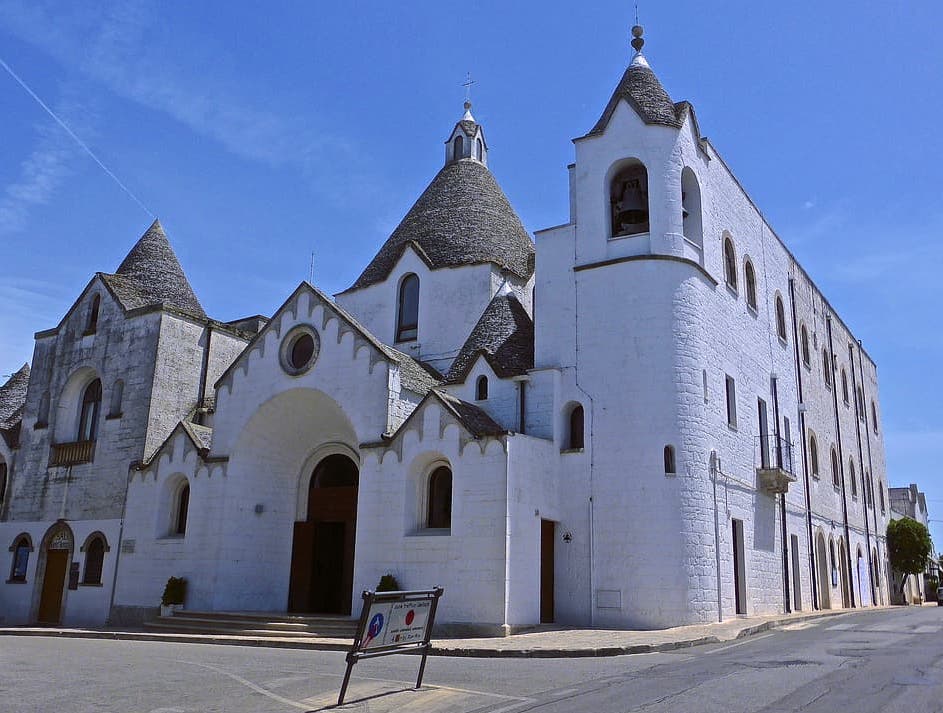

Built in 1927 but designed entirely in the traditional trullo style, the Church of Sant’Antonio is one of the most unusual churches I’ve come across in Italy. Sitting at the highest point of Rione Monti on Via Monte San Michele, it blends so naturally into the skyline that many visitors assume it’s centuries old.
The reason is simple: when the church was built, local regulations required new buildings in this part of Alberobello to follow the town’s distinctive architectural style. Although much newer than the surrounding trulli, it feels like it has always belonged here.
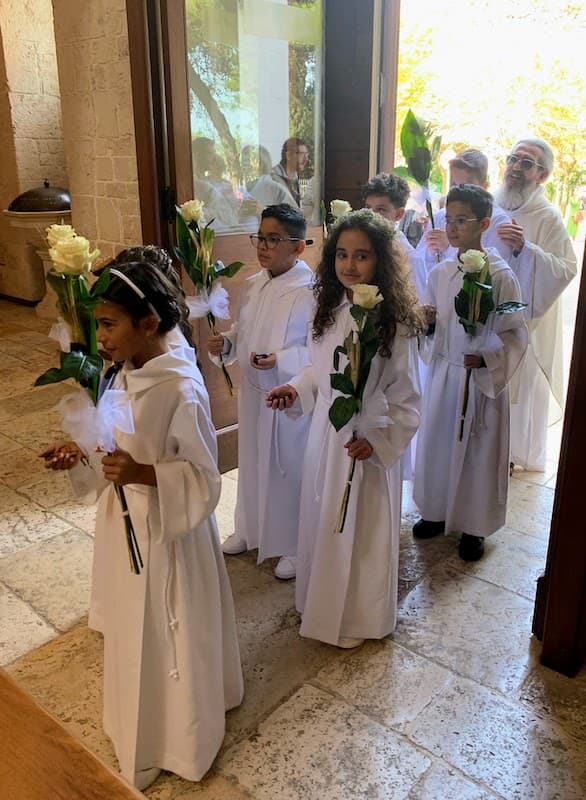
When I visited, I accidentally walked in just as a First Communion Mass was beginning. I hadn’t planned on attending a service, but it felt wrong to interrupt or leave immediately, so I quietly took a seat near the back.
Watching local families celebrate such an important milestone gave me a completely different perspective on Alberobello. Instead of seeing the church as another historic attraction, I experienced it as a living part of the community. The children dressed in white, proud parents taking discreet photos afterward, and the warm atmosphere made it one of the most memorable moments of my visit.
Even if you don’t happen to stumble into a special occasion as I did, it’s worth stepping inside. The interior is surprisingly spacious beneath the large stone cone, with exposed limestone walls and simple wooden furnishings that provide a peaceful contrast to the busy streets outside.
It’s also the only trullo church in the world, making it a genuinely unique stop rather than just another parish church. After your visit, spend a few minutes in the small square outside before heading back through Rione Monti—the elevated position offers one of the loveliest views over Alberobello’s rooftops.
9. Learn local history at the Casa Pezzolla Territory Museum
If you’ve spent an hour wandering Alberobello and find yourself wondering how people actually lived inside these tiny stone houses, Casa Pezzolla Territory Museum fills in all the gaps. Spread across 15 interconnected trulli dating back to the 18th century, it’s less of a traditional museum and more like walking through a miniature trullo village, with each room exploring a different aspect of local history, architecture, farming traditions, and daily life.
I found it much more interesting than I expected because it adds context to everything you’ve already seen outside. Instead of looking at trulli simply as photogenic buildings, you begin to understand how families cooked, stored food, collected rainwater, and organized their homes within surprisingly compact spaces. There are historical photographs, reconstructed interiors, traditional tools, and exhibits explaining the dry-stone building techniques that eventually earned Alberobello UNESCO World Heritage status.
I found myself lingering longer than expected in the reconstructed kitchen. The rooms look deceptively small from the outside, yet they’re surprisingly functional once you see how every corner had a purpose.
If you’re only in town for three or four hours, I wouldn’t call this an essential stop ahead of wandering the two historic neighborhoods. But if you’re staying overnight, visiting on a rainy afternoon, or simply enjoy learning about local culture rather than just taking photos, it’s easily the museum I’d recommend most in Alberobello.
10. Try a Pasqualino sandwich

Every Italian town seems to have one local specialty that residents insist you have to try, and in Alberobello it’s the Pasqualino. Created in 1966 by local grocer Pasquale Dell’Erba, this legendary sandwich starts with a crusty rosetta roll before being stuffed with combinations of cured meats, cheese, tuna, capers, mushrooms, pickles, or other ingredients depending on where you order it. Almost every shop claims to make an authentic version, and asking locals which one is best usually starts a friendly debate.
Mine was overflowing with cured meat, cheese, and capers to the point where I had to stop twice just to keep everything from falling out of the bread. Definitely grab a few extra napkins. The sandwich is substantial enough to keep you going for the rest of the afternoon, easy to eat while exploring the streets, and noticeably cheaper than many of the restaurants clustered around the busiest tourist areas.
If you only have a day in Alberobello, I’d recommend picking up a Pasqualino, finding a quiet bench overlooking the trulli, and taking your time. Sometimes those simple travel moments—a good sandwich, warm sunshine, and a view over the stone rooftops—end up becoming the memories you remember most.
11. Take a Puglia cooking class

One of the best ways to understand Puglia is through its food. The region is famous for simple recipes built around exceptional ingredients: peppery extra virgin olive oil, durum wheat pasta, seasonal vegetables, local cheeses, and seafood from both the Adriatic and Ionian coasts. Joining a cooking class in Alberobello lets you experience that tradition firsthand rather than simply ordering the finished dishes in a restaurant.
Most classes focus on making fresh orecchiette by hand—the small “little ear” pasta that has become one of Puglia’s culinary icons—alongside regional specialties like focaccia, fresh sauces, or traditional desserts. Even if you’ve taken cooking classes elsewhere in Italy, I found the experience here noticeably different because the emphasis is less on elaborate techniques and more on letting excellent local ingredients speak for themselves.
If a full cooking class doesn’t fit your schedule, look for a home-hosted lunch or olive oil tasting instead. Both offer a more personal glimpse into everyday life than a standard restaurant meal, and they’re a great way to slow down after a morning spent exploring Alberobello’s busy streets. For me, experiences like these are what transform a destination from somewhere you’ve seen into somewhere you’ve genuinely experienced.
A cooking class or a home-hosted lunch in Alberobello is a genuinely memorable way to understand the region beyond the trulli. For a deeper dive into the dishes to look for, I’ve put together a full guide to the foods of Puglia.
12. Sleep in an actual trullo

If there’s one experience I’d tell people to prioritize in Alberobello, it’s spending the night in a real trullo instead of treating the town as a quick day trip. I stayed in an elegant single trullo at Trulli Soave in the quieter Rione Aia Piccola, and it completely changed how I experienced Alberobello. Rather than arriving with the morning tour buses and leaving before sunset, I got to see the town at its calmest—early in the morning when shopkeepers were opening their doors and again late in the evening after most visitors had gone home.
My trullo had been beautifully restored, combining modern comforts with plenty of original character. The thick limestone walls kept the room naturally cool despite the warm Puglian weather, while the soaring conical stone ceiling made the space feel unlike any hotel room I’ve stayed in before. It struck a nice balance between authenticity and comfort, with thoughtful design touches that made it feel elegant without losing the charm of a centuries-old building.
If you’re deciding between staying in Rione Monti or Rione Aia Piccola, I’d personally choose Aia Piccola again. It’s only a couple of minutes’ walk from the main attractions, but the atmosphere is noticeably quieter and more residential. Waking up beneath a stone cone and wandering empty trulli streets before breakfast ended up being one of my favorite memories from Alberobello—and something you simply can’t experience on a standard day trip.
13. Have an espresso — or a local wine — surrounded by trulli
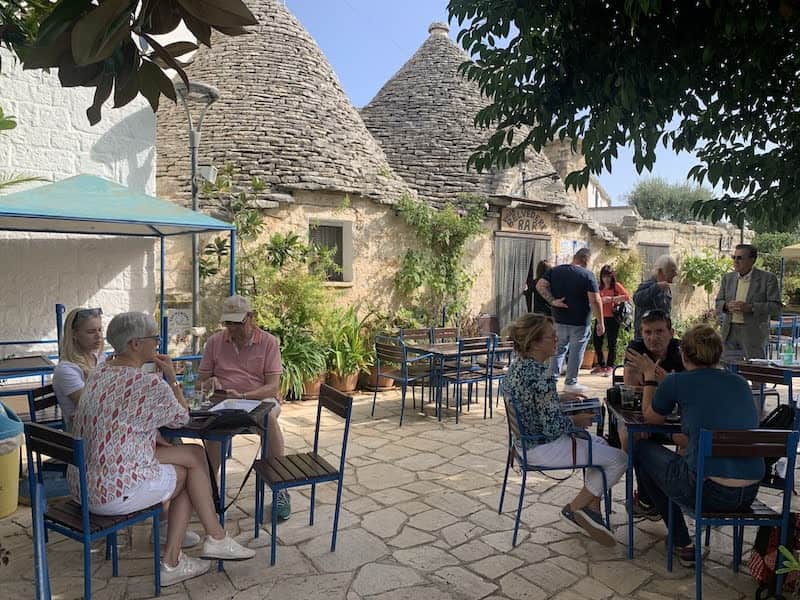
Alberobello isn’t the kind of place where you need to rush from attraction to attraction. In fact, one of my favorite moments came when I stopped trying to tick sights off a list and simply sat down with a drink overlooking the rooftops. After several hours of walking uphill through Rione Monti, an espresso—or later in the day, a local Primitivo wine—felt like the perfect excuse to slow the pace.
Trulli e Puglia Wine Bar is a lovely place to slow down with a glass of local Primitivo or Verdeca if you’re ready to swap coffee for wine. Sitting outside for half an hour, surrounded by centuries-old stone houses, was one of my favorite breaks of the day.
It’s a small thing, but I’d encourage you to build this break into your itinerary rather than treating it as an afterthought. Some of my favorite travel memories aren’t always tied to famous landmarks—they’re the twenty quiet minutes spent people-watching in a beautiful place with a good coffee or a cold spritz in hand.
14. See the Basilica of Saints Cosmas and Damiano
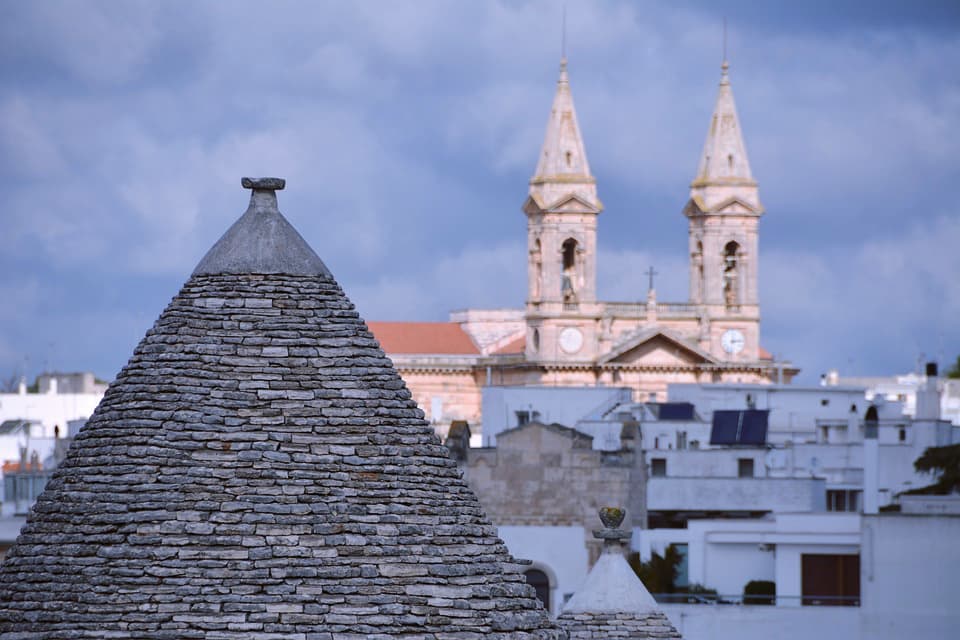
Standing in stark contrast to Alberobello’s low stone trulli, the Basilica of Saints Cosmas and Damiano is impossible to miss with its tall twin bell towers rising above the town. Dedicated to the town’s patron saints, the late 19th-century church is an important place of worship for local residents and remains an active parish rather than simply a historic monument.
I visited after Trullo Sovrano since the two are only a short walk apart, and it’s an easy combination that makes sense if you’re exploring on foot. Inside, the basilica feels surprisingly grand compared to the modest homes surrounding it, with colorful marble, decorative chapels, and the beautiful Madonna of Loreto painting behind the main altar drawing most visitors’ attention. Even if religious art isn’t usually high on your priority list, it’s worth stepping inside for a few minutes simply to appreciate the contrast between the ornate church interior and Alberobello’s otherwise understated architecture.
If your visit happens to coincide with a service, be respectful and wait until it’s finished before wandering around. As with Sant’Antonio Church, it’s a reminder that despite Alberobello’s popularity with tourists, this is still a living town where daily life continues around its UNESCO-listed streets.
15. Explore Alberobello at Night
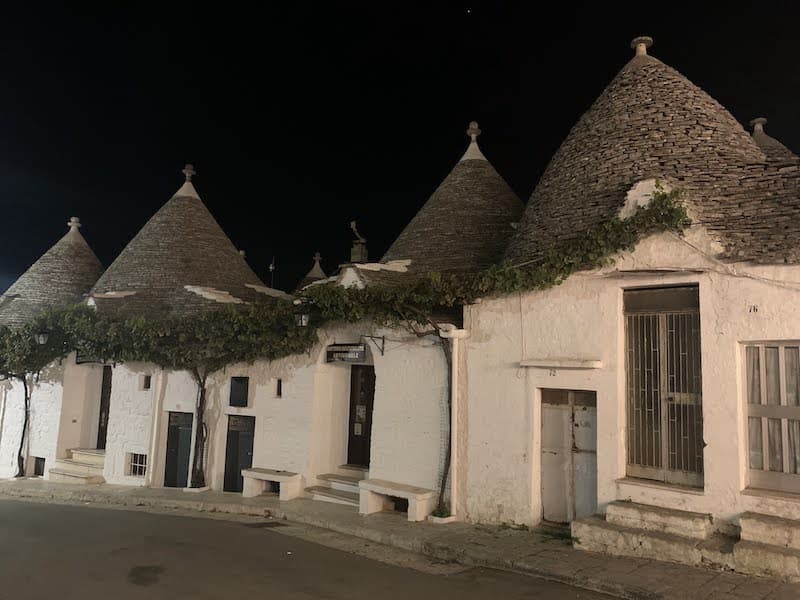
Alberobello during the middle of the day is undeniably beautiful—but it can also feel busy. By late morning, the narrow streets of Rione Monti fill with guided groups, souvenir shoppers, and day-trippers arriving from Bari, Brindisi, and cruise ports along the Adriatic. If you only visit during those peak hours, you’re seeing just one side of the town.
Everything changes after sunset. As the tour buses leave, the streets become noticeably quieter, restaurant terraces fill with overnight guests instead of hurried day visitors, and the trulli are softly illuminated against the evening sky. I went back out after dinner expecting to spend fifteen minutes taking a few photos, but ended up wandering for almost an hour with hardly anyone else around. Without the daytime crowds, I found myself noticing details I’d completely missed earlier—the sound of conversations drifting through open windows, flower boxes outside family homes, and the warm glow of lights spilling from the stone doorways.
Walking through Rione Monti at night felt like visiting a different town altogether. Without dozens of people stopping for photos, I found myself noticing little details like flower pots outside front doors, cats wandering between the trulli, and warm light glowing through tiny windows.
For me, this was when Alberobello felt most authentic. If your itinerary allows, I’d strongly recommend staying at least one night. You’ll enjoy quieter streets, better photography, and a completely different atmosphere than the one most day-trippers experience before heading back to Bari or elsewhere in Puglia.
Essential Alberobello Travel Tips

Alberobello is small, but there are a few mistakes that can make your visit feel more rushed—or more touristy—than it needs to be. Based on my own visit, here’s what I’d do differently (or what I’m glad I did right).
- Don’t arrive late if you’re only visiting for the day. By around 11 a.m., the streets of Rione Monti are noticeably busier with tour groups and day-trippers. If you can, arrive before 9 a.m. You’ll get softer light for photos, quieter streets, and a much more relaxed first impression.
- Don’t spend all your time in Rione Monti. It’s the most famous part of Alberobello, but Rione Aia Piccola ended up being my favorite neighborhood. It’s quieter, still residential, and feels far more authentic once you’re away from the souvenir shops.
- Don’t rush through in an hour or two. You can see the main sights quickly, but Alberobello is a place that rewards slowing down. Have a long lunch, stop for a coffee or a glass of local wine, visit a museum, or simply wander the back streets without an itinerary.
- Don’t skip sleeping in a trullo if your schedule allows. This was easily the highlight of my visit. Seeing Alberobello after the day-trip crowds leave—and again the following morning before they arrive—felt like experiencing a completely different town.
- Don’t eat at the first restaurant you see on the busiest streets. Some places cater almost exclusively to passing tour groups. Walk a few minutes away from the main thoroughfares, or grab a Pasqualino for lunch and save your sit-down dinner for the evening when the town is quieter.
A little planning goes a long way here. Alberobello isn’t difficult to visit, but timing your day well—and staying overnight if you can—makes a surprisingly big difference to the overall experience.
Where to Stay in Alberobello (Best Areas & Hotels)
Trulli accommodation clusters into the same two neighborhoods you’ll be exploring: Rione Monti, which is central and lively but can feel touristy after dark, and Rione Aia Piccola, which is quieter, still residential, and just as close to everything.
I’d recommend Trulli Soave in Alberobello — a collection of charming, historic single and multi-room trulli in Aia Piccola, close enough to Monti that you get the best of both without the noise.
How to Get to Alberobello from Bari, Brindisi & Matera
By car: The easiest route, and my recommendation. Rent a car at Bari Airport and drive about 50 minutes to Alberobello. From Brindisi, it’s roughly an hour by car, and from Matera, also about an hour.
By guided tour: If you’d rather not drive, a day tour from Bari covers Alberobello (and often Matera in the same day) without any logistics on your end.
By public transport: Possible, but slower. A bus from Bari takes about an hour; the train takes closer to three hours and involves a bus transfer in Mola di Bari. From Brindisi, expect around two hours by train with a change in Monopoli.
Best Time to Visit Alberobello, Italy
May, June, and September are the sweet spot — warm enough for comfortable sightseeing, without the July–August crush of tour buses, inflated prices, and Puglia’s full summer heat. I visited in October and had a genuinely pleasant experience: still warm, noticeably calmer, and easier to get good photos without a dozen other people in the frame.
If you can only travel in high summer, arrive as early as possible — Alberobello’s day-tripper crowds thin out dramatically by early evening.
Where to Eat in Alberobello (Best Restaurants & Cafés)
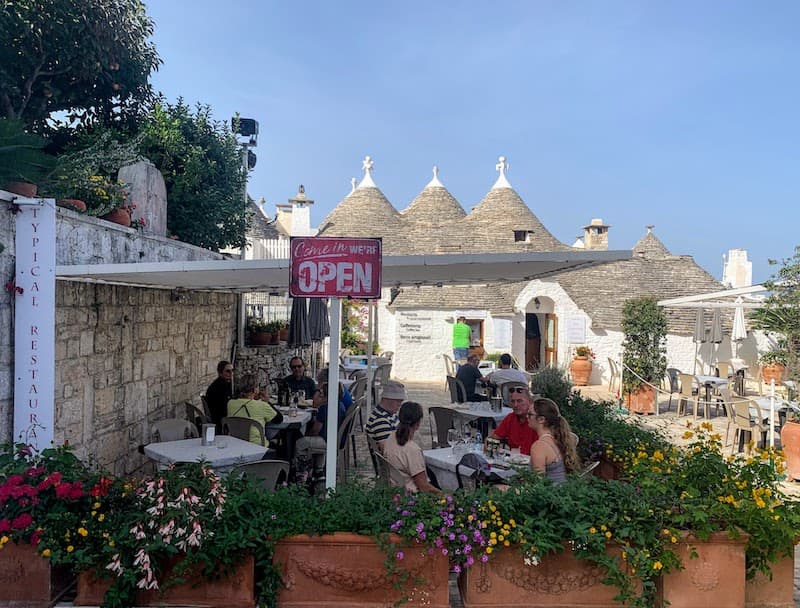
- Paco Wines Eno-Winery (Via Monte Nero 2) — the top-rated restaurant in town, with Puglian classics, regional wines, and gluten-free and vegetarian options.
- Trulli e Puglia Wine Bar (Piazza Gabriele d’Annunzio 3) — good wine list, solid small plates.
- La Pagnottella (Piazza Plebiscito 10) — the go-to spot for a proper Pasqualino sandwich.
- Martinucci Laboratory (Via Monte San Michele 57) — for pasticciotto and other Puglian pastries.
How Many Days Do You Need in Alberobello?

Alberobello is a small town of around 10,000 people, and its two key neighborhoods sit only two minutes apart on foot. You can see the highlights in about 4 hours. That’s enough for a solid day trip.
That said, if a night in a trullo is on your list — and it should be — plan for a full day and one overnight. Families traveling with kids tend to love the hobbit-village feel of the place, and couples consistently rank it among the most romantic stops in Puglia.
Suggested Alberobello Itinerary
If you’re wondering how to fit everything together, here’s how I’d plan your visit based on how much time you have.
3–4 Hours (Perfect Day Trip)
Start at the Belvedere Santa Lucia viewpoint for the classic panorama over Alberobello’s trulli before the streets become crowded. From there, wander through Rione Monti, stopping to browse a few shops before making your way to the quieter Rione Aia Piccola, where you’ll get a better sense of what everyday life in a trullo neighborhood still feels like.
If time allows, visit Trullo Sovrano to see what life inside a traditional trullo was really like, then grab a Pasqualino sandwich for lunch before heading back to Bari or continuing your Puglia road trip.
One Full Day
With a full day, you can slow the pace considerably. Follow the same morning route through the two historic neighborhoods, then add the Casa Pezzolla Territory Museum, the Sant’Antonio trullo church, and a relaxed lunch at one of Alberobello’s local restaurants.
Spend the afternoon browsing artisan shops, stopping for an espresso—or a glass of local wine—overlooking the trulli before returning to the Belvedere around golden hour for some of the best light of the day.
One Night (My Recommendation)
If your itinerary allows, I’d strongly recommend staying overnight in a trullo, ideally in Rione Aia Piccola. Alberobello feels completely different once the day-trip crowds leave. After dinner, wander the illuminated streets of Rione Monti, then wake early the next morning to experience the town before the tour buses arrive.
For me, those quiet evening and early morning hours were the highlight of visiting Alberobello and the biggest reason I’d choose an overnight stay over a rushed day trip.
Day Trips From Alberobello
Alberobello’s location in the Valle d’Itria makes it a natural base for exploring more of Puglia and neighboring Basilicata. Two of my favorite nearby stops:
- Ostuni, Puglia — the whitewashed “White City,” about 40 minutes away, and one of the most photogenic hill towns in the region.
- Matera — the cave-dwelling Sassi district, roughly an hour’s drive and, like Alberobello, a UNESCO World Heritage Site.
If you’re building out a longer route, my Puglia road trip itinerary ties Alberobello, Ostuni, Matera, and the rest of the Valle d’Itria together into one workable trip.
Is Alberobello Worth Visiting?
Yes — and not just because of the Instagram factor. Alberobello has been a UNESCO World Heritage Site since 1996, its trulli represent a construction technique found almost nowhere else in the world, and the town remains genuinely charming rather than purely staged for tourists. If you’re drawn to unusual architecture, romantic small towns, or World Heritage Sites in general, Alberobello earns its reputation.
FAQ: Frequently Asked Questions About Alberobello
Where is Alberobello located?
Alberobello is in the Valle d’Itria, in the province of Bari, in Italy’s Puglia region — about 55 km from Bari and 80 km from Brindisi.
What is Alberobello famous for?
Alberobello is famous for its trulli: small, whitewashed limestone houses with cone-shaped roofs, built without mortar and recognized by UNESCO as a World Heritage Site since 1996.
What to see in Alberobello?
The must-sees are Rione Monti and Rione Aia Piccola (the two trulli neighborhoods), the Belvedere Santa Lucia viewpoint, Trullo Sovrano, Trullo Siamese, Casa D’Amore, and the Basilica of Saints Cosmas and Damiano.
Is Alberobello in Puglia or Apulia?
Both — Puglia and Apulia refer to the same Italian region. You’ll see the town described as both “Alberobello Puglia” and “Alberobello Apulia Italy” depending on the source.
How many days do you need in Alberobello?
Around 4 hours covers the highlights, but a full day plus one night in a trullo is the better way to experience it, especially if you want to see the town after the day-trip crowds leave.
Is Alberobello a good day trip from Bari?
Yes. It’s about 50 minutes by car or an hour by public bus, and it’s a well-established, popular day trip from Bari — many tours even combine it with Matera.
What is the best time to visit Alberobello?
May, June, September, and October offer the best balance of good weather and manageable crowds. July and August are the busiest and hottest months.
Can you sleep inside a trullo house?
Yes, and I’d consider it the single best thing to do in Alberobello. Many trulli in both Rione Monti and Rione Aia Piccola are set up as guesthouses, ranging from single-room stays to larger family homes.
Final Thoughts
Alberobello is one of those places that photographs well but feels even better in person — the quiet stretch of a trullo courtyard in the early morning, the smell of olive oil at a small tasting, a Pasqualino sandwich eaten standing up in a doorway. If you’re mapping out the rest of your trip, my guides to the best places to visit in Puglia and the best things to do in Puglia are the next logical stops.