Padua Might Be Northern Italy’s Most Underrated City—Here’s Why

Padua Italy (Padova in Italian) is one of northern Italy’s most rewarding cities — packed with UNESCO World Heritage Sites, medieval piazzas, and one of the world’s oldest universities, yet far quieter than Venice, which sits just 30 minutes away by train. Most visitors come for a day trip and leave wishing they’d stayed longer.
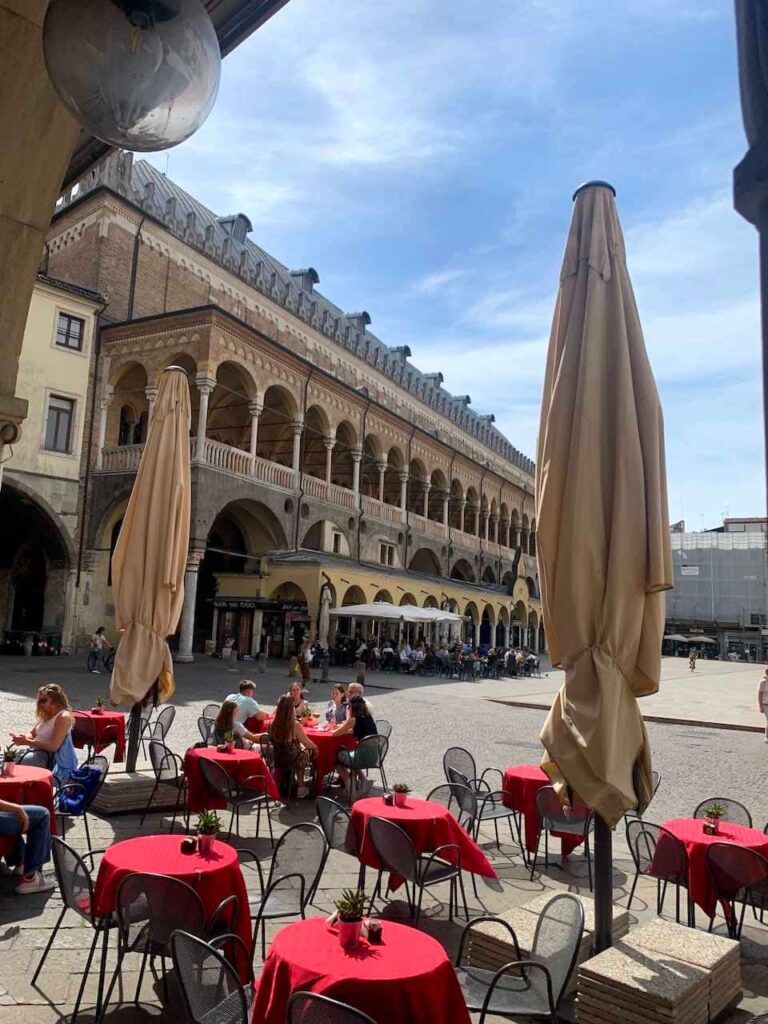
To tell the truth, Padua hadn’t been on my radar the way Venice or Verona had been. The tomb of St. Anthony of Padua was the only reason I wanted to visit Padua. But the moment I stepped off the train and wandered into the arcaded streets toward Piazza delle Erbe, I understood immediately why people who’ve been here can’t stop talking about it. This is real northern Italian life — markets spilling onto medieval squares, students cycling past Romanesque churches, and pilgrims quietly queuing at the tomb of a saint who’s been drawing the faithful for eight centuries.
This guide covers the best things to do in Padua, practical tips for planning your visit, a one-day and two-day Padua itineraries, where to eat, where to stay, and everything else you need to make the most of this brilliant, underrated city.
📌 Padua at a Glance
- 📍 Location: Veneto, northeastern Italy, 30 min from Venice
- 🗓️ Best time to visit: April–June, September–October
- ⏱️ Time needed: 1–2 days
- 🏛️ Famous for: Giotto’s frescoes, St. Anthony’s Basilica, world’s oldest botanical garden, one of Europe’s oldest universities
- 👥 Crowds: Far quieter than Venice, even in peak season

Discover Cars.Discover Cars – no hidden costs, free cancellation
Top Padua Tickets & Tours:
- Private City of Padua Walking Tour & Scrovegni’s Chapel Visit
- Scrovegni Chapel Ticket and Audio Guide
- Baptistery of the Cathedral & Museum of the Diocese
- Jewish Heritage Museum and Synagogue Tour
- Padua to Venice Boat Cruise of the Brenta Riviera
- Winery Tour & Tasting on Padua Hills
Rent a car and visit Padua on a road trip
Discover Cars – no hidden costs, free cancellation
Book Your Stay in Padua:
What to Know Before You Visit Padua
Is Padua Worth Visiting?
Yes — Padua is absolutely worth visiting, and for many travelers it ends up being the highlight of their Veneto trip.
It has two UNESCO World Heritage Sites (the Scrovegni Chapel and the Botanical Garden), one of the world’s oldest universities, an enormous medieval piazza, a world-famous pilgrimage basilica, and a genuine local atmosphere that Venice — for all its beauty — simply can’t offer anymore. If you’re based in Venice, Padua is the single best day trip from Venice you can take. If you’re planning a longer stay in the Veneto region, Padua deserves at least two days of your time.
What is Padua Known For?

Padua is known for several things that make it genuinely distinctive:
- The Scrovegni Chapel — Home to Giotto’s revolutionary frescoes (c. 1305), considered a pivotal moment in the history of Western art and a UNESCO World Heritage Site.
- The Basilica of St. Anthony — One of Italy’s most important pilgrimage sites, drawing millions of faithful visitors each year to the tomb of the beloved 13th-century saint.
- The University of Padua — Founded in 1222, it is one of the oldest universities in the world and has counted Galileo Galilei among its faculty.
- The Botanical Garden of Padua — Established in 1545, and the world’s oldest university botanical garden (also a UNESCO World Heritage Site).
- Prato della Valle — One of the largest squares in Europe, ringed by 78 statues and a peaceful elliptical canal.
- Café Pedrocchi — A legendary 19th-century coffee house famous for its mint coffee and its role in Padua’s intellectual and political history.
Where is Padua?
Padua is located in the Veneto region of northeastern Italy, in the Padanian Plain, about 40 km west of Venice, 80 km east of Verona, and 55 km southwest of Treviso. It sits at the heart of one of Italy’s most culturally and economically significant regions, surrounded by the Euganean Hills to the southwest and the Brenta Riviera to the east. The city is known in Italian as Padova — both names are correct and used interchangeably.
How to Get to Padua

How to Get from Venice to Padua
The Venice to Padua train is the easiest and most popular option, and it’s genuinely excellent. Regional trains run every 15–20 minutes from Venice Santa Lucia station, and the journey takes around 25–30 minutes. The fare is typically €5 each way. You can also take a faster Intercity or Frecciabianca service in about 15 minutes, though the price is higher and advance booking is recommended. Padua’s train station (Padova Centrale) is a 15-minute walk from the historic center, or a short tram ride on Line 1.
By car, the drive from Venice (from Mestre) takes about 35–45 minutes along the A4 motorway.
How far is Padua from Venice? The distance is approximately 40 km by road, or about 30 km as the crow flies.
How to Get from Rome to Padua
From Rome, the fastest option is the high-speed Frecciarossa train from Roma Termini to Padova, which takes approximately 3 hours and 20 minutes. Trains run several times a day, and fares vary depending on how far in advance you book — expect to pay €90 for a standard ticket. Alternatively, you could take a direct train to Venice and change at Mestre or Santa Lucia for a short connection to Padua.
By car from Rome, the drive is approximately 500 km and takes around 4.5–5 hours via the A13 and A4 motorways.
Guided Tours
If you’d prefer to let someone else handle the logistics, a guided tour is a brilliant option — especially if you’re coming from Venice and want to make the most of your limited time:
- 🚢 Burchiello Boat Tour on the Brenta River: Venice to Padua — A gorgeous scenic cruise along the historic Brenta Riviera, passing elegant Venetian villas, and arriving in Padua. One of the most memorable ways to travel between the two cities.
- 🚢 Burchiello Boat Tour: Padua to Venice — The reverse route, starting in Padua and finishing in Venice — ideal if you’re spending the night in Padua and heading back to Venice the following day.
How Much Time to Visit Padua?
One full day is the minimum to see Padua’s essential highlights; two days let you explore at a proper pace.
With one day in Padua, you can comfortably cover the Scrovegni Chapel, the Basilica of St. Anthony, Prato della Valle, the market squares, Café Pedrocchi, and a stroll through the historic center. With two days, you can add the University of Padua, the Botanical Garden, the Astronomical Observatory, the Cathedral and Baptistery, and perhaps a half-day excursion into the Euganean Hills or along the Brenta Riviera.
For those coming as a Padua day trip from Venice, an early start is key — aim to be on the 8am train from Venice Santa Lucia.
Best Time to Visit Padua
The best time to visit Padua is April to June and September to October, when the weather is pleasant, crowds are manageable, and the city’s outdoor markets, squares, and gardens are at their best.
July and August are hot and humid in the Padanian Plain — temperatures regularly exceed 32°C — and the city fills with summer tourists, though it never reaches Venetian levels of saturation. Winter (November to February) can be cold and misty, but Padua is atmospheric in a quieter way, and prices for accommodation drop considerably. Christmas markets add warmth to the medieval piazzas.
The Feast of St. Anthony on June 13th is a particularly special time to visit if you have any interest in pilgrimage culture — the Basilica fills with worshippers from across the world, and the city feels electrified.
Getting Around & Practical Info

Getting Around Padua
The historic center of Padua is largely walkable, and most of the major sights are concentrated within a compact area that can be crossed on foot in 20–25 minutes. For longer distances — especially if you’re staying near the train station — the city’s tram Line 1 is convenient, fast, and inexpensive. Bikes are widely used by locals, and rental is available from several spots near the station. Taxis and ride-hailing apps (such as itTaxi) are available but rarely necessary within the center.
Padua’s historic center has a ZTL (Zona a Traffico Limitato) — a restricted traffic zone that prohibits private cars without a permit. If you’re arriving by car, use one of the peripheral car parks (such as Parcheggio Prato della Valle) and walk or take the tram in.
Tips for Visiting Padua
- Book the Scrovegni Chapel well in advance. Entry is strictly limited to protect the frescoes, and slots sell out weeks ahead in high season. Don’t show up without a reservation. Book here.
- Dress modestly for religious sites. Covered shoulders and knees are required at the Basilica of St. Anthony, the Cathedral, and other churches. Carry a scarf just in case.
- The markets open early and close by 1 pm. If you want to see Piazza delle Erbe and Piazza della Frutta at their liveliest, go before noon.
- Café Pedrocchi’s mint coffee is non-negotiable. Order the caffè menta — it’s the house specialty, and unlike anything you’ll find elsewhere.
- Padua is extremely student-friendly. The university student population keeps prices lower than many comparable Italian cities — take advantage of this.
- Use Padua as a Venice base. Hotels in Padua are significantly cheaper than in Venice, and the 25-minute train connection makes it a very sensible and comfortable alternative. See my guide to one day in Venice and two days in Venice for planning ideas.
- The Padova Card offers free or discounted entry to many museums and unlimited public transport — worth it if you’re staying more than one day.
Best Things to Do in Padua
1. Marvel at the Scrovegni Chapel

Book this before anything else. Tickets for the Scrovegni Chapel sell out weeks ahead in spring and summer, and you cannot walk up on the day — the entry is timed, strictly capped, and non-negotiable. All of this is to protect what’s inside: Giotto’s fresco cycle from 1305, covering every wall and the entire ceiling in scenes from the lives of the Virgin and Christ.
Nothing about the photos prepares you for the blues. Giotto mixed lapis lazuli into his pigment, and the result, seven centuries later, still looks like it’s lit from behind. You get 15–20 minutes inside. That’s enough — people tend to go quiet and stay quiet. Aim for the 9:00 am slot to beat school groups, and take 30 seconds at the door just to look at the whole room before anyone starts talking.
Practical info: Tuesday–Sunday, 9:00 am–7:00 pm. Entry ~€15. Book tickets online well in advance on the offical website or via GetYourGuide— this is essential, not optional.
2. Admire the Basilica of St. Anthony
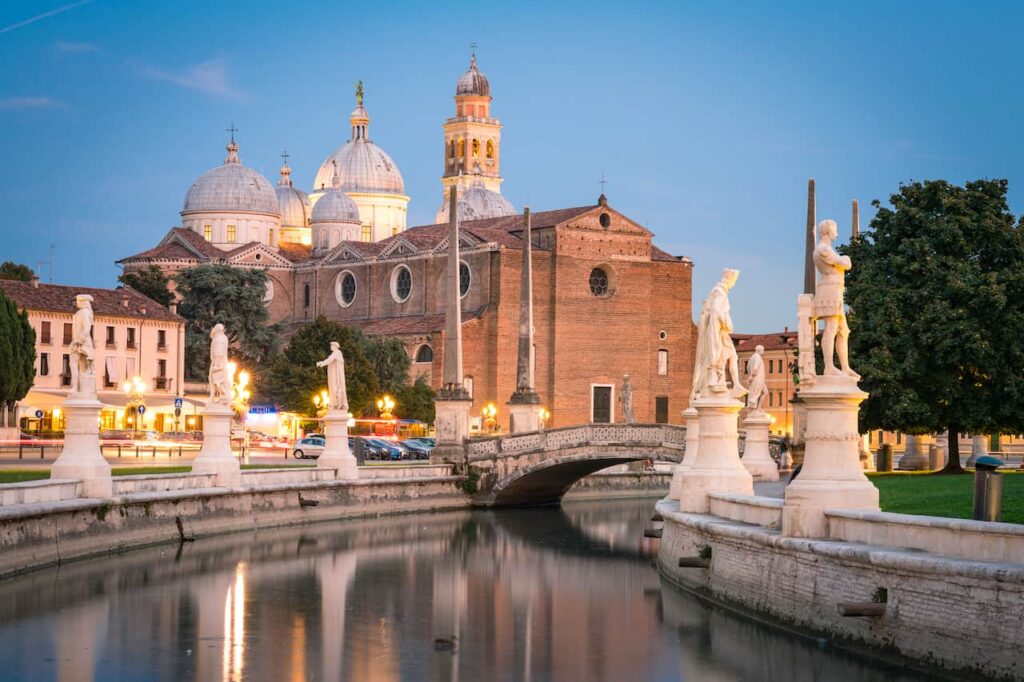
From outside, the Basilica of Sant’Antonio — known locally simply as Il Santo — is unmistakable. Byzantine domes stacked above a Gothic-Romanesque body, a silhouette unlike anything else in Italy. From inside, it’s both vast and surprisingly intimate, pilgrims and tourists moving through it together without much friction.
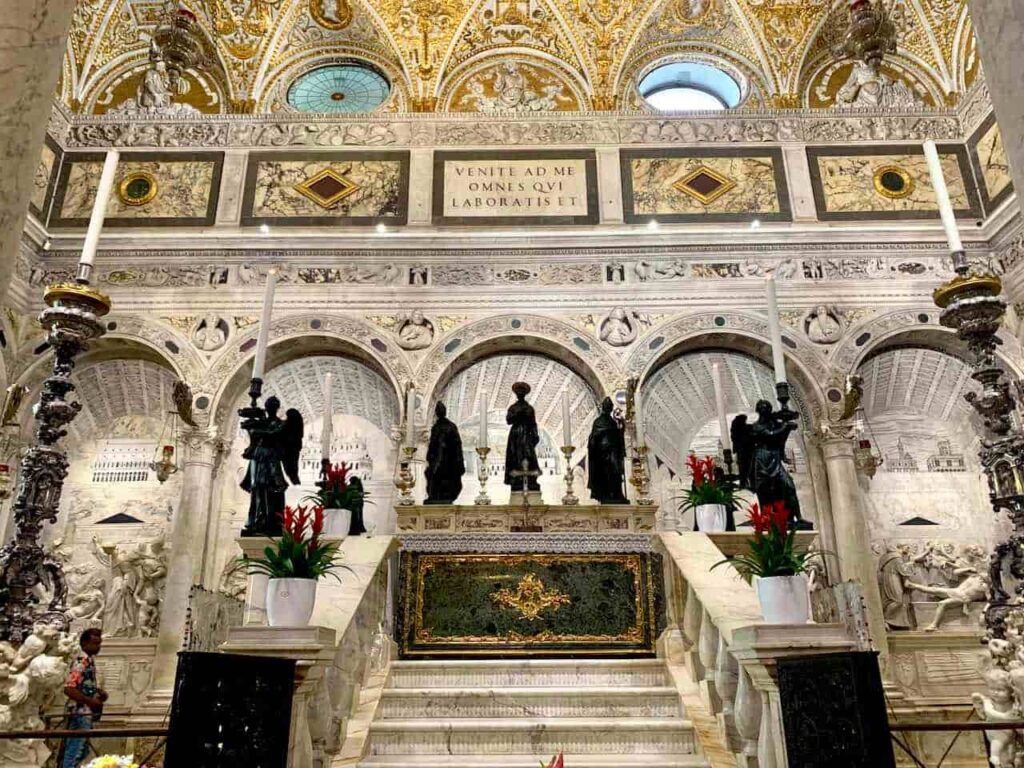
The Tomb Chapel with the Tomb of St. Anthony is the centre of everything. People press their hands to the marble, close their eyes, and stay there. The walls around the tomb are buried under handwritten notes, photographs, and votive offerings from people all over the world — every language, every kind of need. You don’t need to be religious for it to hit you. Beyond the tomb, don’t leave without finding Donatello’s bronze reliefs on the high altar — they’re extraordinary, and most people walk past them. The queue for the Tomb Chapel runs 20–30 minutes on busy mornings; go before 10 am or after 3 pm.
Practical info: Daily 6:30 am–7:00 pm. Free. Covered shoulders and knees required.
3. Stroll Through Prato della Valle
At 88,000 square meters, Prato della Valle is one of the largest squares in Europe — and one of the least touristy for its size. It’s where Padua actually lives. Joggers do laps at 7am. Students eat lunch on the grass. Elderly couples walk the canal path slowly. On the third Sunday of the month, an antiques market fills the outer ring; on the first Sunday, a flower market.
The 78 statues mounted around the elliptical canal represent Padua’s distinguished figures across the centuries — scholars, bishops, doges — and the effect of walking among them at dusk, when the lampposts come on and the water goes copper, is quietly spectacular. It’s five minutes from the Basilica. There’s no entry fee, no queue, no agenda. Just go.
4. Tour the University of Padua

Founded in 1222 and second in age only to Bologna, the University of Padua has a claim on modern civilization that’s hard to overstate. Galileo taught here for 18 years. The first woman to earn a university degree anywhere in the world — Elena Lucrezia Cornaro Piscopia — did so here in 1678.
The guided tour of Palazzo del Bo runs about 45 minutes and is worth every minute. The highlight is the Anatomical Theatre from 1595 — six tiers of steep wooden galleries above a stone dissection table, in a room barely bigger than a large living room. The dissections were technically illegal; the bodies were sourced by bribing prison guards. Standing inside it, none of that feels abstract. Tours depart every 30 minutes in English or Italian on alternating slots — check before booking.
Practical info: Guided tours run Monday to Saturday, approximately 9:30 am–5:30 pm. Entry costs €16.50 for adults. Book in advance on the university’s official website.
5. Explore the Markets and Local Life
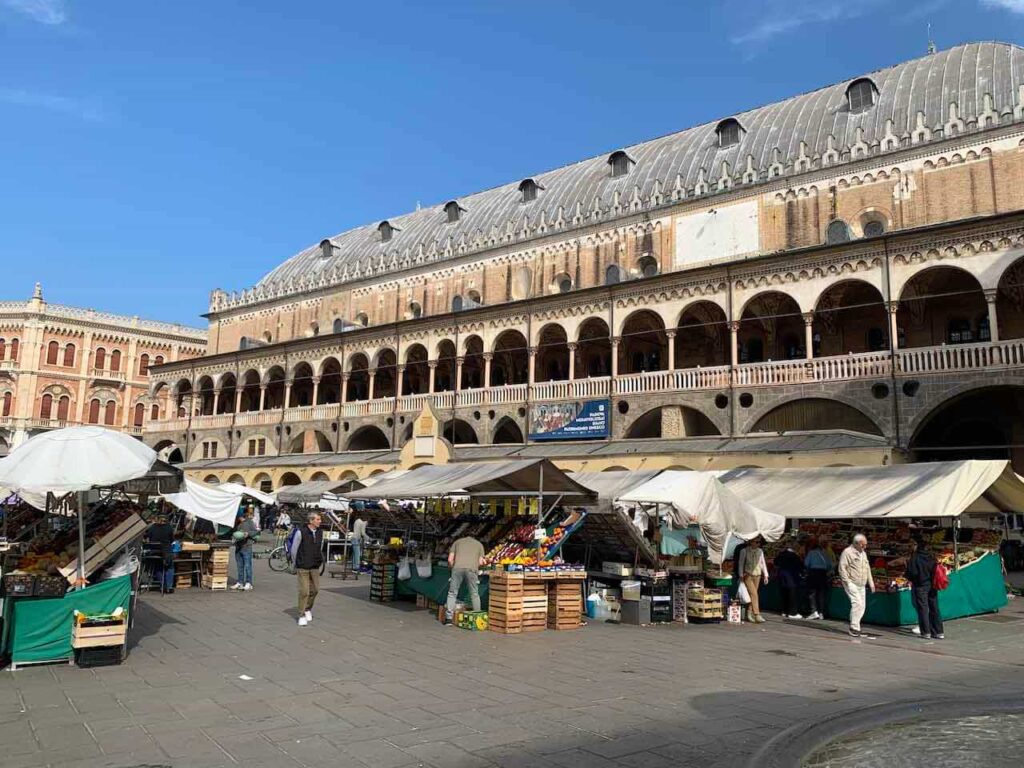
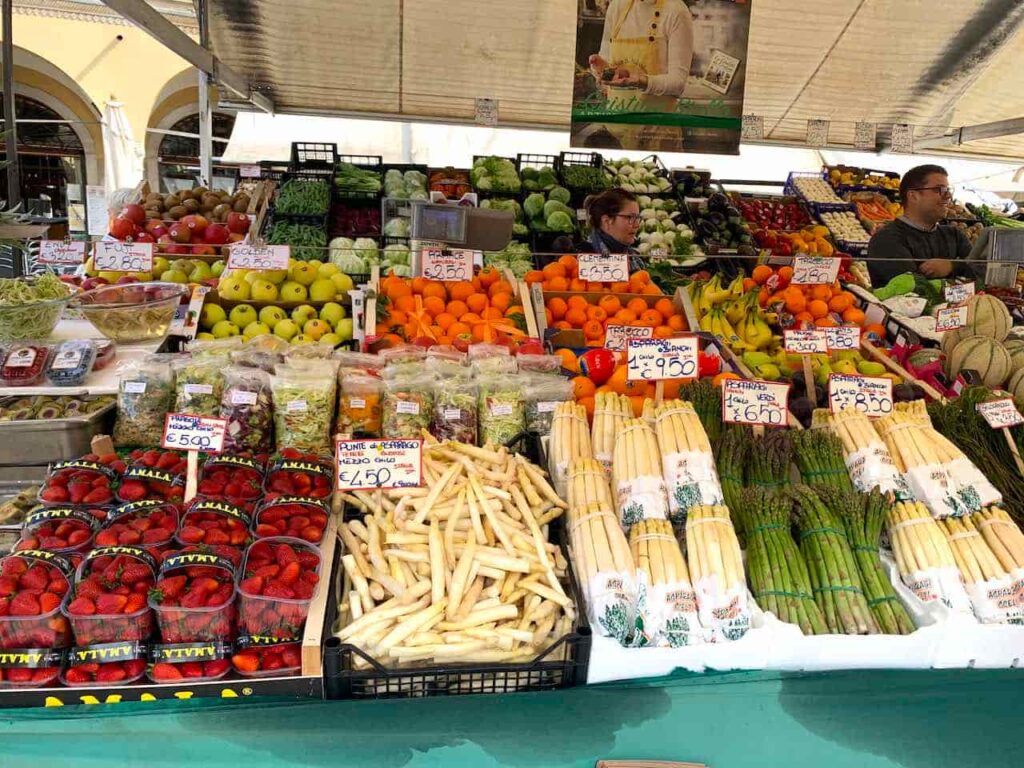
The three interlocking squares at the center of Padua — Piazza delle Erbe, Piazza della Frutta, and Piazza dei Signori — run as an open-air market every morning from Monday to Saturday. These are working markets: produce, cheese, cured meats, flowers, and local wine. The vendors are selling to the same regulars they’ve been serving for years. Tourists are welcome, but not the point.
Get there between 9:00 am and 10:30 am for the market at full noise. By noon, it’s winding down; by 1:00 pm, the stalls are gone, and the squares feel different. Come back at 6:00 pm, and they’ve transformed again — café tables spread across the stone, Spritz glasses on every surface, students occupying the steps. Same places, completely different city. Bring cash for the market. Buy something you can eat that day.
6. Visit Palazzo della Ragione

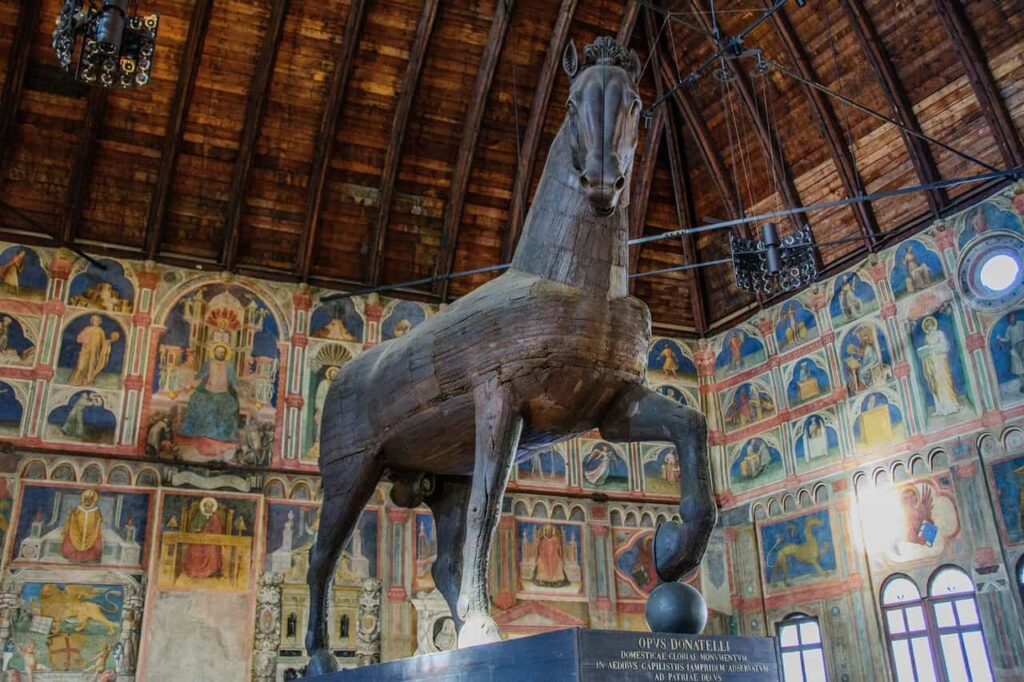
Il Salone — as it’s known locally — was built in 1218 as Padua’s law court, and the upper hall is one of the most extraordinary medieval interiors in Italy. It measures 81 meters by 27, roofed in a ship’s keel wooden vault that was the largest unsupported span in Europe when it was built. The walls and ceiling are covered in 333 frescoes tracking the astrological calendar, the months, allegorical scenes, and saints. It’s overwhelming in the best sense.
In the middle of the hall stands a large wooden horse — a replica of the one built for a jousting tournament in 1466 — which shouldn’t work as an object but somehow does. The market stalls are set up in the ground-floor loggia beneath it every morning. Entry is around €6–8, and it’s usually quiet enough that you can stand in the center of the room and just look up for as long as you want.
Practical info: Open Tuesday to Sunday, 9:00 am–7:00 pm. Entry €8.
7. Discover the Astronomical Clock
On the northern side of Piazza dei Signori stands the Torre dell’Orologio — a clock tower containing one of the oldest and most sophisticated astronomical clocks in the world. Constructed in 1344 by Jacopo Dondi dall’Orologio, the clock displays not just the time but also the phases of the moon, the position of the sun among the zodiac signs, and several other astronomical and calendrical data.
The mechanism is a marvel of medieval engineering, and seeing it up close — especially during the movement of its figures on the hour — is one of those experiences that makes you pause and marvel at what human ingenuity looked like before electricity.
Practical info: Free guided visits on Saturdays (9:30 am, 11:15 am, 3:30 pm, 5:00 pm) and Wednesdays and Fridays (9:30 am and 11:15 am). Advance booking is mandatory. Check the Padua tourism website and book as soon as your dates are confirmed.
8. Visit the Astronomical Observatory

For those fascinated by the history of science, Padua has a second astronomical gem: the Astronomical Observatory of Padua (Osservatorio Astronomico di Padova), established in 1761 and one of Italy’s oldest. It sits atop the Colle della Rocca, a small hill with panoramic views over the city and toward the Euganean Hills on clear days.
The observatory continues to be an active research center, and guided visits allow you to look through historic and modern telescopes, learn about Padua’s extraordinary contribution to astronomy (Galileo taught here and made several of his key discoveries during his Padua years), and enjoy what is arguably the best viewpoint in the city.
Practical info: Public visits on Saturdays, Sundays, and public holidays — at 4:00 pm from October to April, at 6:00 pm from May to September.
9. Savor a Mint Coffee at Café Pedrocchi

Caffè Pedrocchi is not just a café. When it opened in 1831, it became the intellectual heart of Padua — a gathering place for academics, artists, revolutionaries, and anyone who wanted to be at the center of ideas. It played a role in the Risorgimento uprisings of 1848, and its walls have hosted everyone from Stendhal to Lord Byron.
Today, it remains a working café of considerable elegance, with its original neoclassical interior largely intact. The drink to order is the caffè alla menta — espresso topped with a layer of mint-flavored cream, dusted with cocoa. It’s the café’s signature creation and one of those combinations that shouldn’t work but absolutely does.
Even if coffee isn’t your thing, step inside just to absorb the atmosphere. Few places in Italy feel quite like this.
Practical info: Located at Via VIII Febbraio 15, near the university. Open daily 8:00 am to midnight (extended hours on weekends).
10. Visit the Padua Cathedral, Baptistery & Diocesan Museum

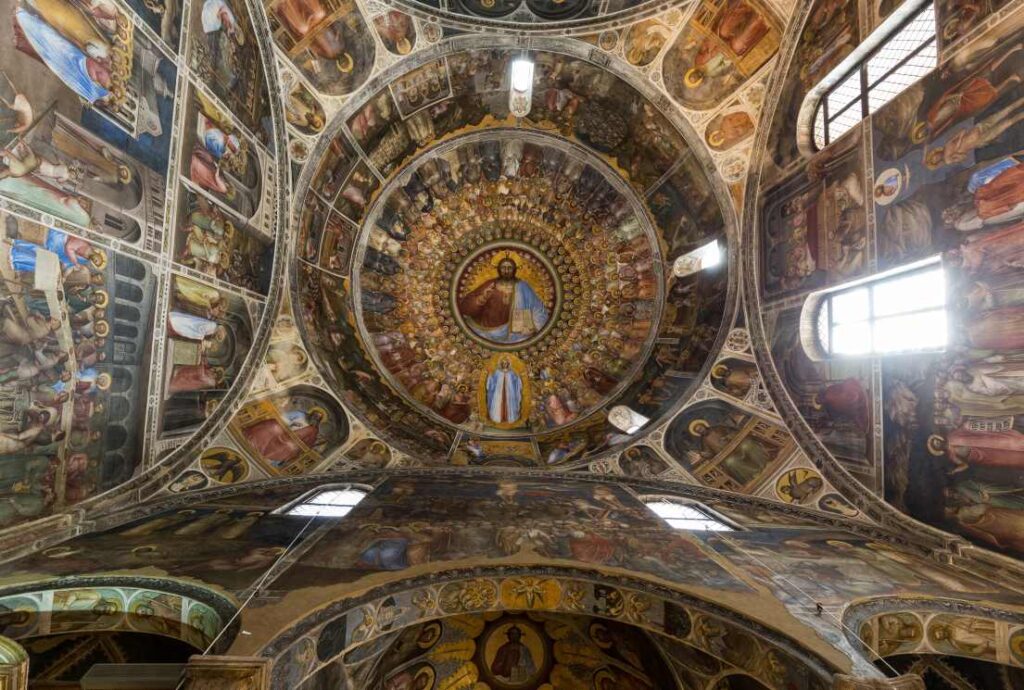
The Duomo di Padova (Padua Cathedral) is not Padua’s most famous church, but it deserves a visit for several reasons. The building, as it stands, is largely Baroque — designed with input from Michelangelo — and the interior contains a powerful fresco by Giambattista Tiepolo. But the real jewel is next door: the Baptistery of the Cathedral (Battistero della Cattedrale), commissioned by the Carraresi lords in the late 14th century and covered in stunning frescoes by Giusto de’ Menabuoi depicting the life of Christ, the Apocalypse, and scenes from the Old Testament. It is one of the most complete and impressive fresco cycles in northern Italy.
Adjacent to both is the Museo Diocesano (Diocesan Museum), which houses a compelling collection of religious art, liturgical objects, and devotional paintings from across the centuries.
Practical info: The Cathedral is free and open daily. The Baptistery and Diocesan Museum charge a small admission fee (around €4–6); combined tickets are available. Book the Baptistery & Museum visit online here.
11. Wander through Padua’s Historic Streets

The arcaded streets of Padua’s historic center — the portici — run for kilometers, keeping you out of the rain in winter and the sun in summer. Under them, the city doesn’t stop for weather. Just walk.
The best streets for this: Via dei Soncin near the market squares, where the medieval fabric is almost intact; Via del Santo between the Cathedral and the Basilica, busy with pilgrims and students; and the lanes around the former Jewish Ghetto, east of the center, where the narrow alleys and worn stonework feel genuinely unchanged. The late afternoon is the best time — after the market clears and before dinner, when the light goes amber and the streets belong mostly to people who live here.
12. Visit the Botanical Garden of Padua
The Orto Botanico di Padova, the world’s oldest university botanical garden, established in 1545, is smaller and calmer than you’d expect from a UNESCO listing. The historic circular layout — geometric beds inside a high stone wall — takes about an hour to walk properly, which is exactly the right amount of time. Weekday mornings before noon are best; school groups tend to arrive after midday.
The famous resident is a Chamaerops humilis palm planted in 1585, still alive, still in its original spot. Goethe visited it in 1786 and credited it with inspiring his theory of plant metamorphosis. It looks like an unremarkable palm until you do the maths on its age, and then you look at it differently. The biodiversity greenhouse added in 2014 is worth 20 minutes on its own
Practical info: Located at Via Orto Botanico 15. Open daily 9:00 am–7:00 pm (shorter hours off-season). Admission €10, with student and group discounts.
13. Go to the Sanctuary of Leopold Mandić, Patron Saint of Cancer Patients

This is one of Padua’s lesser-known but deeply significant pilgrimage sites. Saint Leopold Mandić (1866–1942) was a Capuchin friar of Croatian-Venetian heritage who spent his entire adult life virtually in a tiny cell in Padua, hearing confessions. He was known for his extraordinary compassion, his gift for reconciliation, and his deep spirituality. He was canonized in 1983 and is venerated as a patron of cancer patients and of those in spiritual need.
His cell has been preserved exactly as it was: a narrow wooden chair, a small crucifix, a kneeler worn smooth. It’s tucked inside a modest sanctuary a few minutes’ walk from the Basilica. There’s no queue, no ticket, rarely more than a handful of other visitors. For a city full of grand religious monuments, this small room is one of the most affecting things you can visit.
14. Visit the Church of the Eremitani

The Chiesa degli Eremitani (Church of the Hermits) stands right next to the Scrovegni Chapel and almost nobody visits it, which makes no sense. Before Allied bombing destroyed most of the building in 1944, it contained what scholars consider among the greatest frescoes of the Italian 15th century — painted by the young Andrea Mantegna, who was in his early twenties when he did the work. Almost all of it was lost.
What survives — fragments of the Martyrdom of St. Christopher, painstakingly reconstructed from photographs and rubble — is displayed in the Ovetari Chapel. The fragments feel more powerful for being fragments. The reconstruction of the church itself, completed in the 1950s, is a quiet meditation on loss. Entry is free. Allow 20–30 minutes and go with some knowledge of what isn’t there anymore. Entry is free, and it is rarely crowded.
15. Discover Padua’s Jewish Heritage
Padua’s Jewish community dates back to at least the 14th century. The Jewish Ghetto was established in 1601, and the community that developed within it — small, pressured, remarkably resilient — produced scholars, merchants, and artists who shaped the cultural life of the Veneto.
The historic ghetto area around Via delle Piazze still has the physical character of what it was: narrow streets, low buildings, the sense of a neighborhood designed to contain rather than welcome. The Museo Ebraico di Padova (Jewish Museum) and the historic synagogue are open for guided visits that take about an hour and cover the full arc of the community’s history, from medieval arrival to the deportations of 1943. It’s one of the better-curated small museum experiences in the Veneto. Book the Jewish Heritage Museum and Synagogue Tour.
16. Cruise the Brenta River

One of the most romantic and historically resonant experiences in the Veneto is a cruise along the Brenta Riviera — the stretch of the Brenta River between Padua and Venice that was, from the 16th century onward, lined with magnificent summer villas built by Venetian aristocrats escaping the heat of the lagoon city.
The most famous of these villas is Villa Pisani at Stra, with its legendary hedge maze, but there are dozens of others, including designs by Andrea Palladio. The historic Burchiello boat has been making this journey since the 18th century, and today you can travel the full route from Padua to Venice (or vice versa) in a day, stopping to visit several villas along the way.
Book the Burchiello Boat Tour on the Brenta River (Padua to Venice, entry tickets to about 20 villas are included)
17. Indulge in Local Delicacies
Padua sits in one of Italy’s richest agricultural regions, and the local food scene reflects it. Key things to eat and drink in Padua:
- Bigoli — thick, whole-wheat spaghetti-like pasta, traditionally served with duck ragù or anchovy-and-onion sauce
- Tramezzini — Padua (not Turin) claims the Italian version of the crustless sandwich, and the ones at Café Pedrocchi and local bars are outstanding
- Soppressa Vicentina — a local cured pork sausage from the Veneto hills
- Radicchio di Chioggia — the round, bitter red chicory typical of the Veneto
- Spritz — Aperol spritz was invented in the Veneto, and you’ll drink better ones here than almost anywhere else
- Fior di Latte gelato — the plain milk gelato found at old-school gelaterias is remarkably good in Padua
18. Learn to Cook Pasta and Tiramisu Like a Local

Padua and the broader Veneto region claim an important stake in the origins of tiramisu (the cities of Treviso and Padua both assert it was invented locally), and there is no better way to honor that heritage than learning to make it properly, alongside fresh pasta, in a local kitchen.
Cooking classes in Padua typically last 3–4 hours, and usually start at the market, which is the right way to begin anything food-related in this city. You make fresh pasta, you make tiramisu, you eat both at the end with local wine. The classes are small (usually 6–10 people), relaxed, and genuinely instructive. If you’re in Padua for two days, this fits well into a Day 2 afternoon
19. Take a Wine Tour to the Padova Hills
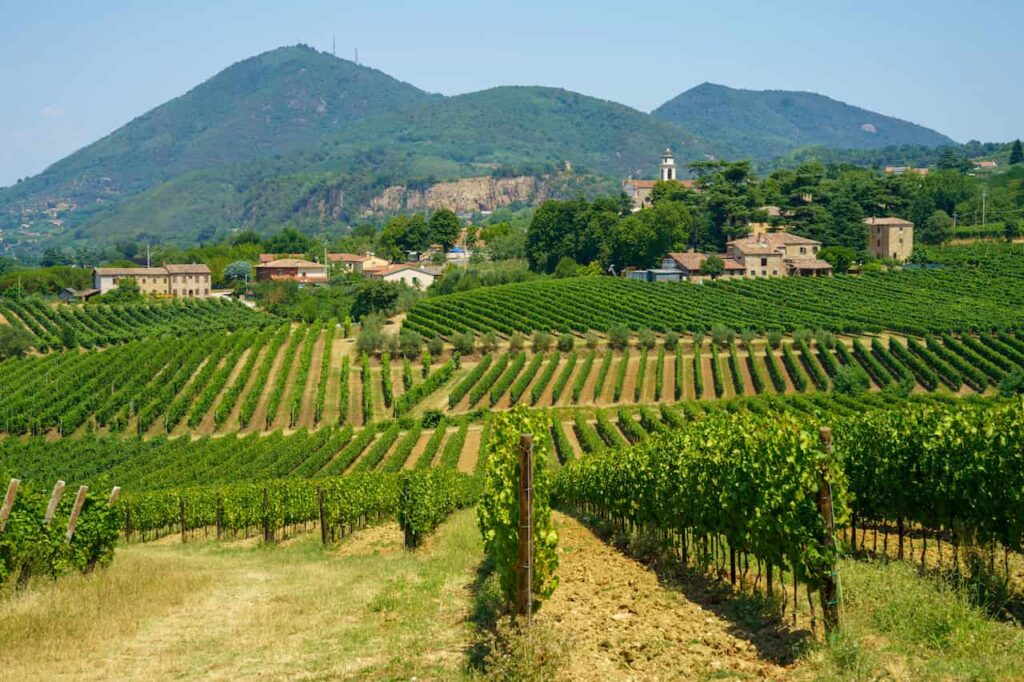
Thirty minutes south of Padua, the Euganean Hills (Colli Euganei) rise out of the flat plain in a cluster of extinct volcanic peaks that look slightly wrong for the geography — too abrupt, too green. The volcanic soil and the sheltered microclimate produce wines that rarely make it far outside the region: Friularo (a dark red from the Raboso grape with real character), Moscato Giallo, Cabernet, and Merlot. None of them is famous. Most of them are excellent.
A half-day wine tour from Padua covers a couple of cellars, a proper tasting, and the landscape itself — which is beautiful in a way that doesn’t get written about enough. Abbey ruins, hilltop villages, thermal spa towns. Worth building into a second day. Book the Winery Tour & Tasting on Padova Hills
20. Tour Villa dei Vescovi (Bishops’ Villa)

About 20 minutes by car south of Padua in the Euganean Hills, Villa dei Vescovi (the Bishops’ Villa)was built in the 1530s for the Bishop of Padua and decorated by the Flemish painter Lambert Sustris with frescoes that cover the entire piano nobile. The FAI (Italy’s National Trust equivalent) manages it and opens it for guided visits.
What makes it worth the detour is the combination: extraordinary 16th-century frescoes in excellent condition, a Falconetto loggia that frames the Euganean landscape like a Renaissance painting, and a hilltop setting with views that explain exactly why the Venetian elite came out here to think and read and argue. It pairs well with a wine tasting at a nearby Colli Euganei producer. Book the ticket online!
21. Experience Venice Like a Local on a Guided Tour from Padua
Padua makes a genuinely better base than Venice for most travelers — the hotels cost half as much, the train takes 25 minutes, and you can be in Venice before the day-trippers arrive if you catch the 8:00 am service. The best food in Venice is in the bacari and osterie that are gone by 2 pm; with a Padua base, you can be there when they open.
A guided tour from Padua to Venice handles all the logistics and gets you into the Venice that most people miss — Cannaregio, Dorsoduro, the Jewish Ghetto, and the quiet campi where locals actually live. It’s a very different experience from the Rialto-Accademia-St Mark’s triangle, and a much better one.
22. Prosecco Wine and Tastings Tour from Padua

North of Padua, the hills between Conegliano and Valdobbiadene produce Prosecco Superiore DOCG — some of the world’s finest sparkling wine, now a UNESCO-recognized landscape. A dedicated Prosecco tour from Padua typically covers the vineyard landscape (which is genuinely beautiful, with steep terraced slopes and medieval hill towns), multiple cellar visits, and comparative tastings of different styles.
It’s a longer excursion — usually a full day —, but for wine lovers it’s one of the best experiences available in this part of Italy.
23. Discover Chioggia – The Little Venice on a Day Trip

Chioggia — sometimes called La Piccola Venezia (Little Venice) — sits at the southern end of the Venetian Lagoon, about an hour from Padua by bus or bus-and-boat. It looks nothing like Venice — it’s a working fishing town, flat and dense, with a long main canal lined by crumbling facades and moored fishing boats rather than palazzi and gondolas. International tourists barely go there. That’s the point.
The morning fish market is one of the best in the Veneto; the Duomo is underrated; the side streets are genuinely quiet. Lunch here — fresh seafood, half the price of Venice — is one of the better meals you’ll have in the region. Take the public bus from Padua’s bus station (around €5-€7 each way) or this 4.5-h tour from Padua, walk the main drag, eat well, and be back in Padua by late afternoon.
1 Day Padua Itinerary
Here is the best way to spend one day in Padua if you’re working with a tight schedule — whether as a day trip from Venice or as a standalone visit:
Morning:
- 8:30 am — Arrive at Padua train station. Take the tram or walk to the center.
- 9:00 am — Begin at the Scrovegni Chapel (pre-booked ticket essential). Allow 45–60 minutes, including the introductory film.
- 10:15 am — Walk to Palazzo della Ragione and explore the market squares of Piazza delle Erbe and Piazza della Frutta while the market is at its peak.
- 11:00 am — Stop at Café Pedrocchi for a mint coffee and a cornetto or tramezzino.
Midday:
- 11:30 am — Walk south to the Basilica of St. Anthony. Allow 45–60 minutes to explore the interior, the Treasury, and the tomb chapel.
- 1:00 pm — Stroll through Prato della Valle (adjacent to the Basilica) and find a café or restaurant nearby for lunch.
Afternoon:
- 2:30 pm — Visit the University of Padua / Palazzo del Bo (send an email to
to**@***pd.it to book a guided tour in advance). Allow 1.5–2 hours. - 4:30 pm — Wander through the historic streets toward Piazza dei Signori to see the Astronomical Clock.
- 5:30 pm — Late afternoon aperitivo with a Veneto Spritz at one of the bars around Piazza delle Erbe.
- 6:30 pm — Return to the train station for the journey back to Venice or dinner in Padua.
What to see in Padua in one day: The Scrovegni Chapel, the Basilica of St. Anthony, Prato della Valle, the market squares, Café Pedrocchi, and the Palazzo del Bo will give you a genuinely complete picture of why Padua matters.
2 Day Padua Itinerary
Two days in Padua is the sweet spot. Day one covers the unmissable landmarks at a proper pace; day two lets you slow down, go deeper, and discover the sides of the city that most visitors never reach. If you’re using Padua as a base for the Veneto — and I’d strongly encourage it — you’ll also have time for a half-day excursion.
Day 1 – The Essential Padua
Morning:
- 8:30 am — Arrive at Padua train station. Walk or take the tram to the historic center.
- 9:00 am — Start at the Scrovegni Chapel (pre-booked ticket is essential). Allow 45–60 minutes, including the introductory film in the acclimatization room. Don’t rush this — it deserves your full attention.
- 10:15 am — Walk next door to the Church of the Eremitani (free entry, rarely crowded) for a quiet 20 minutes with the surviving Mantegna fragments and the medieval interior.
- 11:00 am — Head into the market squares — Piazza delle Erbe and Piazza della Frutta — while the market is still in full swing. Buy something: a piece of cheese, a handful of olives, a paper cone of strawberries. This is Padua at its most alive.
- 11:30 am — Stop at Café Pedrocchi for a mint coffee and a cornetto. Take a seat inside and look at the room properly.
Midday:
- 12:15 pm — Walk south through the arcaded streets toward the Basilica of St. Anthony. Allow a full hour inside — the Tomb Chapel, the Treasury, Donatello’s bronze reliefs on the high altar, and the quiet side chapels all reward time.
- 1:30 pm — Lunch at Osteria Dal Capo (Via degli Obizzi 2), a decades-old, intimate osteria tucked in the heart of the former Jewish ghetto — consistently praised for its traditional Veneto dishes, warm atmosphere, and outstanding house wine. Order the liver alla veneziana with grilled polenta, or the gnocchi with rabbit sauce. It’s small and books up fast, so reserve ahead.
Afternoon:
- 3:00 pm — Stroll through Prato della Valle — the vast elliptical square is five minutes from the Basilica. Walk the full circuit of the canal and the 78 statues. Buy a gelato if the sun is out.
- 4:00 pm — Visit Palazzo della Ragione (Il Salone). The enormous frescoed hall and the extraordinary medieval roof structure are unlike anything else in the city.
- 5:30 pm — Cross to Piazza dei Signori to see the Astronomical Clock Tower up close.
- 6:15 pm — Aperitivo at one of the bars on Piazza delle Erbe or Piazza della Frutta. Spritz, local wine, or a Campari soda — and watch the square transition from market to social hub.
- 8:00 pm — Dinner at Osteria L’Anfora (Via dei Soncin 13) or one of the osterie in the university quarter. Order the bigoli.
Day 2 – Deeper Padua & Beyond
Day two is about the layers beneath the landmarks — the scientific heritage, the religious corners, the Jewish history, the gardens — and one excursion that puts the city in its broader context.
Morning:
- 9:00 am — Begin at the Botanical Garden of Padua (Orto Botanico). Allow 1–1.5 hours to walk the historic circular layout, visit the glasshouses, and find the ancient palm that Goethe described in 1786. It’s a genuinely peaceful start to the day.
- 10:30 am — Walk to the Padua Cathedral (Duomo di Padova) and spend time inside the Baptistery of the Cathedral — the 14th-century fresco cycle by Giusto de’ Menabuoi is one of the most complete and beautiful in northern Italy and is far less visited than it deserves to be. Allow 45 minutes.
- 11:30 am — Cross to the Diocesan Museum (adjacent to the Cathedral) for the religious art collection. 30–45 minutes is sufficient.
Midday:
- 12:30 pm — Walk to the University of Padua / Palazzo del Bo for a guided tour (book in advance). The Anatomical Theatre is the highlight — the world’s oldest, built in 1595. Allow 1.5–2 hours.
- 2:30 pm — Lunch in the university quarter. The streets around Via Altinate are full of good options; look for a place with handwritten daily specials on a chalkboard.
Afternoon — Choose Your Direction:
Option A: The Jewish Quarter & Historic Streets
- 3:30 pm — Explore the Jewish Ghetto around Via delle Piazze and take the guided tour of the Jewish Heritage Museum and Synagogue.
- 5:00 pm — Wander through Via dei Soncin and the medieval streets north of Piazza delle Erbe at your own pace.
- 6:30 pm — Visit the Sanctuary of St. Leopold Mandić for a quiet, reflective end to the afternoon.
Option B: Half-Day Excursion to the Euganean Hills
- 3:00 pm — Drive or take a bus south to the Euganean Hills (Colli Euganei). Visit Villa dei Vescovi at Luvigliano for the Renaissance frescoes and the extraordinary hilltop setting, then wind through the volcanic landscape to a local winery for a tasting of Colli Euganei DOC wines.
- Return by 7:30 pm for a late dinner in Padua.
Option C: Brenta Riviera Cruise
- If you’ve timed your visit for the right season and booked in advance, the Burchiello boat tour along the Brenta Riviera makes a spectacular second-day excursion — a full-day cruise through the Venetian villa landscape, finishing in Venice. A perfect way to close a two-day stay in Padua if you’re heading back to Venice anyway.
Evening:
- 7:30 pm — Aperitivo in the university quarter (Via Cesare Battisti or Piazzale Pontocorvo are both lively).
- 8:30 pm — Dinner at Enoteca dei Tadi for cicchetti and Veneto wine, or somewhere more substantial if Option B or C left you hungry.
Two days in Padua tip: If you’re staying overnight, book a hotel within or very close to the historic center — you’ll save time, avoid tram logistics, and be able to step out in the evening without planning. The city after dark, when the students fill the piazze and the market stalls have been cleared away, is a different and equally wonderful place.
Where to Eat in Padua
Padua’s dining scene is rooted in the Veneto tradition — generous portions, excellent local ingredients, and an emphasis on seasonal cooking. Here are some of the best options across different styles and budgets:
For traditional Venetian and Paduan cuisine:
- Osteria L’Anfora (Via dei Soncin 13) — A beloved, unpretentious osteria near the Piazze with rotating daily specials, excellent bigoli, and a wonderful wine list focused on Veneto producers.
- Antica Osteria Dal Capo (Via degli Obizzi 2) — A decades-old gem tucked in the former Jewish ghetto, small and intimate, with a warm, homey atmosphere. The liver alla veneziana with grilled polenta and the gnocchi with rabbit sauce are standouts. Excellent house wine and moderate prices. Book in advance.
- Enoteca dei Tadi — A wine bar and osteria hybrid with excellent cicchetti (Venetian-style small plates) and a rotating selection of Veneto wines.
For lunch and snacks:
- Mercato Sotto Salone — The covered market adjacent to Piazza delle Erbe has several stalls selling prepared foods; grab a plate and find a seat. It’s exactly what a market lunch should be.
- Bar Nazionale (Piazza delle Erbe) — standout for its toasted tramezzini and spritz right on the main market square, praised across multiple sources as having the best tramezzini in Padua
- Bar Romeo (Sotto il Salone) — the hidden market bar inside Palazzo della Ragione, a proper local institution popular with vendors and students
For something more considered:
- Le Calandre (in nearby Sarmeola di Rubano) — Padua’s legendary three-Michelin-star restaurant run by the Alajmo family. One of the finest restaurants in Italy. Requires planning well in advance, but it is a once-in-a-lifetime meal.
What to do in Padua at night: The area around Piazza delle Erbe, Piazza della Frutta, and the nearby university streets (particularly Via Altinate and Via Cesare Battisti) comes alive after dark with students and locals. Aperitivo hour (6 pm–8 pm) at the bars facing the piazze is the authentic Paduan evening ritual.
Hotels in Padua
Padua offers a genuinely good range of hotels across all budgets, and rates are significantly lower than in Venice for comparable quality. This makes it an excellent base for exploring the wider Veneto — including day trips to Venice itself (see my guide to the best day trips from Venice for context on how well-connected the region is).
Mid-range:
- Hotel Majestic Toscanelli (Via dell’Arco 2) — A lovely 34-room hotel in a converted palazzo in the heart of the historic center, just steps from the market squares. Well-managed, great location, atmospheric rooms.
- Hotel al Fagiano (Via Locatelli 45) — A simple, clean, and welcoming two-star near Prato della Valle and the Basilica. Excellent value.
Upper mid-range:
- Hotel M14 (Via Marsilio da Padova 14) — A smart, contemporary hotel with comfortable rooms and a very central location, popular with business travelers and tourists alike.
- Hotel Methis (Riviera Paleocapa 70) — Design-focused boutique hotel near the train station, with four floors each themed around one of the classical elements. A genuinely stylish option.
Luxury:
- Grand Hotel Terme di Abano (in nearby Abano Terme, 15 minutes by car) — For something truly different: a grand thermal spa hotel in the spa town just outside Padua, where you can soak in natural thermal waters in the evening after a day of sightseeing.
Frequently Asked Questions About Padua
Is Padua worth visiting?
Yes, unequivocally. Padua offers two UNESCO World Heritage Sites, one of the world’s oldest universities, a magnificent pilgrimage basilica, and genuine Italian city life — with far fewer crowds than Venice. It is one of the most rewarding cities in northeastern Italy.
How far is Padua from Venice?
Padua is approximately 40 km from Venice by road. The train journey from Venice Santa Lucia station to Padova Centrale takes 25–30 minutes on regional services, which run every 15–20 minutes.
Is Padua a good day trip from Venice?
Yes — Padua is the single best day trip from Venice in terms of accessibility and the richness of what it offers. Take the early morning train, book your Scrovegni Chapel ticket in advance, and you can see the city’s essential highlights comfortably in a full day.
What is Padua known for?
Padua is known for the Scrovegni Chapel (Giotto’s frescoes), the Basilica of St. Anthony (a major pilgrimage site), the University of Padua (founded in 1222), the world’s oldest botanical garden, and Prato della Valle (one of Europe’s largest squares).
How much time do you need in Padua?
One full day is enough to see the main highlights. Two days allow a more leisurely exploration, including the Botanical Garden, the University, and perhaps a half-day excursion to the Euganean Hills or the Brenta Riviera.
What to do in Padua at night?
Join the aperitivo hour at the bars around Piazza delle Erbe and Piazza della Frutta, enjoy dinner at one of the osterie in the university quarter, or attend an evening performance at the Teatro Verdi. Padua has a genuine nightlife driven by its large student population.
Is Padua expensive?
No — Padua is considerably less expensive than Venice for food, accommodation, and daily costs. It offers excellent value, particularly for accommodation.
Do I need to book attractions in advance?
The Scrovegni Chapel requires advance booking — this is essential, not optional. The University of Padua guided tours are also best booked ahead. Other attractions can generally be visited without prior reservation.
My Favorite Experience in Padua

If I had to choose one moment from my time in Padua that I would keep above all others, it would be standing at the tomb of St. Anthony in the Basilica.
I came with something personal — a quiet thank you to St. Anthony for his intercession in my life. It was the real reason I had wanted to visit Padua in the first place, and when I finally stood at the marble tomb and placed my hand on it, the emotion caught me off guard. Looking at the wall around me, covered floor to ceiling in small handwritten notes, photographs, and tokens of gratitude left by other visitors, I understood immediately that I was far from alone in this.
Hundreds of thousands of people have stood in that exact spot and done exactly the same thing — people from every country, every background, every kind of grief and joy and need. The thank you notes alone tell more human stories than most museums in the world.
The Basilica is vast and magnificent, but it is this corner — the Tomb Chapel, quiet and warm and worn smooth by centuries of hands — that stays with you forever.
Final Thoughts
Padua is the kind of Italian city that rewards genuine curiosity. It doesn’t perform for tourists the way some destinations do — it simply exists, fully and confidently, as it has for more than two thousand years. The markets open every morning. The students cycle past medieval churches. Pilgrims queue at the tomb of a saint. Professors debate in arcaded courtyards that Galileo once walked through.
If you’re planning a trip to the Veneto, don’t treat Padua as just an add-on to Venice. Give it a proper day at minimum — two if you can — and approach it with the same attention you’d bring to Florence or Rome. It will surprise you, move you, and almost certainly send you home wishing you’d stayed longer.
Planning a longer trip to the region? Don’t miss my guides to one day in Venice, two days in Venice, the best areas and hotels to stay in Venice, and the best food in Venice, Italy.