Vicenza Italy: The Most Beautiful City You’re Probably Skipping

Vicenza, Italy (La Città del Palladio) is one of the most architecturally extraordinary cities in northern Italy — home to a UNESCO World Heritage Site, a main square that stopped me in my tracks, and a local pace of life that feels a world away from the tourist crowds of Venice, just an hour east by train. Most visitors drive past it on the autostrada without stopping. That’s a mistake.
I’ll be honest: before I visited Vicenza, I thought of it mainly as a layover between Venice and Verona. But the moment I stepped into Piazza dei Signori and looked up at the Basilica Palladiana’s loggia glowing in the afternoon light, I got it completely. This city was the laboratory of one of the most influential architects in Western history — and it shows on every corner. Symmetry, proportion, elegance, and a quiet Italian pride that never tips into showiness.
This guide covers everything you need to know about Vicenza Italy: the top things to do in Vicenza, practical tips, a one-day itinerary, where to eat, where to stay, and answers to the questions travelers actually ask. Whether you’re planning a day trip or a longer stay, this is the guide I wish I’d had.
📌 Vicenza at a Glance
- Location: Veneto, northeastern Italy
- Best time to visit: April–June, September–October
- Time needed: 1–2 days
- Famous for: Palladian architecture, UNESCO Heritage status, Teatro Olimpico, Villa La Rotonda, baccalà alla Vicentina
- Crowds: Far quieter than Venice or Verona
Top Vicenza Tours Worth Booking in Advance:
- Secret Vicenza Walking Tour
- Self-Guided E-Bike Tour Among the Palladian Villas
- Vicenza City Highlights Private Walking Tour with Local Guide
- Palladian Classic Vicenza 1-Day Experience
- Tour of La Rotonda and Villa Valmarana with an Art Historian
- Villa Valmarana ai Nani (ticket)
Rent a car and visit Vicenza on a road trip
Discover Cars – no hidden costs, free cancellation
Book Your Stay in Vicenza:
What to Know Before You Visit Vicenza
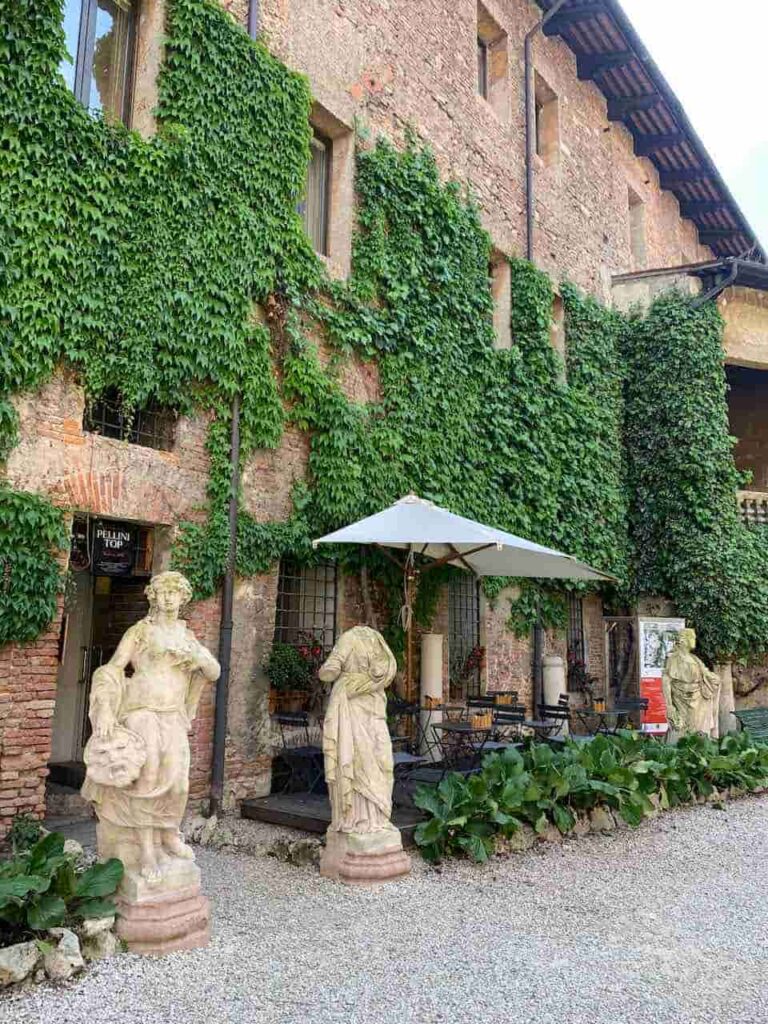
Is Vicenza Worth Visiting?
Yes — absolutely, and most travelers who visit say it was a highlight of their entire Veneto trip.
Vicenza is a UNESCO World Heritage City, home to some of the most important Renaissance architecture in Italy, with a compact old town that’s genuinely beautiful and not yet overrun with tourists. If you’re based in Venice, Vicenza is one of the best day trips from Venice you can take — fast to reach by train and completely different in atmosphere. If you’re planning a longer stay in the Veneto, Vicenza deserves at least one full day, ideally two.
The city has its own personality, its own food culture, and its own story to tell. It’s not trying to be Venice or Verona. It just exists, quietly magnificent, waiting for the travelers who take the time to find it.
What is Vicenza Known For?
Vicenza Italy is known above all for Andrea Palladio — the 16th-century architect whose influence spread across Europe and all the way to the United States. Palladio made Vicenza his canvas, and the city is still living inside his vision today. A few things make Vicenza genuinely distinctive:
- The Palladian Architecture — Vicenza is nicknamed “La Città del Palladio” (The City of Palladio) for good reason. The Basilica Palladiana, Teatro Olimpico, Palazzo Chiericati, and Palazzo del Capitaniato are just a few of Palladio’s masterworks still standing here.
- UNESCO World Heritage Status — The City of Vicenza and the 23 Palladian Villas of the Veneto were inscribed as a UNESCO World Heritage Site, recognizing Palladio’s extraordinary legacy.
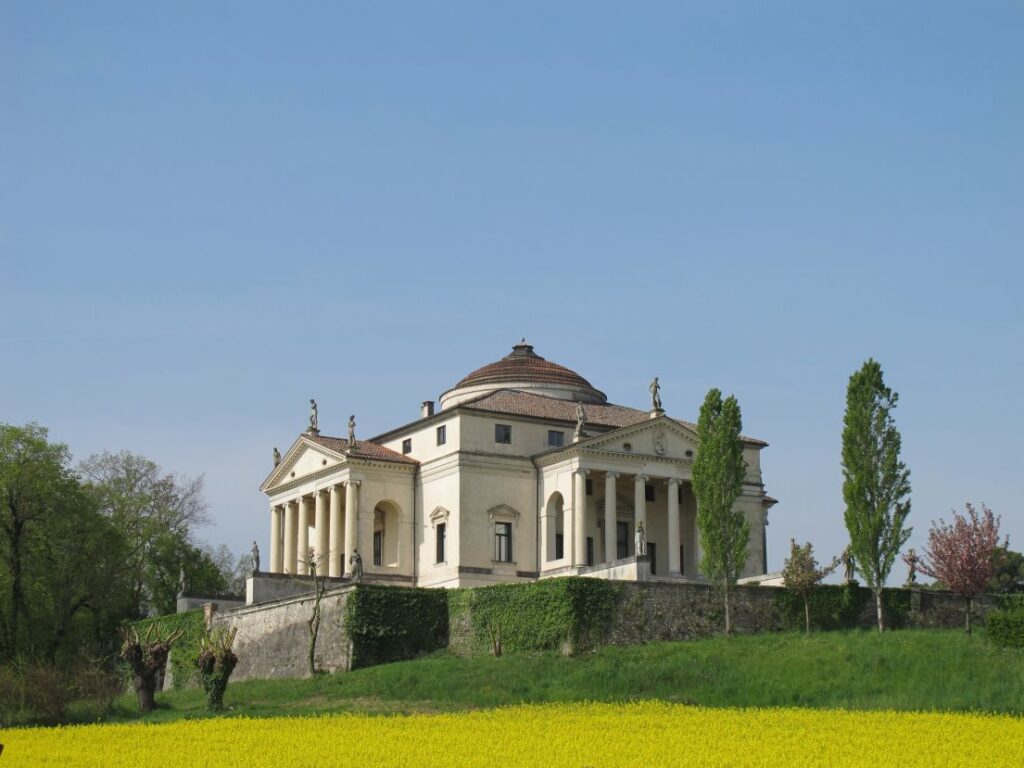
- Villa La Rotonda — Perhaps the most copied building in history. Thomas Jefferson modeled Monticello partly on it. It sits just outside the city center and is a must-see.
- Teatro Olimpico — The oldest surviving indoor theater in the world, with the world’s oldest permanent 3D stage set still intact from the 16th century.
- Baccalà alla Vicentina — The city’s iconic dish: salt cod slow-cooked in milk with onions, anchovies, and Parmigiano. Vicenza takes its baccalà seriously.
- The original Romeo and Juliet — Not Shakespeare’s — the story was first written by Luigi da Porto, a nobleman from Vicenza, around 1515. Shakespeare adapted it later.
Where is Vicenza?
Vicenza is located in the Veneto region of northeastern Italy, in the Po Valley between the Euganean Hills to the south and the Dolomite foothills to the north. It sits approximately 54 km west of Venice, 58 km east of Verona, and just 38 km west of Padua. Two rivers — the Retrone and the Bacchiglione — flow through the city. The surrounding countryside is dotted with Palladian villas, many of which are open to visitors.
How to Get to Vicenza
By train from Venice: The Venice to Vicenza train is the easiest and most popular option. Regional and high-speed trains depart regularly from Venice Santa Lucia station, and the journey takes between 45 minutes and 1 hour, depending on the service. Fares typically start around €8–10 each way. Vicenza’s train station sits at the western edge of the historic center — you can walk to the main square in about 15 minutes.
By train from Padua: Padua to Vicenza by train takes only 20–25 minutes, making it an easy combination on any Veneto itinerary.
By train from Rome: Vicenza to Rome by high-speed train takes approximately 3 hours and 30 minutes via a connection in Padua or Venezia Mestre. Direct Frecciarossa services run several times daily from Roma Termini to Vicenza. Book in advance for the best fares.
By car: Vicenza sits directly on the A4 motorway (Turin–Trieste), making it straightforward to reach by road from anywhere in northern Italy. Be aware that the historic center has a ZTL (restricted traffic zone) — use the peripheral car parks and walk in.
Airports near Vicenza: The closest airports to Vicenza are Venice Marco Polo Airport (about 75 km east, roughly 1 hour by car or shuttle) and Verona Villafranca Airport (about 55 km west, typically betwwn 45 min and 1 h). Both are well-connected to Vicenza by train and car.
How Much Time to Visit Vicenza?
One full day is enough to cover Vicenza’s highlights; two days let you breathe and add the villas.
With one day in Vicenza, you can see Piazza dei Signori, Basilica Palladiana, the Teatro Olimpico, Palazzo Chiericati, the Church of Santa Corona, a walk along Corso Palladio, and head up to Monte Berico for the panoramic view. That’s a full, satisfying day.
With two days, you can add Villa La Rotonda, Villa Valmarana ai Nani, explore the Palladian villas in the countryside, and eat your way properly through the city’s baccalà and cicchetti scene.
If you’re on a tight schedule coming from Venice, plan to arrive early — the 8:00 am train from Venice Santa Lucia is a smart move.
Best Time to Visit Vicenza
The best time to visit Vicenza is April through June and September through October — when temperatures are comfortable (18–26°C), the sky is reliably blue, and the outdoor squares and café terraces are at their best.
July and August are hot and humid, often exceeding 33°C, but Vicenza never gets as suffocatingly crowded as Venice in summer — you’ll still have space to stand in Piazza dei Signori and appreciate what you’re looking at.
Winter in Vicenza (November to February) is cold and occasionally foggy, but there’s an atmospheric, unhurried quality to the city in the off-season, and hotel prices drop significantly. Christmas markets appear in the historic center and are genuinely charming.
Spring is my personal recommendation. The light is extraordinary, the roses are out in the villa gardens, and you’ll share the Basilica rooftop terrace with a fraction of the summer crowds.
Getting Around & Practical Info

Getting Around Vicenza
The historic center of Vicenza is compact and walkable. From the train station to the far end of Corso Palladio takes less than 20 minutes on foot, and most of the major sights are clustered within a short radius of Piazza dei Signori. You genuinely don’t need public transport to explore the center.
For the villas outside the center — Villa La Rotonda and Villa Valmarana ai Nani — you can walk (about 3 km from the center) or take a taxi. Both villas are clustered near the base of Monte Berico, so it makes sense to combine them with the Monte Berico sanctuary in a single afternoon.
Guided tours are a smart choice in Vicenza, especially if you want to understand the architecture properly. Palladio’s buildings look beautiful even without context, but the story behind them is what makes the visit genuinely memorable. These are the tours I recommend:
- 🚶 Secret Vicenza Walking Tour — Takes you off the main drag into the courtyards, alleyways, and hidden stories that most visitors walk straight past. Excellent for repeat visitors or anyone who wants more than the postcard version.
- 🚲 Self-Guided E-Bike Tour Among the Palladian Villas — A brilliant way to explore the villas in the Vicenza countryside at your own pace, covering ground that’s impossible to reach on foot in a single day.
- 🎙️ Vicenza City Highlights Private Walking Tour with Local Guide — The best option if you want a knowledgeable local to walk you through the architectural highlights and bring the city’s history to life.
- 🏛️ Palladian Classic Vicenza 1-Day Experience — A full-day immersion in Palladio’s Vicenza, combining the city center with villas in the surrounding hills. Ideal if you have just one day and want to see it all properly.
Tips for Visiting Vicenza
- Get the Vicenza City Card. Buy it at the Tourist Office in Piazza Matteotti 12 (next to the Teatro Olimpico). It costs €20, is valid for 8 days, and covers 11 sites, including the Teatro Olimpico, Basilica Palladiana, Palazzo Chiericati, Palladio Museum, and the Church of Santa Corona. It pays for itself quickly.
- Book the Villa Valmarana ai Nani ticket separately. Entry to Villa Valmarana is not included in the City Card — buy your ticket in advance to avoid disappointment.
- Villa La Rotonda and Villa Valmarana are best visited together — with an expert. The two villas are close to each other and easy to combine in a half-day. If you only book one guided experience in Vicenza, make it the Tour of La Rotonda and Villa Valmarana with an Art Historian — the specialist context transforms what could easily feel like a polite house visit into something genuinely illuminating.
- Dress modestly for churches. The Church of Santa Corona, the Cathedral, and the Sanctuary of Monte Berico all require covered shoulders and knees. Carry a light scarf.
- Arrive early at Villa La Rotonda. The villa gets busy mid-morning. If you’re there at opening time, you may have the grounds almost to yourself — and the light is better for photos.
- The rooftop of the Basilica Palladiana has one of the best views in the city. Don’t skip it. Included with the City Card.
- Locals eat lunch between 12:30 and 2:00 pm. If you want a table at a proper trattoria, arrive at 12:30 on the dot. By 1:30, the good spots are full.
- Vicenza is excellent as a Venice base. Hotels here cost a fraction of Venetian prices, and the train ride is easy. See my guides to one day in Venice and two days in Venice to plan your wider Veneto trip.
Best Things to Do in Vicenza
Piazza dei Signori
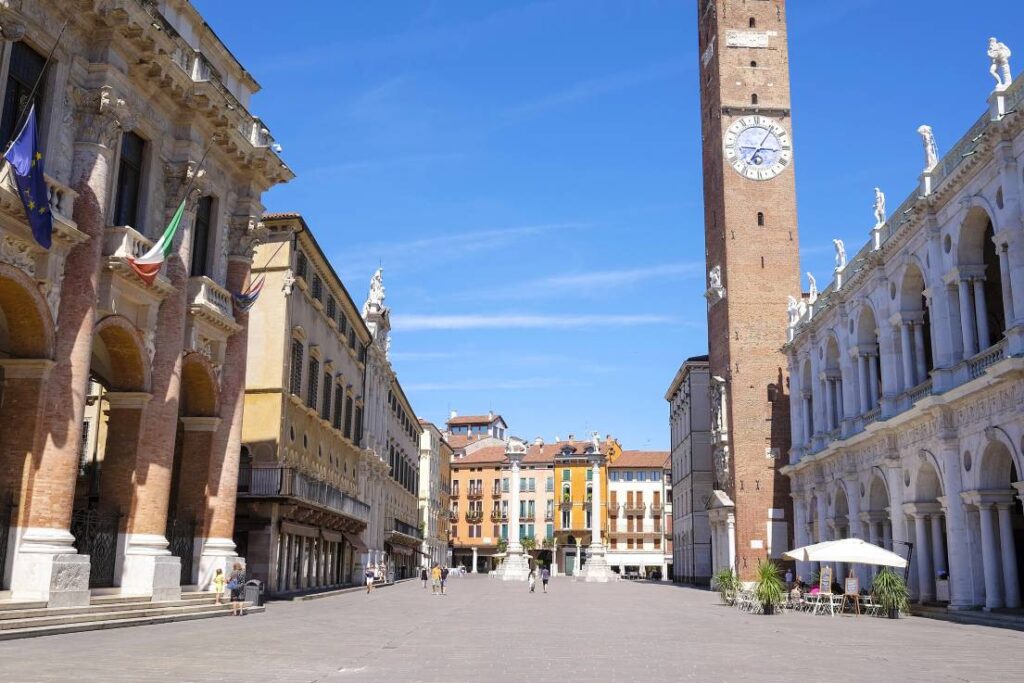
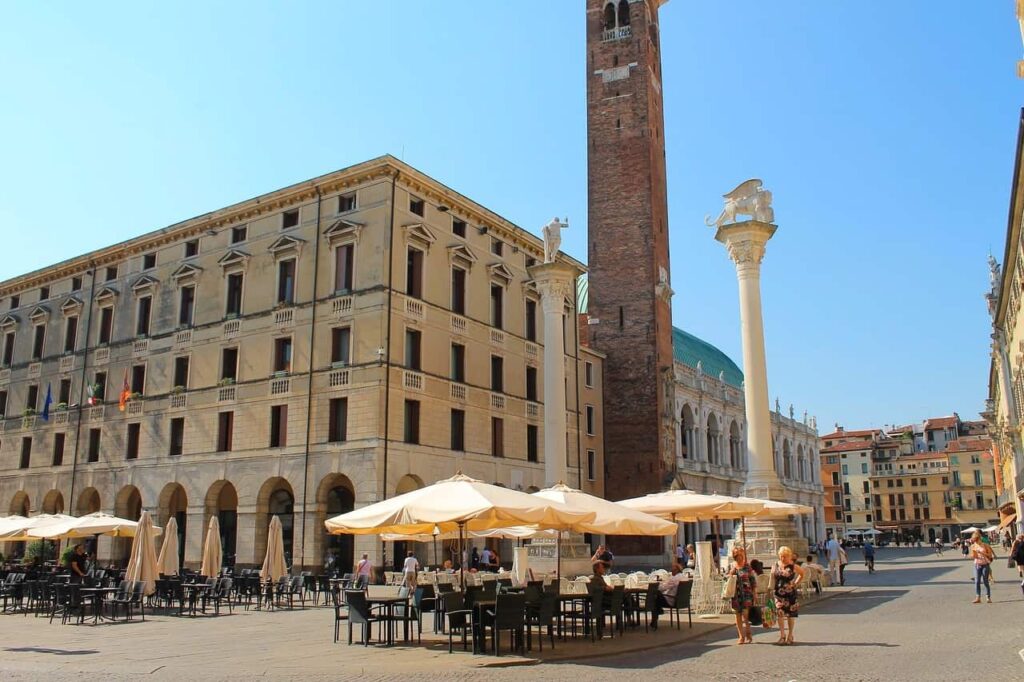
Start here. Always start here. Piazza dei Signori is the heart of Vicenza — the place where the city reveals itself all at once, and the first view hits harder than you’d expect after a 40-minute train ride from Venice.
It was the Roman Forum in antiquity, the center of civic and commercial life for two thousand years. Today it’s still where Vicentini gather: old men on benches in the morning, students with coffee in hand at lunchtime, families in the evening passeggiata. The square is ringed by some of the most important buildings in Italian Renaissance architecture — and unlike Rome or Florence, you can stand in the middle and take it all in without fighting through a crowd.
Sit at one of the outdoor bars on the square’s edge, order a spritz, and spend twenty minutes just looking. The light on the Basilica Palladiana’s loggia in the late afternoon is something you’ll remember.
Basilica Palladiana

The building that made Palladio’s name — and the one that still defines the Vicenza skyline. The Basilica Palladiana isn’t actually a church (confusing name, deliberate homage to ancient Rome): it’s the former city hall, rebuilt by Palladio in the 16th century after the original Gothic structure was threatening to collapse.
What Palladio did was wrap the old Gothic hall in a new Renaissance shell of two-story loggias, using what became known as the “Palladian window” — a tripartite arch flanked by two smaller rectangular openings — repeated rhythmically around the entire building. The result is perfectly proportioned, endlessly satisfying to look at, and enormously influential on architecture across Europe and America.
Inside, the ground floor arcades house some of the most elegant small shops and bars in the city — Il Grottino and Bar Borsa have been operating here for decades. The upper level has a Jewelry Museum. But the real reward is the rooftop terrace: a sweeping 360-degree view over the square, the Torre Bissara, the red rooftops, and the hills beyond. Covered by the Vicenza City Card. Entrance ticket without the card: €5.
Torre Bissara

The 86-meter clock tower rising alongside the Basilica Palladiana isn’t just a good-looking backdrop for photos — it’s a compressed history of Vicenza in stone. Built by the Bissara family in the 12th century, it was altered significantly over the following centuries as the city changed hands and changed identity.
Look at the tower carefully from the square: the statue of Athena at the top references Vicenza’s Roman origins; the white marble bas-relief of St. Mark’s Lion halfway up marks the Venetian era; and the triumphal arch at the base was added as a reference to the city’s experience in the Second World War. Three distinct eras, one tower. It’s the kind of detail that rewards a slow look.
Palazzo del Capitaniato
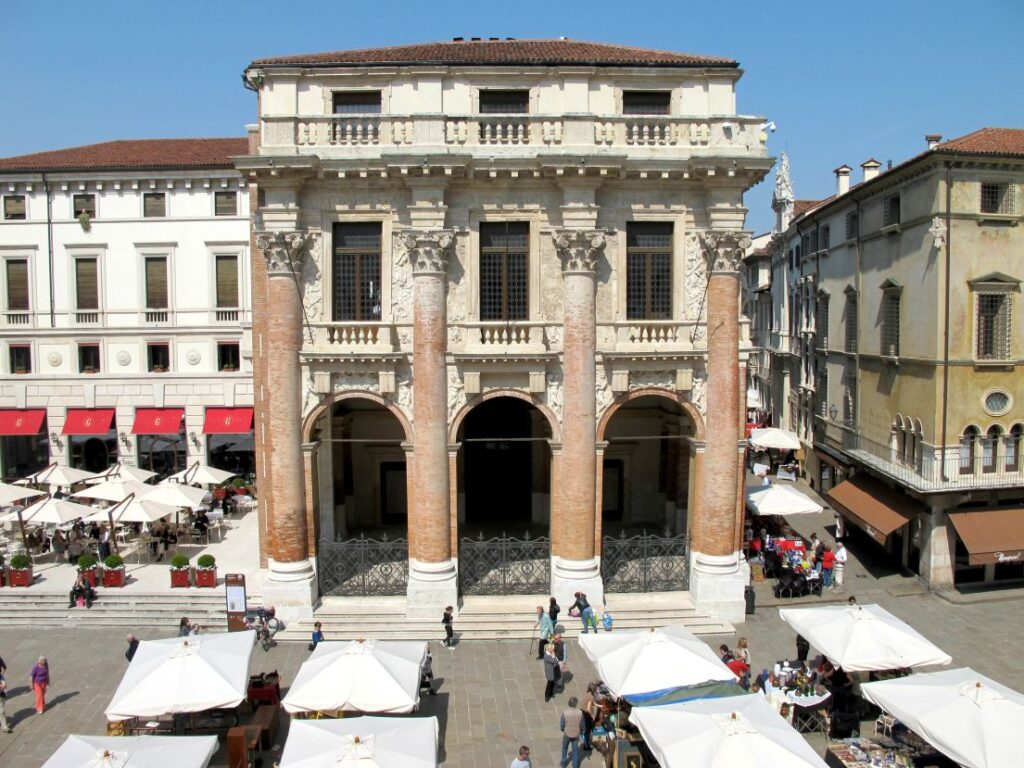
Directly across from the Basilica Palladiana — so close you see them together — the Palazzo del Capitaniato is another Palladio work, and one that shows a different side of his style. Where the Basilica is rhythmic and measured, this is bold and theatrical: a red-tinted facade with colossal semi-columns rising the full height of the building, massive arches, and decorative work that announces civic power with absolute confidence.
Palladio began the project in 1571, but it was never finished — only three of the intended five bays were built before funding ran out. The truncated end is still there if you look. Today it serves as Vicenza’s city hall. It’s part of the UNESCO-listed Palladian heritage, and worth a close look before you move on.
Two Pillars on the Square

Don’t leave Piazza dei Signori without noticing the two tall columns standing at the far end of the square near the piazzetta. They’re a symbol of Vicenza, quietly present in every view of the square, and most visitors walk past without a second glance.
One column — erected in 1473, after Vicenza came under Venetian rule — is topped by a winged lion of St. Mark, the symbol of the Republic of Venice. The other, added in 1640, carries a statue of Christ the Redeemer. Together, they tell the story of Vicenza’s dual identity: a Venetian subject city with its own deeply Catholic heart.
Andrea Palladio Statue
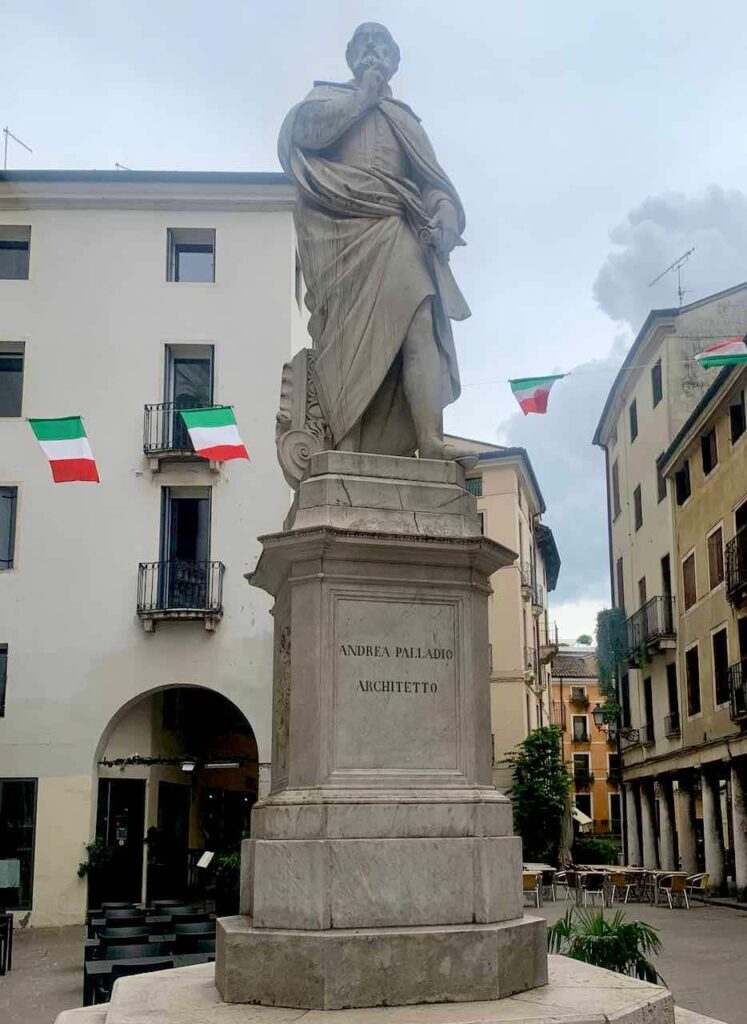
Standing beside the Basilica Palladiana, his white marble figure slightly larger than life, Andrea Palladio watches over the square he transformed. The statue was carved by Vincenzo Gajassi in 1859 — nearly three centuries after Palladio’s death — and placed here as a permanent tribute to the city’s most famous son.
It’s a small thing, a statue, but pausing in front of it and thinking about the scale of his influence — Monticello, the White House, every neoclassical bank building and country house in England, the entire Palladian revival across Europe — is genuinely moving. He was born in Padua, but Vicenza claimed him completely.
Corso Palladio
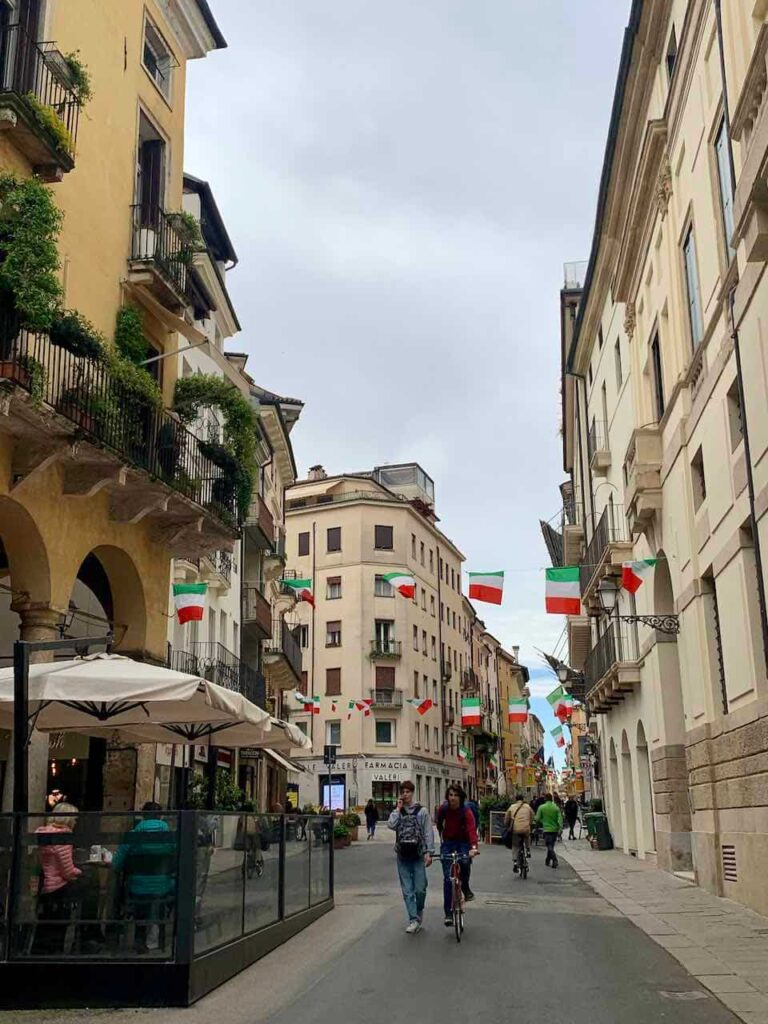
Corso Palladio is the city’s main thoroughfare — a 700-meter pedestrian street running from the Torrione tower at one end to the Teatro Olimpico at the other, cutting straight through the heart of the old town. You’ll walk it multiple times over any visit to Vicenza without noticing, because it’s where everything is.
The street is lined with grand palazzi (several by Palladio himself or his contemporaries), independent boutiques, wine bars, and pasticcerie. It’s where locals do their shopping and their socializing, where the morning espresso stops happen, and where the evening passeggiata unfolds. Walk it slowly, look up at the building facades, and duck into any courtyard that has its doors open — some of the most beautiful corners of Vicenza are invisible from the street.
The Church of Santa Corona
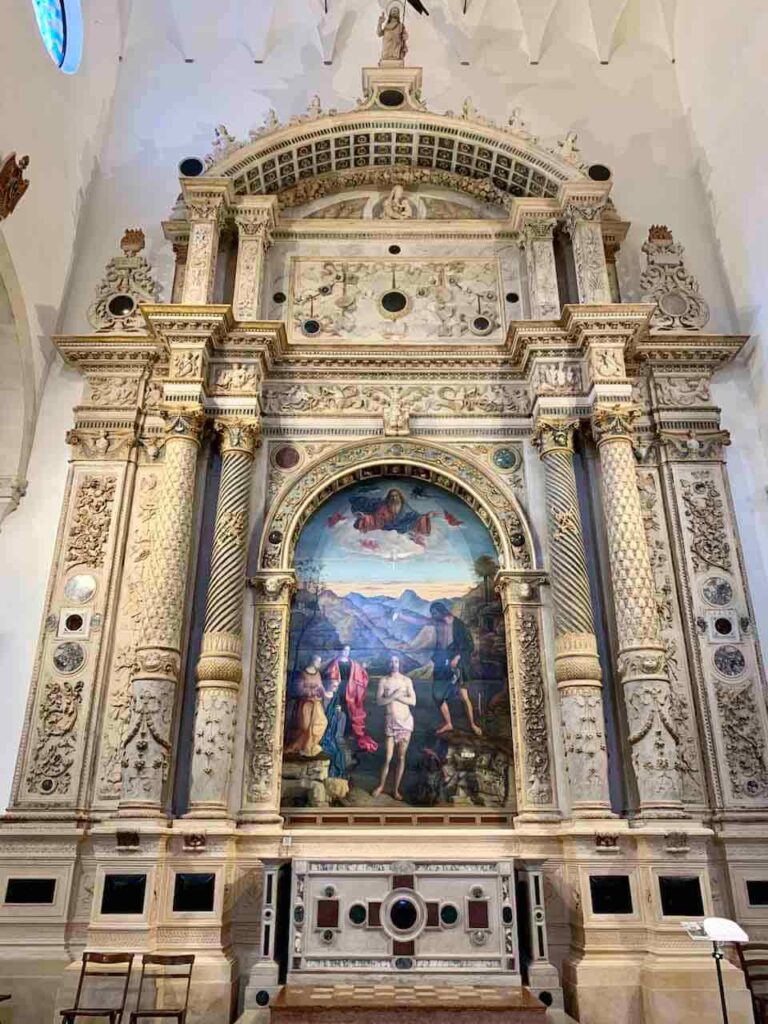
The Church of Santa Corona is the kind of place you walk into expecting ten minutes and come out an hour later, wondering where the time went. It’s a 13th-century Dominican church that holds, according to its founding tradition, a thorn from Christ’s crown — brought back from Paris by a bishop in 1261. That relic drew pilgrims here for centuries, and the church was enriched accordingly.
Inside, two paintings stop you completely: Giovanni Bellini’s Baptism of Christ (painted around 1500–1502), luminous and still, with that quality of light that makes Venetian Renaissance painting feel unlike anything else; and Paolo Veronese’s Adoration of the Magi, massive and exuberant, filling the far wall of a side chapel. Both are major works by major artists — and you’re standing in front of them in a quiet church in Vicenza with perhaps twenty other people.
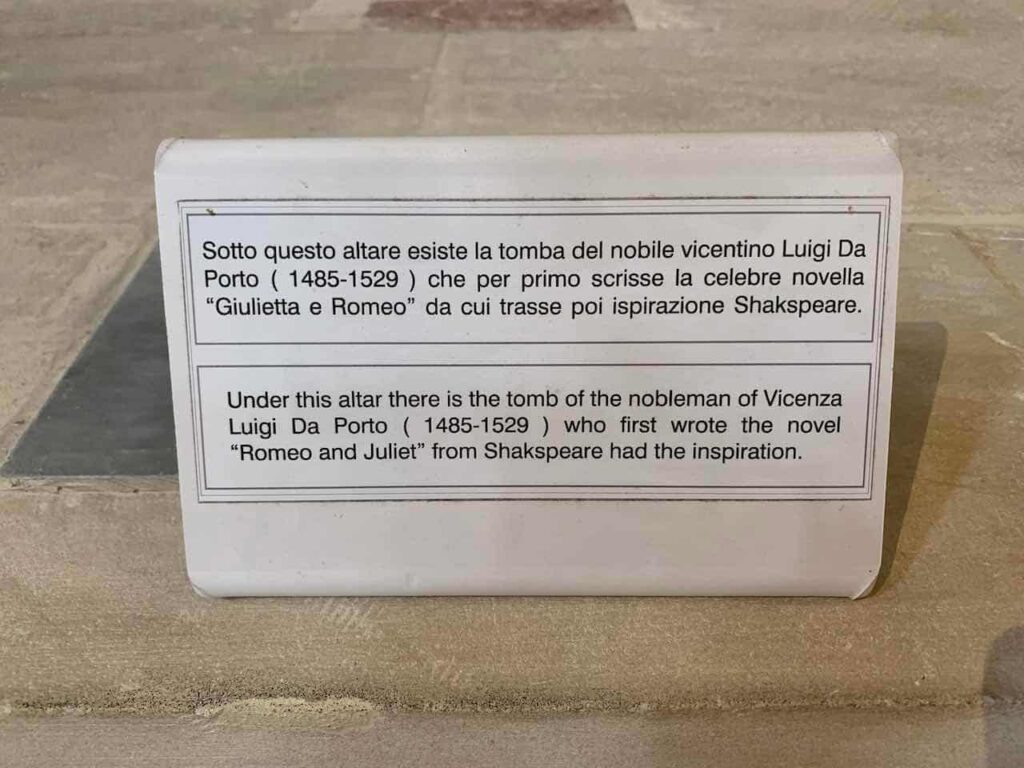
The Valmarana Chapel inside was designed by Andrea Palladio. And near the altar, the tomb of Luigi da Porto — of whom more below. Entry is covered by the Vicenza City Card.
Luigi da Porto’s House

Here’s the detail that makes people do a double-take: the original Romeo and Juliet wasn’t written by Shakespeare. It was written by a Vicentine nobleman named Luigi da Porto, around 1515, and his house is still standing on Contra Porti Street, number 15-17.
Da Porto was a soldier and minor noble who was wounded in battle and retired to his country villa near Montecchio Maggiore, where he could see two rival medieval castles facing each other across a valley. A local love legend, combined with that view, inspired him to write a novella about Romeo Cappelletti and Giulietta Montecchi — set in Verona, published in Venice in 1531. Shakespeare adapted the story sixty-six years later.
The house itself is an elegant Venetian Gothic building, not open to the public, but worth pausing at for a moment. Da Porto’s tomb is in the Church of Santa Corona, just nearby.
Palladio Museum

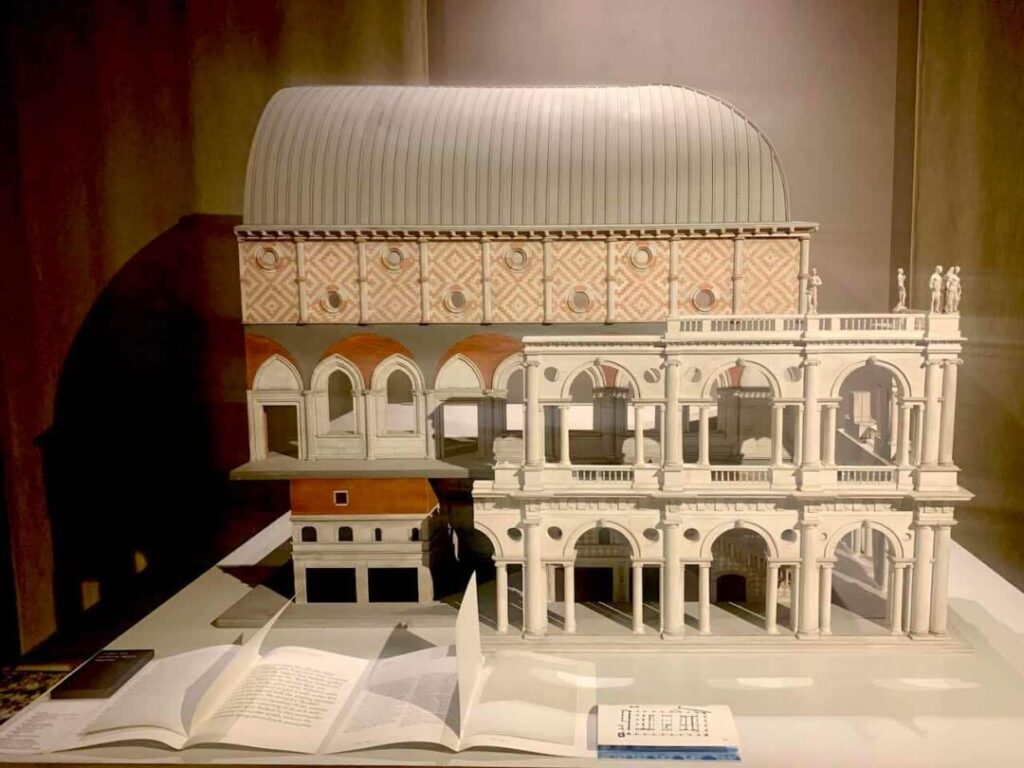
If the architecture on Vicenza’s streets has caught your eye and you want to understand it more deeply, the Palladio Museum is where to go. It’s housed in the Palazzo Barbaran — itself a building Palladio designed — and fills its rooms with scale models of his major villas, original drawings, architectural sketches, and scholarly material on his life and influence.
For architecture students and enthusiasts, this is genuinely a pilgrimage site. The scale models are extraordinary — they let you see, at a glance, how Villa La Rotonda or the Basilica Palladiana actually works in three dimensions. For travelers who came to Vicenza without much prior knowledge of Palladio and want to understand why the city matters, this is the best investment of an hour you can make. Covered by the Vicenza City Card.
Teatro Olimpico


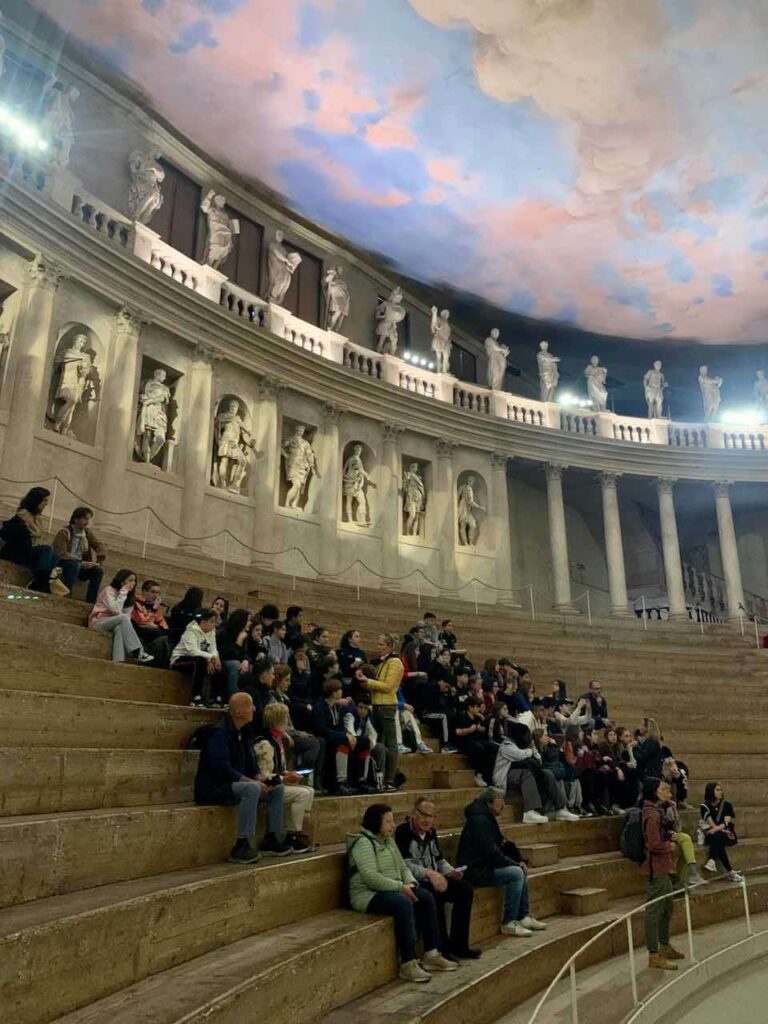
The Teatro Olimpico is the oldest surviving indoor theater in the world, and one of the most astonishing rooms I’ve ever stood in.
Palladio designed it late in his life — the project began in 1580 for the Accademia Olimpica, a society of humanist scholars. He died the same year construction started, and his collaborator Vincenzo Scamozzi completed the theater in 1585. The inaugural production was Sophocles’ Oedipus Rex, and for that performance, Scamozzi built a permanent 3D stage set depicting the streets of the ancient city of Thebes — in forced perspective, so the streets appear to recede far into the distance even though they’re only a few meters deep.
That stage set has never been removed. It’s still there, exactly as it was in 1585.
The elliptical auditorium is stucco and wood painted to look like marble. The back wall of the stage — the scaenae frons — is covered in classical statues and architectural ornamentation. The painted ceiling simulates an open sky. The overall effect is theatrical in the truest sense: a room designed entirely to create illusion and wonder. Give it at least 45 minutes. The garden outside the theater has beautiful statuary and is a quiet place to sit after the intensity of the interior. Covered by the Vicenza City Card.
Palazzo Chiericati
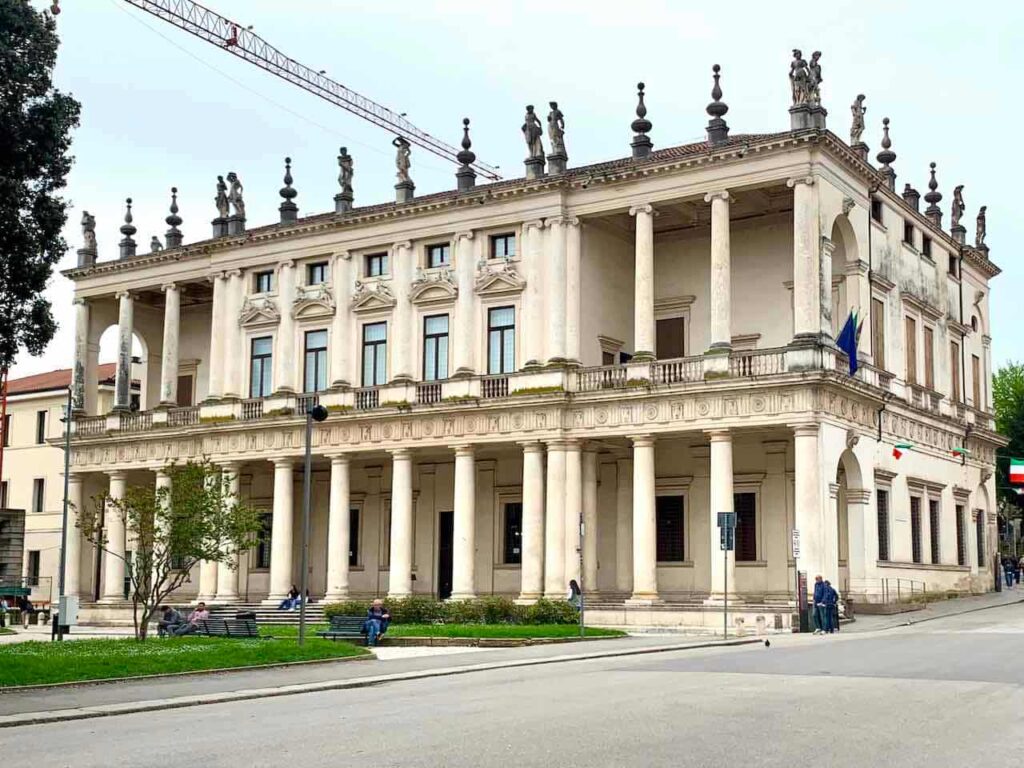

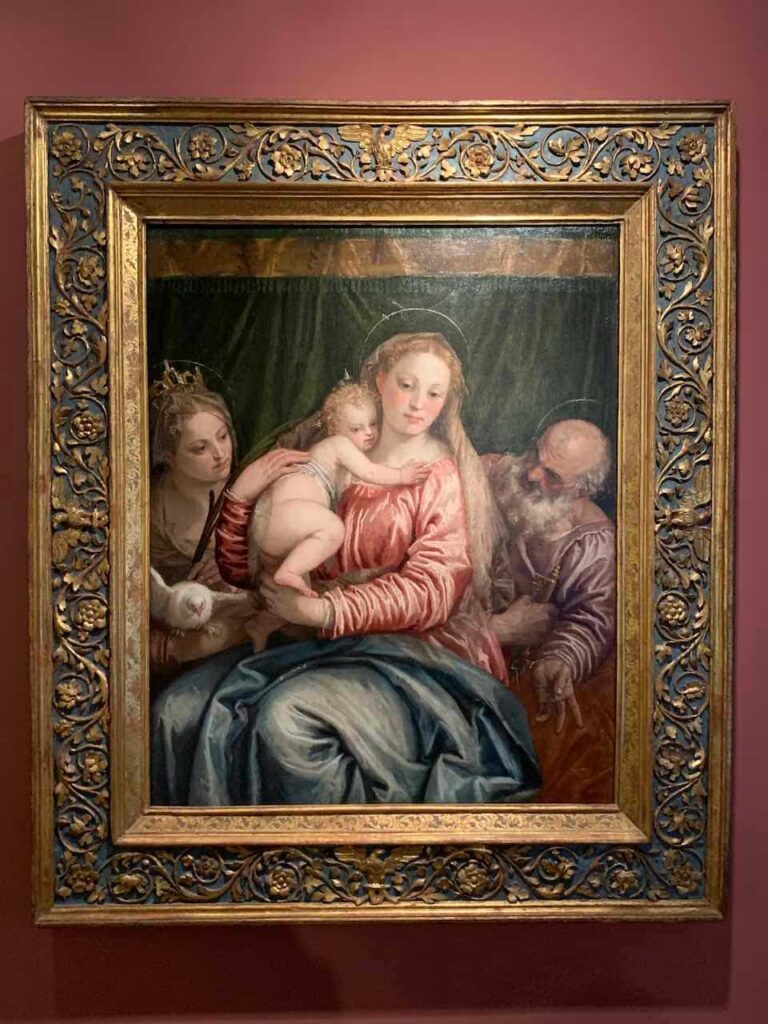
Two minutes from the Teatro Olimpico, the Palazzo Chiericati is another Palladio masterwork — and today houses the Civic Museum of Vicenza, with a collection of over 35,000 works spanning medieval to modern times.
The facade is typically Palladian: two levels of colonnaded loggias, perfectly proportioned, with statues along the roofline. Inside, the museum’s permanent collection includes significant works by Tintoretto, Veronese, Tiepolo, and Bartolomeo Montagna. I spent longer here than I planned, partly because the building itself is so beautiful, and partly because the Tiepolo ceiling frescoes in the upper rooms are genuinely spectacular.
Worth noting: the museum is never crowded. You can stand in front of major Renaissance paintings in near-solitude, which in Italy in tourist season is a rare gift. Covered by the Vicenza City Card.
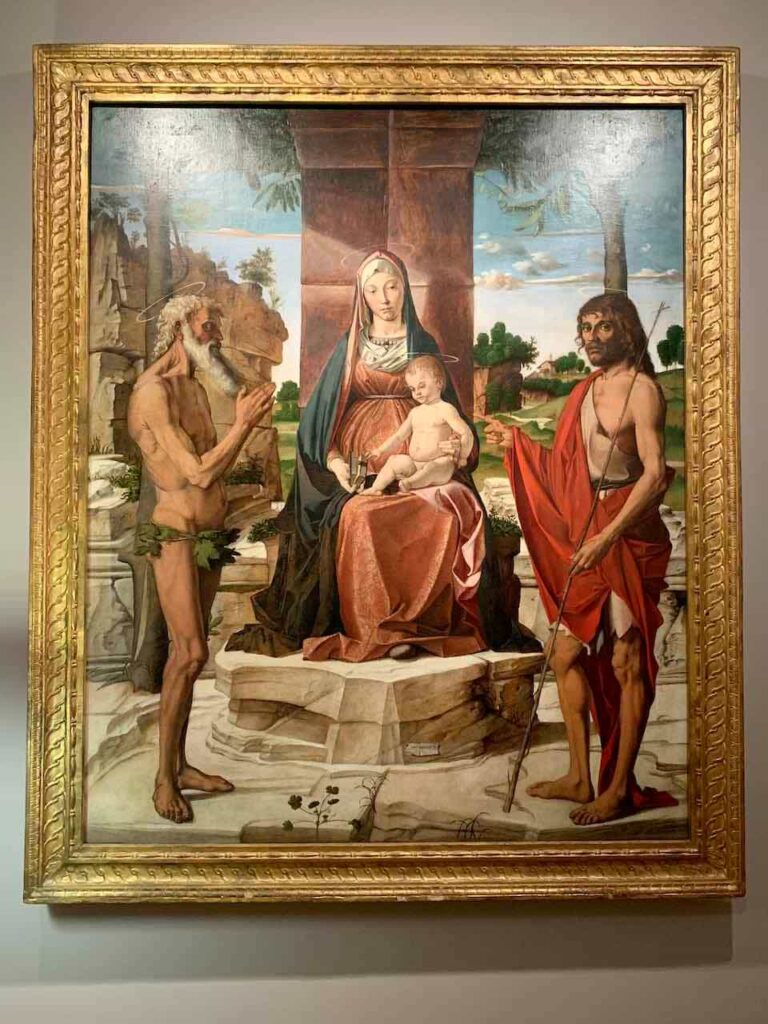
Vicenza Cathedral
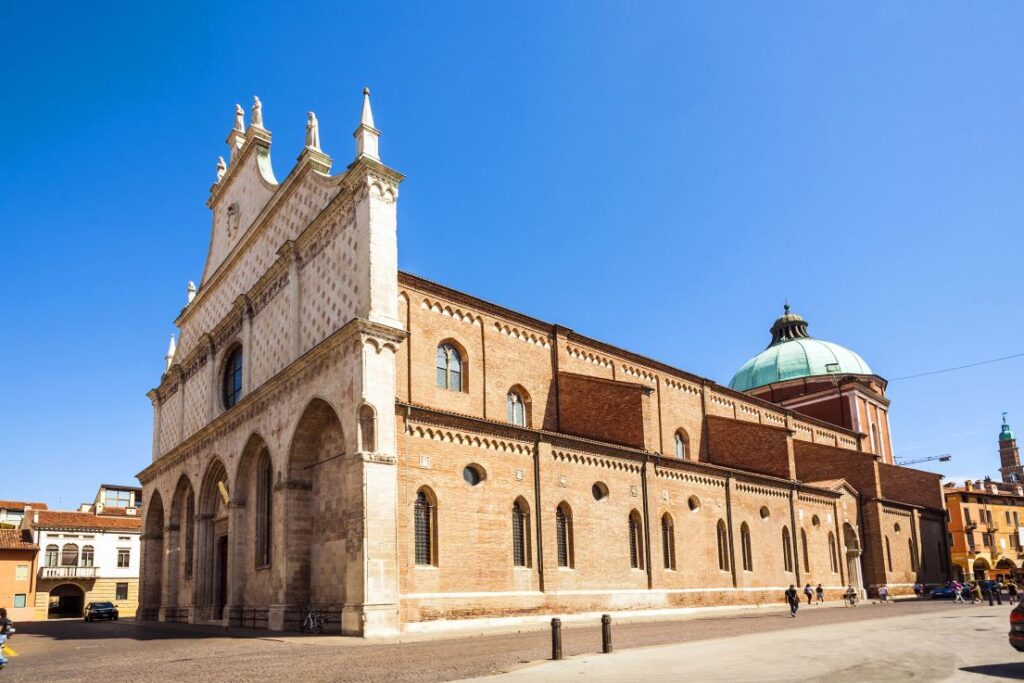
The Cathedral of Vicenza — the Duomo — sits a short walk from Piazza dei Signori and is often overlooked in favor of Palladio’s secular buildings. That’s a shame, because it has its own quiet dignity and a lovely Gothic-Renaissance facade that Palladio himself had a hand in completing.
The interior is spacious and calm, with a notable polyptych by Lorenzo Veneziano above one of the altars. The cathedral was heavily damaged in World War II and carefully restored — the resulting blend of original detail and restoration work is handled with more sensitivity than you’d expect. If you’re churched-out by this point, even a five-minute stop on the square outside gives you a good sense of the building.
Villa La Rotonda
Villa La Rotonda — officially the Villa Almerico Capra — is possibly the single most influential private building ever constructed. Palladio built it between 1566 and 1571 on a hilltop just outside the city center, and its design — a cube topped by a central dome, with four identical temple-fronted porticoes facing the four compass points — became a template copied across the world for the next four centuries.
Jefferson’s Monticello is the most famous example. Chiswick House in London, the Panthéon in Paris, innumerable neoclassical buildings across Europe and America — all trace their lineage here. Standing in front of it is one of those moments when you realize you’ve been looking at echoes of something your entire life without ever seeing the original.
The villa is about 2 km from the city center, an easy walk through a pleasant residential neighborhood. The grounds are open most days, and the interior is open on certain days — check the current schedule before visiting. This is the single most important thing to see outside Vicenza’s city center.
If you want to understand what you’re actually looking at — the geometry, the symbolism, the long shadow this building has cast across four centuries of Western architecture — consider booking the Tour of La Rotonda and Villa Valmarana with an Art Historian. Combining both villas in a single guided visit led by a specialist is genuinely one of the best ways to spend a half-day in Vicenza — you’ll leave with context that makes everything else in the city click into place.
Villa Valmarana ai Nani
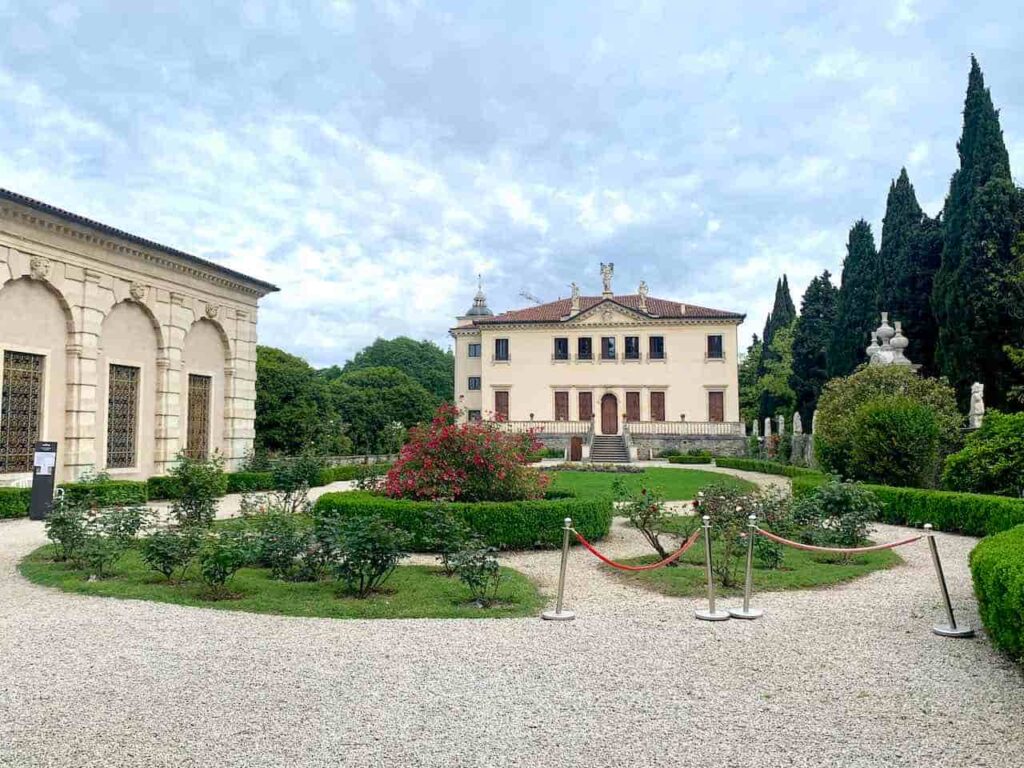
A 10-minute walk from Villa La Rotonda, Villa Valmarana ai Nani is famous for two things: the extraordinary frescoes by Giambattista Tiepolo and his son Giandomenico (painted in 1757), and the stone dwarf statues that line the garden wall and give the villa its popular name (ai Nani means “of the dwarves”).
The Tiepolo frescoes in the main building (Palazzina) depict scenes from classical mythology and Homeric epic — the Iliad, the Aeneid, Ariosto — with that swooping, theatrical, slightly dreamy quality that makes 18th-century Venetian painting so immediately appealing. The son’s frescoes in the guest house (Foresteria) take a more playful turn, with scenes of carnival and country life that have an almost modern freshness to them.
This is one of the great fresco experiences in Italy — less famous than the Scrovegni Chapel in Padua but more intimate, and genuinely moving. The art historian-guided tour combining La Rotonda and Villa Valmarana is the ideal way to visit both in a single outing — the expert commentary on Tiepolo’s iconography alone is worth it. Entry is not included in the Vicenza City Card — book your ticket separately.
The Sanctuary of Monte Berico

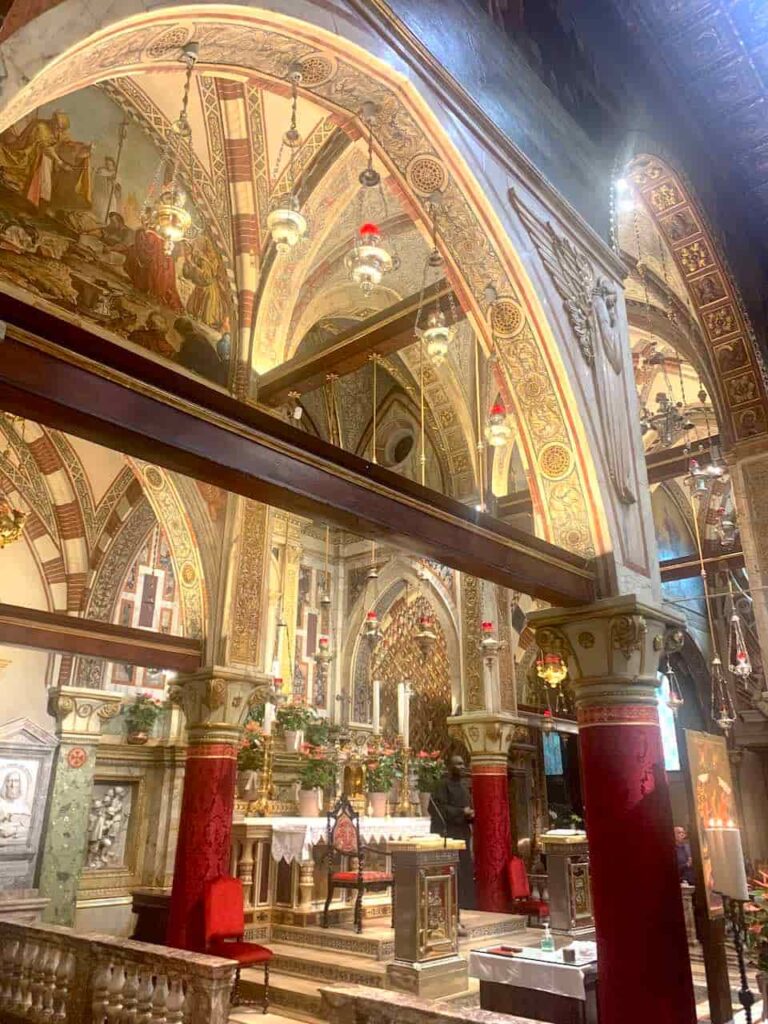
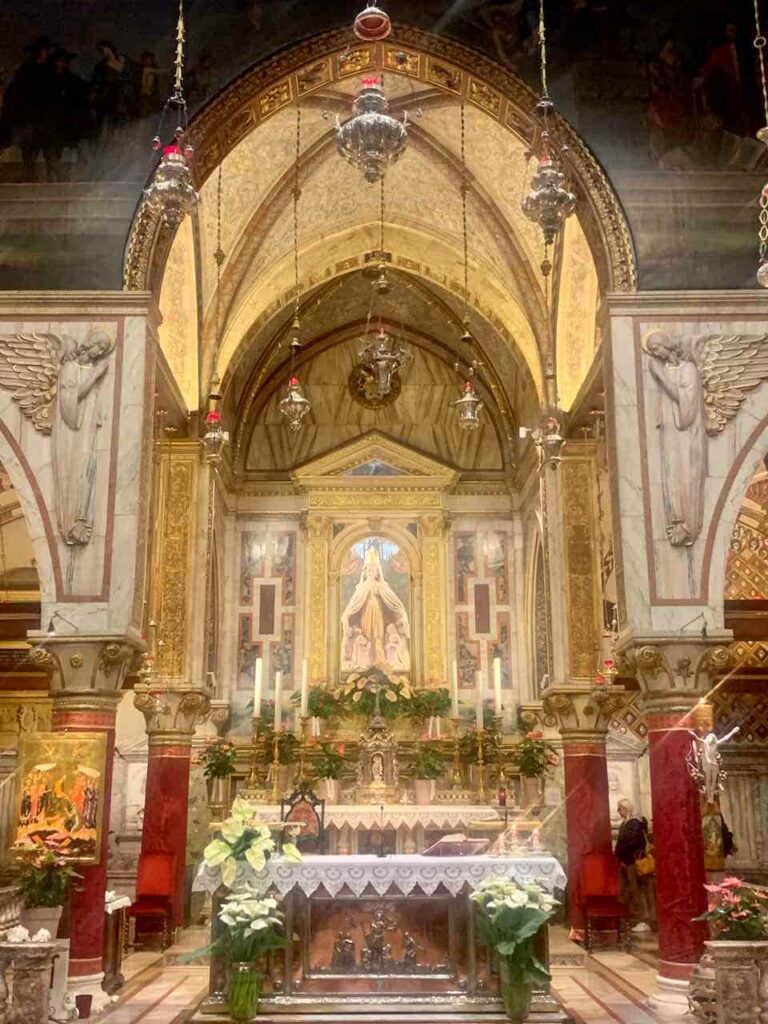
Monte Berico is the hill that rises immediately south of Vicenza’s city center, and the Sanctuary at its summit has dominated the city’s skyline and spiritual life since the 15th century. According to local tradition, the Virgin Mary appeared here twice in 1426 and 1428, asking for a church to be built as a refuge during a plague epidemic. The original sanctuary was built the following year.
The current Baroque church dates from the 17th century, rebuilt and expanded multiple times over the centuries. Inside, one work stands out above everything else: Paolo Veronese’s Feast of Saint Gregory the Great (1572), a massive canvas with something like 200 figures, originally painted for the refectory and now one of the most important works in the Veneto. The painting was badly damaged by French soldiers in 1848 — they slashed it into strips — and subsequently painstakingly restored. The story of its survival is almost as interesting as the painting itself.
The Sanctuary is free to enter and open daily. Combined with the panoramic terrace, the portico walk, and the villages below, it makes for a deeply atmospheric half-day away from the busy streets of the center.
Panoramic Terrace of Monte Berico

The terrace immediately in front of the Sanctuary of Monte Berico offers what is, in my view, the finest view of Vicenza. The entire city spreads below you — the rooftops, the towers, the dome of the Cathedral, the spires of the churches — and on clear days the view extends north to the pre-Alpine foothills and south across the Po Valley.
Go in the late afternoon when the light is warm and low. Bring something to drink and sit on the wall for a while. It’s the kind of view that makes you feel grateful you didn’t just stay on the train.
Portico of Monte Berico
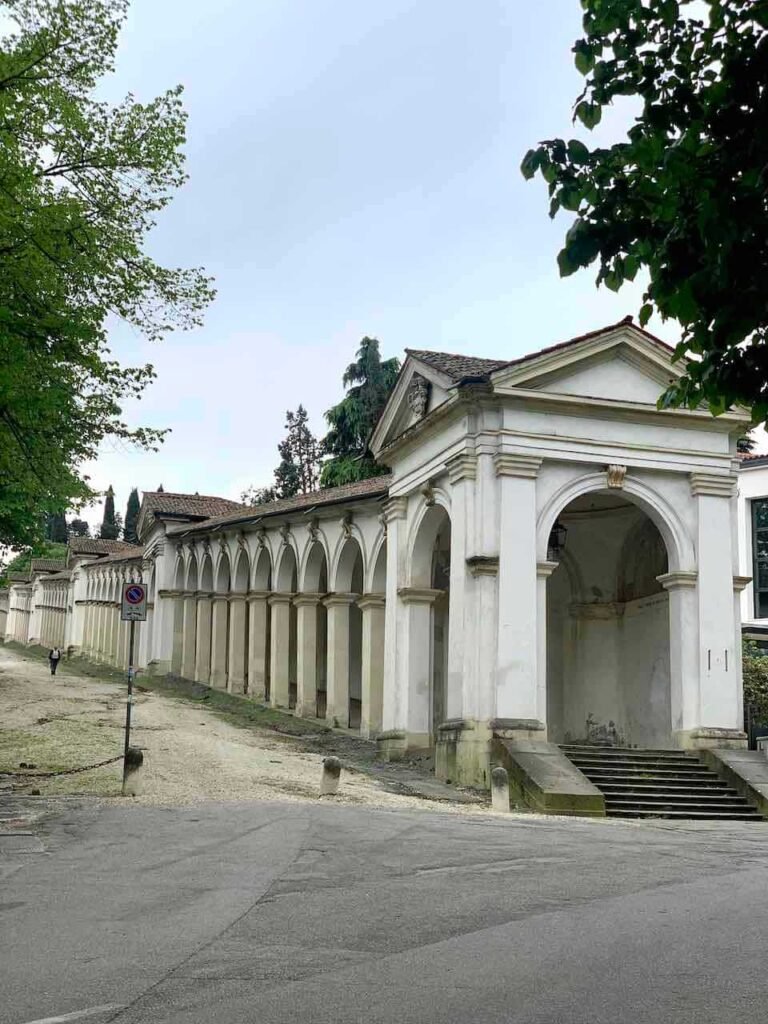
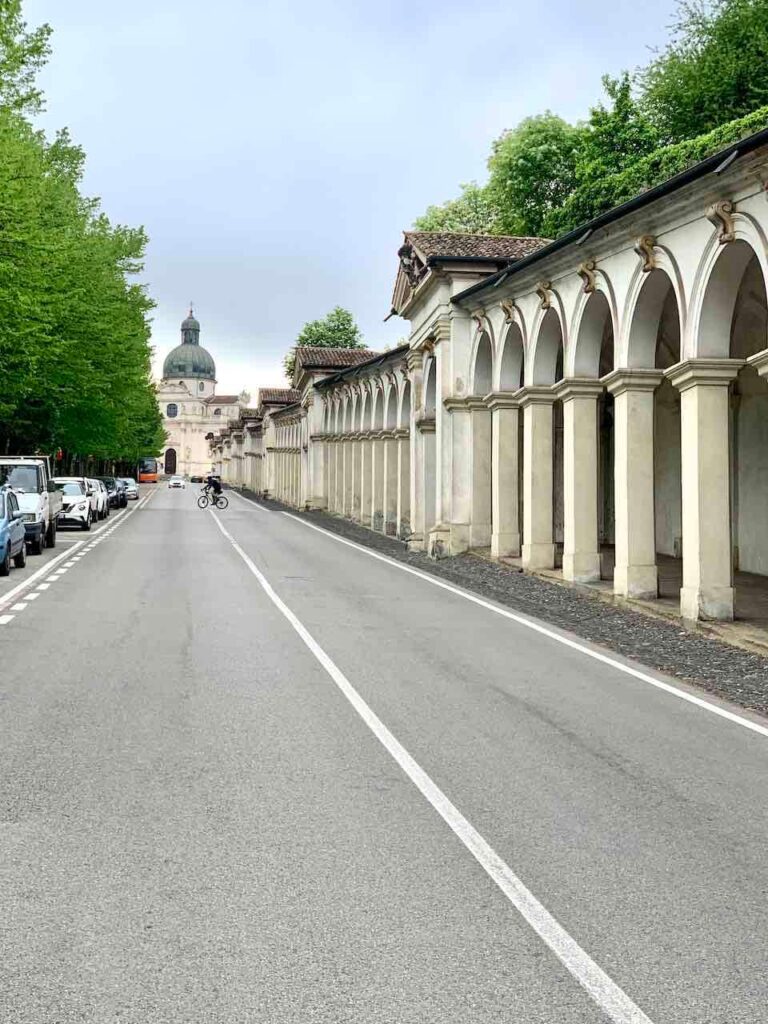
The long covered portico that climbs Monte Berico from the city below was built in the early 18th century, stretching nearly 700 meters up the hillside in a series of elegant baroque arches. It was designed to shelter pilgrims walking up to the Sanctuary in bad weather.
Today it’s a quiet, beautiful walk — the arches frame the view outward and the light filters through in long diagonal beams. Early mornings, before the city wakes up, you might have the whole portico to yourself. Walking it downhill on the return, with Vicenza spread out before you between the columns, is one of those small, perfect travel moments.
Arch of the Little Stairs

Where the Portico of Monte Berico meets the city below, there’s a small architectural junction that most visitors ignore: the Arco delle Scalette, or Arch of the Little Stairs. Designed by Andrea Palladio in the 1560s as a formal gateway marking the start of the ascent to the Sanctuary, it’s a modest triumphal arch of white stone that beautifully frames the portico’s beginning.
It’s the kind of detail that rewards the slow traveler — the person who’s walking rather than rushing, who notices what’s at the edge of their vision. Palladio is everywhere in this city, even in the corners.
Baccalà alla Vicentina
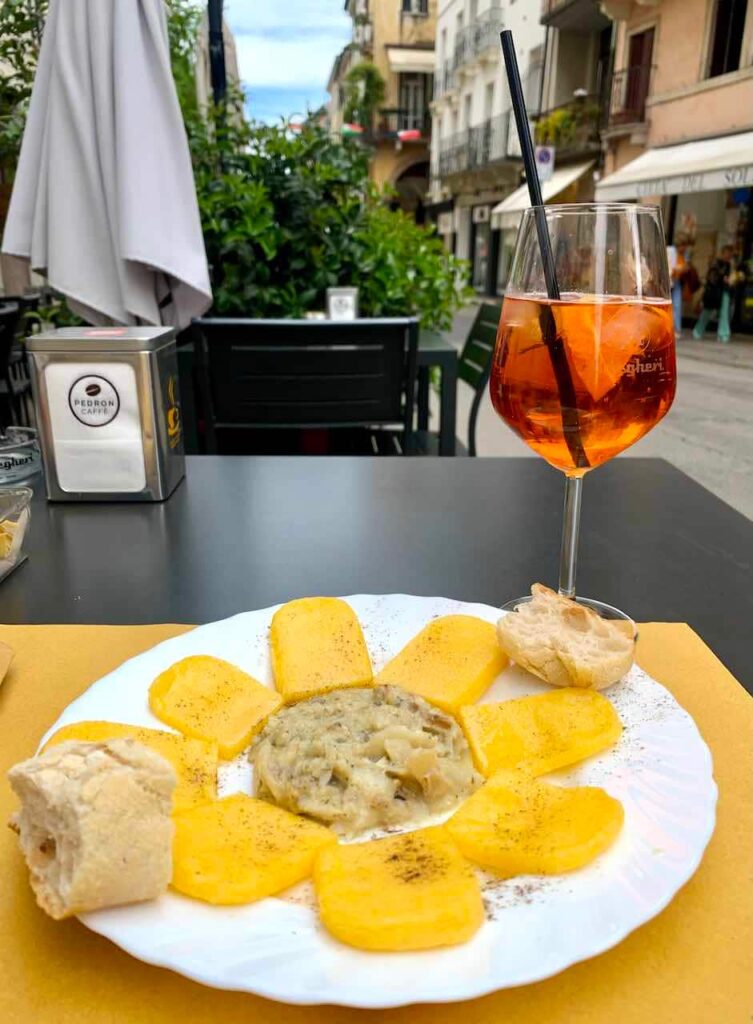
Vicenza’s most famous dish — and the one that Vicentini feel most strongly about — is baccalà alla Vicentina: salt cod (actually stoccafisso, dried cod, not salted) slowly cooked in milk with onions, anchovies, olive oil, and a dusting of Parmigiano Reggiano, served on a bed of polenta. It takes at least four hours to cook properly, sometimes more.
This is comfort food of the deepest kind — rich, silky, faintly oceanic, deeply savory. Despite being a landlocked city, Vicenza developed an obsession with dried cod during the centuries of Venetian Republic trade, and the tradition has never wavered. Every self-respecting trattoria in the city serves it on Thursdays and Fridays. Order it once, and you’ll understand why there’s an entire local confraternity dedicated to protecting the authentic recipe.
Sopressa Vicentina
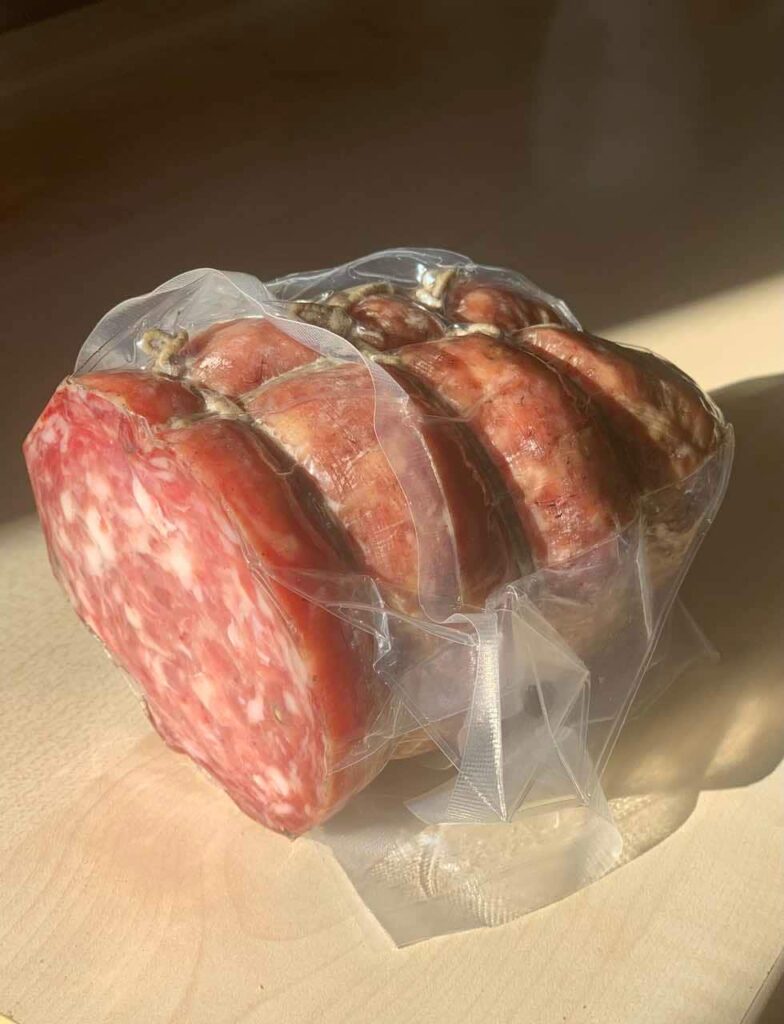
Less internationally famous than the baccalà but equally important to local identity, Sopressa Vicentina is a large, slow-cured salami made from coarsely ground pork with garlic, spices, and local herbs, aged for at least three months and sometimes up to two years. It has DOP status (Protected Designation of Origin), meaning the name is legally protected, and the production method is strictly defined.
In Vicenza, you eat sopressa the way it deserves to be eaten: sliced thick, at room temperature, with good bread and a glass of Gambellara or Soave white wine. Find it at any market stall, at the delis along Contra Porti and Corso Palladio, or as the opening act of a proper dinner at a local trattoria. Don’t leave without trying it.
Vicenza Itinerary
One day in Vicenza is enough to see the heart of the city and come away with a real sense of the place. Here’s how I’d structure it:
Morning (8:00 am – 1:00 pm) Start by picking up the Vicenza City Card at the Tourist Office on Piazza Matteotti 12 (opens at 9:00 am — arrive then, or plan your route to loop back). Walk straight to Piazza dei Signori. Spend time taking in the Basilica Palladiana from the outside, walk around the square, look at the columns, and find the Palladio statue. Go into the Basilica and take the elevator up to the rooftop terrace before the crowds arrive.
Move on to Torre Bissara (exterior), then walk to the Church of Santa Corona on Contra Santa Corona — allow 30–40 minutes inside for Bellini and Veronese. Continue to Contra Porti to see Luigi da Porto’s house, then duck into the Palladio Museum for an hour if architecture is your thing.
Afternoon (1:00 pm – 6:00 pm) Lunch at one of the trattorie around Piazza delle Erbe or on Corso Palladio (ask for baccalà alla Vicentina if it’s Thursday or Friday). After lunch, walk to Piazza Matteotti and visit the Teatro Olimpico — allow at least 45 minutes. Cross the square to Palazzo Chiericati for the Civic Museum (an hour at least for art lovers).
Walk south through town and up to Monte Berico — via the Portico if you want the scenic route, or through the city streets if energy is flagging. Visit the Sanctuary, and stand on the panoramic terrace for the view. Walk back down in time for an aperitivo.
Evening (6:30 pm onwards) Aperitivo in one of the bars in Piazza dei Signori or along Corso Palladio. Dinner at a trattoria serving Vicentine cuisine: baccalà, sopressa, local wines from the Colli Berici.
If you have a second day: Dedicate the morning to Villa La Rotonda and Villa Valmarana ai Nani (both are about 2–3 km south of the center — walk or take a taxi). Tour of La Rotonda and Villa Valmarana with an Art Historian. Spend the afternoon exploring the Vicenza cathedral and any corners of the old town you missed on day one.
Where to Eat in Vicenza
Vicenza has a proud and underappreciated food culture built on a few key local ingredients: dried cod, sopressa salami, polenta, local white wines from Gambellara and Soave, and the red wines of the Colli Berici. These are a few places worth knowing:
Trattoria Antico Guelfo — A classic local trattoria on Contra Pedemuro San Biagio, close to the Duomo. The baccalà alla Vicentina here is some of the best in the city — they cook it overnight, and it shows. Busy at lunch, so book ahead or arrive at 12:30.
Osteria Il Cursore — Small, old-fashioned, and beloved by locals. The menu changes with the season and uses Vicentine produce throughout. The risotto with local asparagus (in spring) is outstanding. On Corso Palladio.
Righetti — A self-service lunch spot in Piazza Duomo that locals have been eating at for decades. Exceptional value, generous portions, and genuinely good home cooking. No reservation needed — just join the queue.
Bar Borsa and Il Grottino — Both located in the ground-floor arcades of the Basilica Palladiana. Historic bars serving excellent coffee, aperitivo, and small plates. Il Grottino has particularly good wine by the glass. The perfect spot for a morning espresso with a view of the square.
Antica Pasticceria Sorarù — The city’s most respected pastry shop, near Basilica Paladina. Try the torta Vicentina and the local almond biscuits.
For food inspiration across the wider Veneto region, check my guide to the best food in Venice Italy — many of the same ingredients and traditions appear here in Vicenza, just with a less tourist-facing price tag.
Hotels in Vicenza
Vicenza is small enough that staying in or immediately adjacent to the historic center puts everything within walking distance. These are the options I’d consider:
Relais Santa Corona — A boutique hotel inside a renovated historic building on Contra Santa Corona, steps from the church of the same name and close to everything in the old town. Quiet, well-run, with private parking for road trippers. My recommendation for a comfortable, well-located mid-range stay.
Hotel Campo Marzio — A larger, well-appointed hotel just outside the historic center (5 minutes on foot from Piazza dei Signori). Good restaurant, parking, and reliable service. Popular with business travelers but perfectly suited for tourists.
Hotel Cristina — Good value, clean, and close to the train station. Best choice if you’re using Vicenza as a base and moving around the Veneto by train.
One practical note: staying in Vicenza and day-tripping to Venice is a genuinely smart move if you’re on a tighter budget. Hotel prices here are considerably lower than in Venice, and the train from Venice takes under an hour. You get the best of both cities.
Frequently Asked Questions About Vicenza
Is Vicenza worth visiting?
Yes — genuinely and enthusiastically. Vicenza is a UNESCO World Heritage City with extraordinary architecture, real local food culture, and far fewer crowds than Venice or Verona. It consistently surprises visitors who arrive with low expectations.
What is Vicenza Italy known for?
Vicenza is known for Andrea Palladio and his Renaissance architecture, UNESCO World Heritage status, the Teatro Olimpico (the world’s oldest indoor theater), Villa La Rotonda, and baccalà alla Vicentina. It’s also the city where the original story of Romeo and Juliet was written.
How do I get from Vicenza to Venice?
By train, the Vicenza to Venice journey takes between 45 minutes and 1 hour. Trains run regularly throughout the day from Vicenza station. It’s the easiest and most practical connection.
What airports are near Vicenza Italy?
The closest airports to Vicenza are Venice Marco Polo Airport (about 75 km, roughly 1 hour by car) and Verona Villafranca Airport (about 55 km). Both have regular train connections to Vicenza.
Is there a train station in Vicenza Italy?
Yes — Vicenza has a main train station, Stazione di Vicenza, located at the western edge of the historic center. It’s on the main Milan–Venice line and is served by regional trains, Intercity, and high-speed Frecciarossa services.
How far is Vicenza from Rome?
Vicenza is approximately 570 km from Rome by road, or about 3 hours 15 minutes by high-speed Frecciarossa train with a connection in Padua or Venezia Mestre.
What are the best day trips from Vicenza?
The best day trips from Vicenza include Padua (25 minutes by train), Venice (about 1 hour by train — see our guide to the best day trips from Venice for the reverse trip), Verona (30 minutes by train), and the Palladian Villas scattered across the Vicenza countryside.
How much time do I need in Vicenza?
One full day is enough to see the essential highlights. Two days is ideal if you want to include the villas outside the center (Villa La Rotonda, Villa Valmarana ai Nani) and explore at a comfortable pace.
My Favorite Experience in Vicenza
If I had to pick one moment from my time in Vicenza, it wouldn’t be the most famous sight. It would be the late afternoon I walked up to the panoramic terrace of Monte Berico, sat on the low stone wall with a coffee from the little bar beside the Sanctuary, and watched the light change over the city below.
The rooftops, the towers, the dome of the cathedral, the curve of the Bacchiglione river catching the last light — and in the far distance, the faint white line of the Dolomites, still holding snow. Vicenza is compact enough that you can see almost all of it from that hill. And it’s beautiful in a way that doesn’t announce itself. It just sits there, four-hundred-year-old buildings going about their day, residents cycling home through Palladio’s arcades, a city that has never needed anyone’s approval.
That’s what I love about Vicenza. It’s not trying to impress you. It just is.
Final Thoughts
Vicenza, Italy is one of those cities that rewards the traveler who chooses it deliberately rather than ending up there by accident. It is not Venice, which is both its advantage and its identity. It’s quieter, more local, more affordable, and architecturally perhaps more coherent — because one man’s vision shaped so much of it, and that vision was extraordinary.
The top things to do in Vicenza are genuinely world-class: the Teatro Olimpico is unlike anything else in Italy; Villa La Rotonda is a pilgrimage site for anyone who has ever looked at a neoclassical building; the Basilica Palladiana’s rooftop terrace is one of the great free views of northern Italy; and the baccalà alla Vicentina, eaten slowly at a trattoria table on a Thursday afternoon, is comfort food of the highest order.
Come for a day. Stay for two. Consider making it your base for a wider Veneto adventure — Padua to the east, Venice just beyond that, Verona to the west. The train connections are fast and cheap, and Vicenza sits in the middle of all of it, quiet and magnificent, waiting for you to arrive.
Planning a Veneto trip? Don’t miss these guides: