Why Bologna Is Italy’s Most Delicious City (+ 20 Amazing Things to Do)
Bologna might be the most underrated city in Italy — and I say that as someone who has spent a lot of time in Rome, Florence, and Venice. It has the oldest university in the world, a food scene that makes the rest of Italy jealous, UNESCO-listed porticos stretching for 38 kilometers, and medieval towers that lean further than Pisa’s. Yet it sees a fraction of the tourist traffic of its more famous neighbors.
My first impression of Bologna was unexpected. On my first visit to Bologna, I’d come from Florence. But, despite still being full of Renaissance grandeur, nothing had prepared me for the energy of Bologna — the piazzas buzzing with a mix of locals and students, old men arguing outside a bar next to a group of twenty-year-olds with espressos, a woman carrying a paper-wrapped parcel of mortadella weaving through it all. It had the kind of atmosphere that’s impossible to manufacture: genuinely alive, a little chaotic, completely itself.
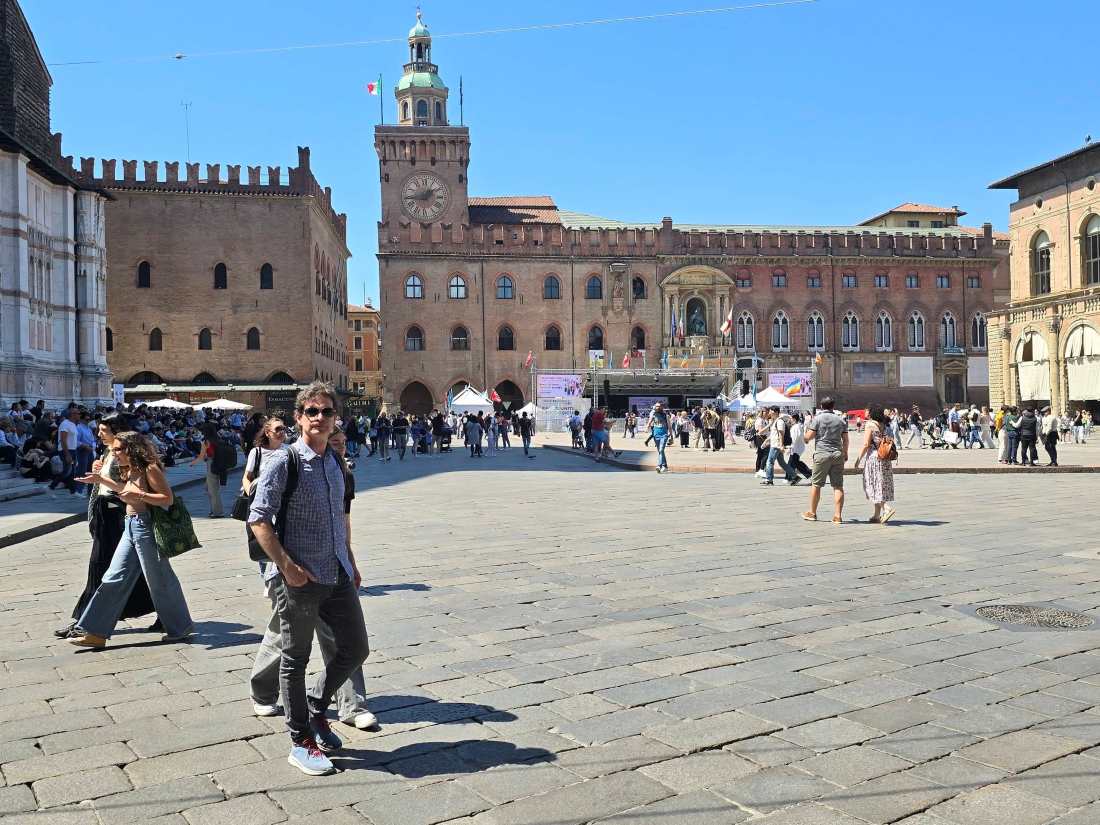
I found myself in Piazza Maggiore without quite knowing how I’d gotten there, and I just stopped. The square was enormous but not empty — it hummed. The smell of coffee and something cured drifted from a side street. Students cutting across on bicycles. A city that clearly had no interest in slowing down for tourists. By dinner — tagliatelle al ragù, a carafe of local Sangiovese, a room full of Bolognesi eating exactly the same thing — I understood why people who know Italy well always put Bologna near the top. It gets under your skin fast.
This guide covers everything you need to know: the best things to do in Bologna Italy, practical tips, a Bologna itinerary, where to eat, where to stay, and the best day trips from the city. Whether you’re here for a weekend or using it as a base for the Emilia-Romagna region, Bologna will surprise you.
📌 Bologna at a Glance
- Location: Emilia-Romagna, northern Italy
- Best time to visit: April–June, September–October
- Time needed: 2–3 days
- Famous for: World’s oldest university, ragù, porticos, medieval towers
- Crowds: A fraction of Florence or Venice
Top Bologna Tours Worth Booking in Advance:
- 🍝 Bologna Walking Food Tour with Private Tour Option — the best single introduction to Bologna’s food culture, hitting the key markets, producers, and tastings in one well-paced morning
- 🍷 Emilian Gastronomic Experience with a Local — a deeply local take on Emilian food and wine that goes well beyond what most tourists ever taste
- 🏛️ Bologna City Walking Tour — a solid guided walk through the historic center that puts the architecture, history, and porticos in proper context
- 🧀 Italian Food Experience: Parmigiano Reggiano Factory, Wine & Vinegar Tasting — a rare chance to see how Italy’s most iconic cheese and vinegar are actually made, with tasting and lunch included
- 🍽️ Do Eat Better: Bologna Traditional Food and Wine Tour — pairs local Emilian wines with traditional food stops in a way that makes the whole regional picture make sense
- 🛒 Bologna Food Tour from a Local Perspective — skips the tourist trail and takes you to the spots locals actually use, with a guide who genuinely knows the city
- 🍝 Exclusive Bologna Cooking Class: Pasta, Tagliatelle, Ragù & Spritz — you make tagliatelle and ragù from scratch, then eat what you’ve made with a Spritz; the best possible Bologna evening
- 🧀 The Secrets of Parmigiano Reggiano and Balsamic Vinegar — goes behind the scenes at a cheese dairy and a balsamic acetaia, revealing why these products are in a category of their own
- 🏎️ Ferrari, Lamborghini & Pagani Tour — a full Motor Valley day from Bologna, visiting three of the world’s most legendary car manufacturers in their home territory
Rent a car and visit Bologna on a road trip
- Discover Cars – no hidden costs, free cancellation
Book Your Stay in Bologna:
- Grand Hotel Majestic già Baglioni (luxury): Hotel Corona d’Oro (mid-range), or Albergo Panorama (budget)

What to Know Before You Visit Bologna
Is Bologna Worth Visiting?
Yes — Bologna is absolutely worth visiting. It has a way of turning first-timers into regulars — the food alone is reason enough to come back, and the city keeps giving you more reasons after that.
Bologna has the world’s oldest university, the longest porticoed street on earth, one of the largest churches in the world, and a food culture so rich that the city earned the nickname La Grassa (the Fat One) centuries ago. It sits between Florence and Venice and is easily reached from both — but it draws far smaller crowds, which means you can actually experience it. If you’re tired of fighting tourists for a table or a view, Bologna is where you go. It is, in my view, one of the most complete cities in Italy.

What is Bologna Known For?
Bologna is famous for several things that make it genuinely singular:
- The world’s oldest university — Founded in 1088, the University of Bologna predates Oxford. The city has been a center of learning for nearly a thousand years.
- Bolognese ragù — What the world calls “Bolognese sauce” was born here, and the real version — slow-cooked meat, barely any tomato — is transformative.
- The porticos of Bologna — Over 38 km of covered arcaded walkways run through the city, now a UNESCO World Heritage Site.
- The Two Towers — Garisenda and Asinelli, medieval towers that lean more dramatically than the Tower of Pisa.
- Piazza Maggiore — One of the oldest and finest city squares in Italy, surrounded by magnificent Gothic and Renaissance buildings.
- Mortadella and Parmigiano Reggiano — Bologna is the capital of Emilia-Romagna, the region that produces Italy’s most celebrated cured meats and cheeses.
- La Rossa (the Red One) — The city’s famous red-tiled rooftops give it a distinctive warm glow from any viewpoint.
Where is Bologna?
Bologna is located in the Emilia-Romagna region of northern Italy, sitting at the foot of the Apennine Mountains in the Po Valley. It lies roughly midway between Milan (210 km northwest) and the Adriatic coast, and is exceptionally well-connected to Italy’s major cities: Florence is just 45 minutes away by high-speed train, Venice is 85 minutes, and Rome is around 2 hours 10 minutes. This central position makes Bologna one of the best-connected cities in Italy, and one of the most logical bases for an Italian trip.
How to Get to Bologna
By train: Bologna Centrale is one of Italy’s main rail hubs, served by all major high-speed and regional services. Trenitalia’s Frecciarossa runs frequently to Florence (45 min), Rome (2h10), Milan (1h), and Venice (1h25). The station is a short walk from the city center.
By plane: Bologna Guglielmo Marconi Airport (BLQ) is located just 6 km from the city center. A dedicated Aerobus shuttle connects the airport to Bologna Centrale station in about 30 minutes.
By car: Bologna sits at the junction of the A1 (Milan–Naples), A13 (Padua), and A14 (Venice–Rimini) motorways. Note that the historic center has a ZTL (restricted traffic zone) — park in one of the peripheral car parks and walk or take public transport.
How Many Days Do You Need in Bologna?
Two full days is the ideal minimum; three gives you room to breathe and explore.
With two days, you can cover the main piazzas, churches, towers, the Archiginnasio, the porticos, and the food markets, with time for a proper food experience. Add a third day, and you have space for the Sanctuary of San Luca, a cooking class, or a day trip to Modena or Parma. Bologna also works brilliantly as a weekend from Florence or Venice — the train connections make it genuinely easy.
Best Time to Visit Bologna
The best time to visit Bologna is April to June and September to October, when temperatures are comfortable, the light is beautiful, and the city is lively without being overwhelmed.
July and August are hot — Bologna’s position in the Po Valley means summer humidity can be intense — and many locals leave for the coast. The city still functions well for tourists in summer, and the outdoor film festival on Piazza Maggiore (see below) is a genuine reason to visit in July and early August.
Spring and autumn are the sweet spot: outdoor markets are at their best, food festival season runs through October, and the light on those red rooftops is extraordinary. Winter is cool and can be foggy, but Bologna at Christmas, with its warm arcades and festive food stalls, has a charm of its own.
Map of the Best Things to Do in Bologna
Getting Around Bologna
How to Get Around Bologna
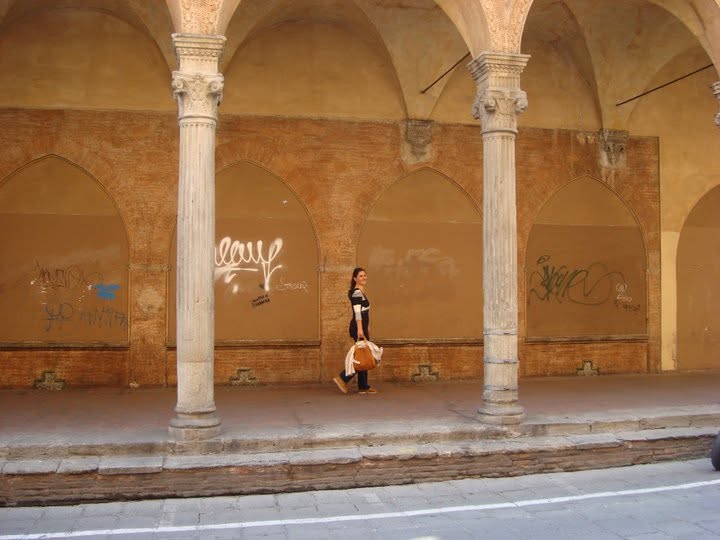
Bologna’s historic center is one of the most walkable in Italy. The main sights — Piazza Maggiore, the Two Towers, the Archiginnasio, the Mercato di Mezzo — are all within 10–15 minutes of each other on foot, and the porticos mean you rarely get rained on or sunburned while walking between them.
For the Sanctuary of San Luca (outside the center on a hill), there’s a small funicular railway that runs seasonally, or you can walk the full portico route (more than 3.8 km each way). City buses cover the wider urban area, and taxis and ride-hailing apps are available.
The best way to discover the city is with a local — these tours are all excellent starting points:
- 🚶 Bologna in One Day: Art, History & Gastronomy — a comprehensive introduction that covers all the essential highlights
- 🤝 Private & Personalized Experience: See Bologna with a Local — for a fully tailored visit at your own pace
- 🏛️ Bologna City Walking Tour — a classic guided walk through the historic center
- 🚲 Private Guided E-bike Tour in Bologna — the best way to cover more ground and see neighborhoods beyond the tourist trail
Practical Tips for Visiting Bologna
- Book food tours in advance. The best food experiences — market tours, cooking classes, factory visits — fill up fast, especially in spring and autumn.
- Dress modestly for churches. Covered shoulders and knees are expected at San Petronio, the Archiginnasio, and other religious sites.
- Go to the Mercato di Mezzo early. The food market gets busy by mid-morning. Get there at 9 am for the best experience.
- Bologna is a university city. The student population keeps the food and drink scene excellent and affordable — take advantage.
- Use Bologna as a base. Hotels are far cheaper here than in Florence or Venice, and both cities are under 90 minutes by train. See my guides to the best day trips from Florence and best day trips from Venice for inspiration on how to plan the wider region.
- Sunday is quiet. Many shops and some restaurants close on Sunday mornings. The porticos and piazzas, however, are open and beautiful.
Best Things to Do in Bologna
1. Visit Piazza Maggiore
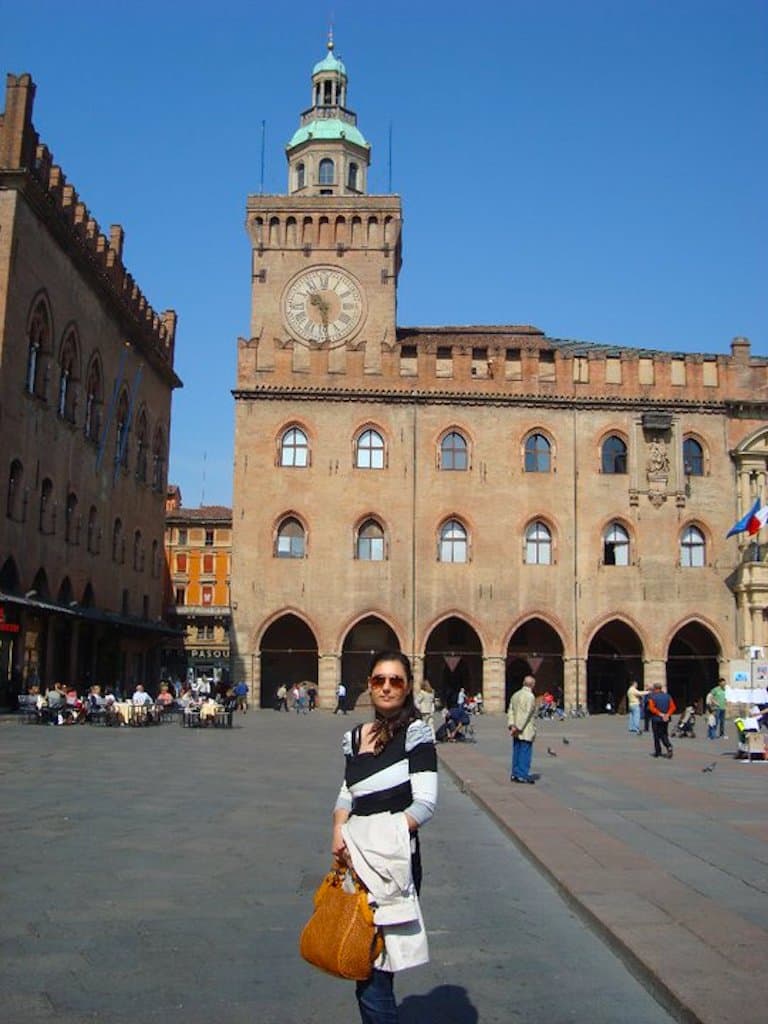
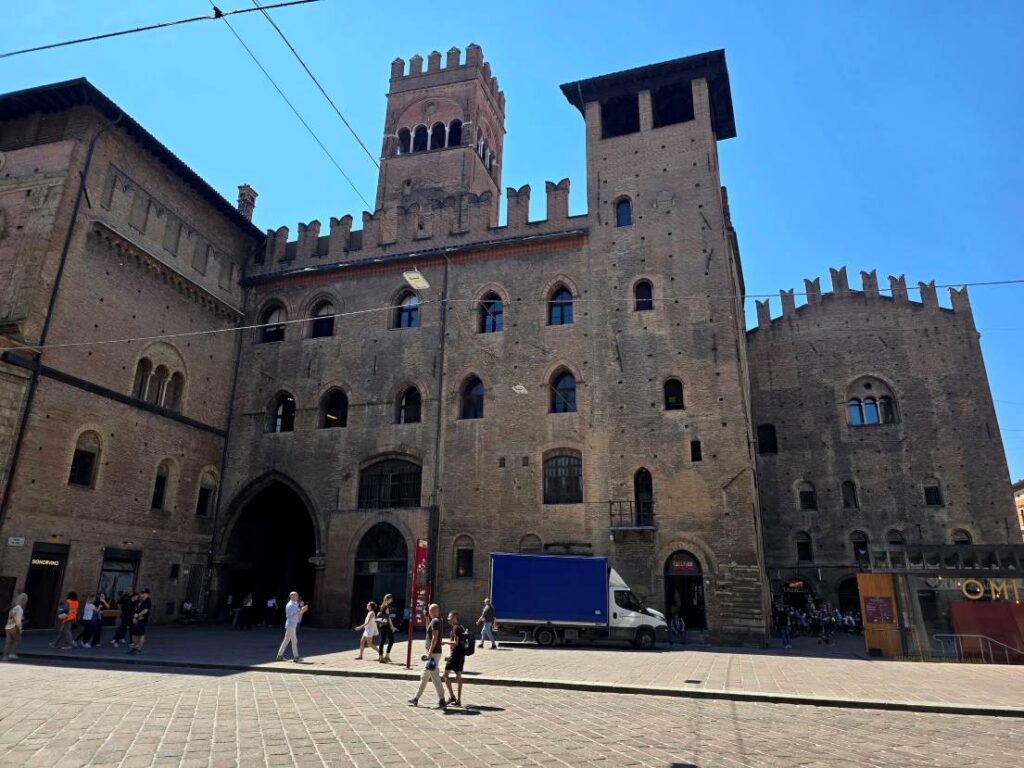
Piazza Maggiore is where Bologna announces itself. I arrived here on a Tuesday morning with no particular agenda, and I stood in the middle of this vast medieval square and felt the city make sense all at once. The scale surprises you — the Basilica of Saint Petronius (Basilica of San Petronio ) on one side, the Palace of Notaries (Palazzo dei Notai ) on another, Accursio’s Palace (Palazzo d’Accursio – the old seat of city government) on a third. Pigeons. A man reading a newspaper on the steps. Students cutting across on bicycles.
The square has been the heart of Bologna since the 12th century, when it served as a marketplace and public gathering point. That civic energy hasn’t left. On summer evenings, Piazza Maggiore fills up again — aperitivo crowds, outdoor screenings, people just being in a city that knows how to live. Start every morning here, and end some evenings here too. It’s the kind of place that keeps giving you something new.
2. See Basilica di San Petronio

San Petronio stops you dead. It’s the tenth-largest church in the world, and that scale hits you from across the piazza — this enormous Gothic brick building with an unfinished marble facade that was never completed and now tells its own story about ambition, money, and the passage of centuries. Step inside and the interior amplifies everything: the nave stretches seemingly forever, the stained glass throws light in long colored bars across the stone floor, and somewhere in the middle of the right aisle, there’s a sundial line — a meridiana — that was used by astronomers to reform the calendar.
San Petronio is a church, a civic monument, and a scientific instrument all at once. Dress modestly, go in the morning, and allow at least 45 minutes to absorb it properly. It is free to enter. However, there is a small fee of €5.00 for some parts (the Bolognini Chapel, San Sebastiano, San Vincenzo, and the small church museum).
3. Visit the Fountain of Neptune
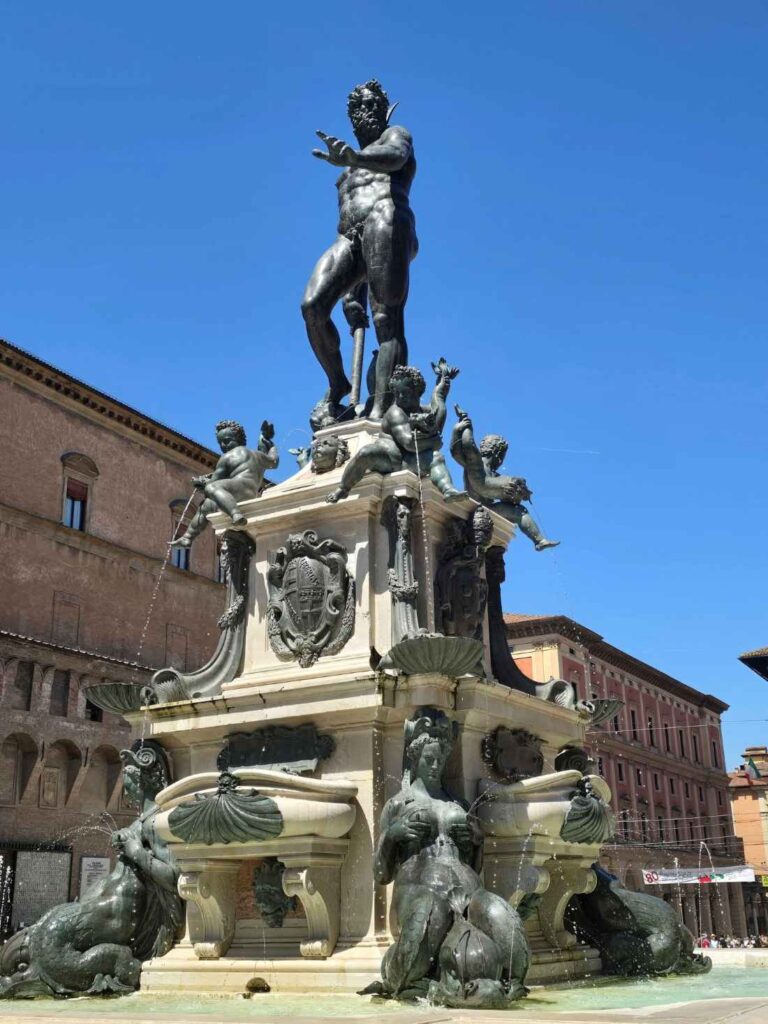
The Fontana di Nettuno stands at the edge of Piazza Maggiore on the adjacent Piazza del Nettuno, and it deserves more than the passing glance most visitors give it en route to the bigger square. Built in 1566 by the Flemish sculptor Giambologna, this bronze Neptune — trident raised, water pouring from beneath his feet — was commissioned by a pope to demonstrate that his authority over earthly affairs was as complete as Neptune’s dominion over the sea. Papal power expressed through mythology and plumbing.
The craftsmanship is extraordinary. Neptune’s face carries a kind of imperious calm that I kept returning to. The surrounding figures — putti, sea creatures, four women whose compressed breasts create four jets of water (this caused considerable controversy at the time) — are equally fine. It was the first public fountain in Bologna, and it remains the most beautiful. Stand in front of it at dusk, when the bronze turns dark gold.
4. Explore the Pinacoteca Nazionale di Bologna
The Pinacoteca Nazionale in Bologna is one of those art museums that serious travelers quietly love, and most others skip — which means you often have the rooms nearly to yourself. The collection was founded in the 18th century around altarpieces that were being removed from suppressed monasteries, and what’s grown up around those original works is a remarkable document of painting in Emilia-Romagna across five centuries.
The collection runs from the 13th to the 18th century and includes works by Botticelli, Giovanni Bellini, and a host of Bolognese masters — Guido Reni, the Carracci family, and Francesco Francia — who shaped European painting and are still underappreciated outside Italy. I spent a particularly long time in front of Raphael’s Ecstasy of St. Cecilia, which didn’t need my help but seemed to appreciate the attention. Admisson €12. Budget two hours. No queue, no crowds. A rare thing in Italy.
5. See The Two Towers

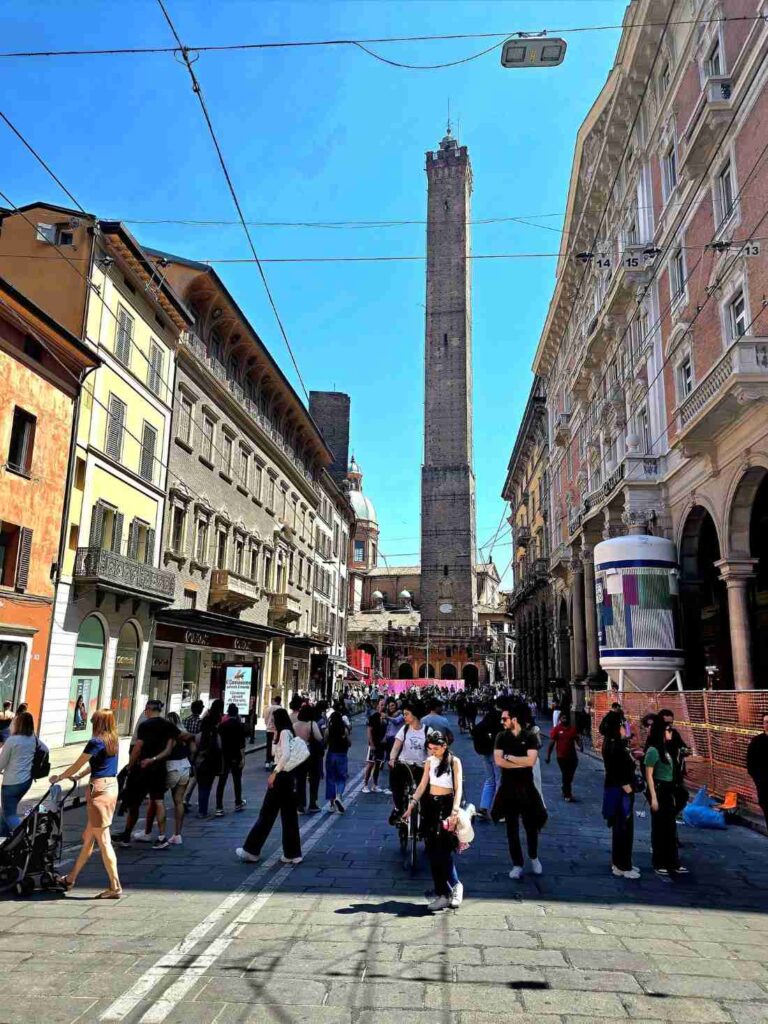
There were once more than 180 towers in medieval Bologna — status symbols and, possibly, military strongholds built by the city’s competing noble families. Twenty or so survive. The two that have become Bologna’s symbol are Asinelli (97 meters, the tallest medieval tower in Italy) and Garisenda (48 meters and noticeably leaning), which greet you as you enter the historic center and never quite stop being remarkable.
Important update: Both towers are currently closed to visitors for major structural restoration work, with climbing not expected to resume until late 2028 at the earliest. That means no 498-step ascent for now — but the towers are still absolutely worth seeing. The view of them, particularly from the junction of Via Rizzoli and Via Zamboni at dusk, is one of Bologna’s great sights. Garisenda’s lean is dramatic enough that Dante mentioned it in the Inferno, and it’s no less striking viewed from the street. Plan your photos from street level, check the official Bologna tourism website for the latest updates before your visit, and if you’re here after 2028, the climb will be waiting.
6. Visit the Archiginnasio of Bologna
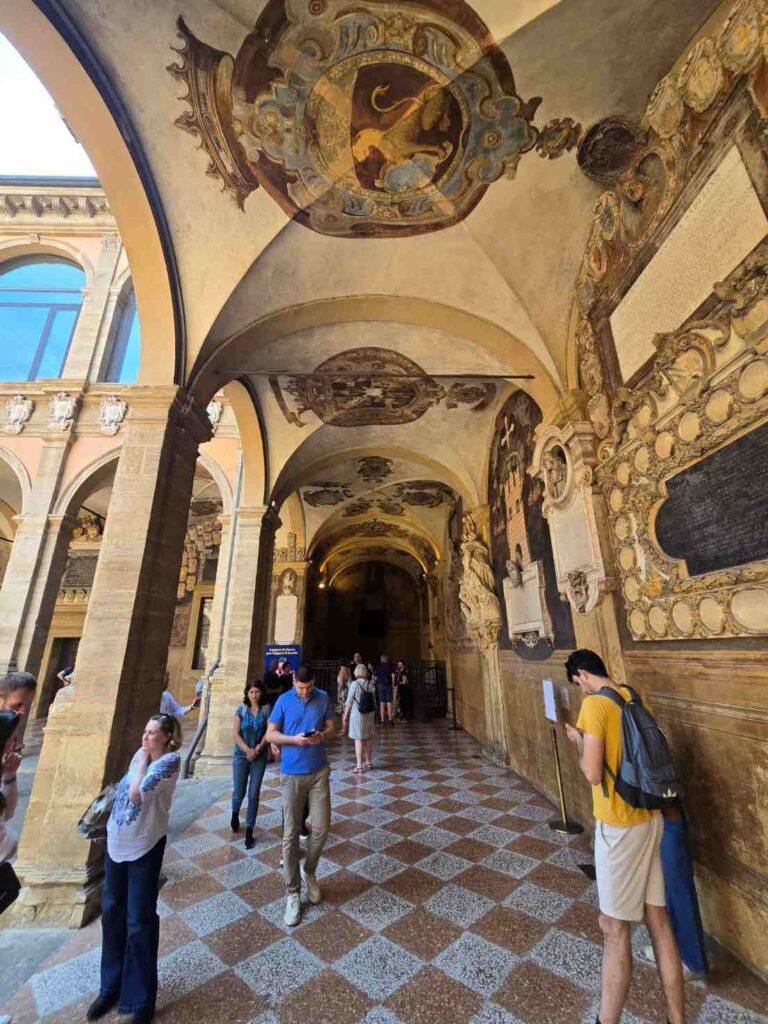
The University of Bologna was founded in 1088. That’s not a rounding error. It is, by any measure, the oldest continuously operating university in the world — predating Oxford, Cambridge, and every other institution of higher learning in Europe. The Archiginnasio, completed in 1563, was the university’s main building for two centuries and now houses the municipal library and the extraordinary Anatomical Theatre.
The Teatro Anatomico, built in 1637, is the room that gets people. It’s small — intimate, even — with carved wooden tiers of seats surrounding a central dissection table, the whole thing presided over by wooden figures of famous physicians. Dissections were performed here in secret, the bodies sourced through arrangements with the city’s authorities. Standing in that room, you feel the tension between knowledge and its cost in a way that no textbook can replicate. Entry costs a few euros (€10) and takes about 30 minutes. Don’t skip it. Book it on the official Bologna tourism website.
7. Walk Beneath Bologna’s Famous Porticos
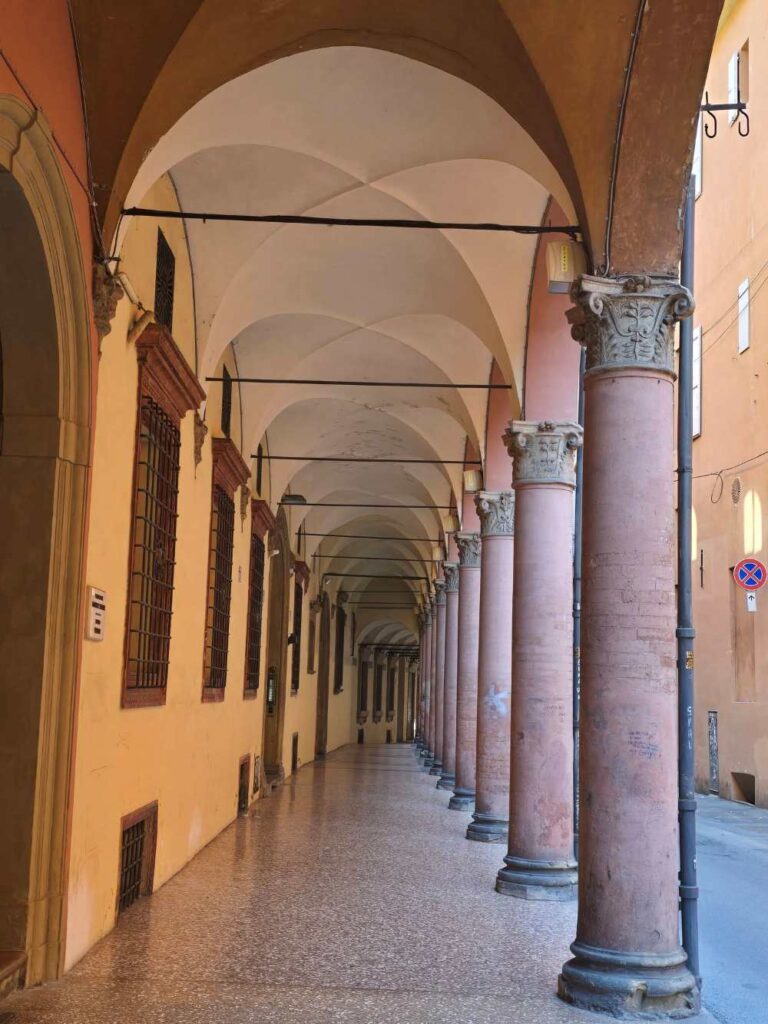
Bologna’s porticos — the long covered arcades that line street after street through the historic center and beyond — are a UNESCO World Heritage Site, and they deserve that designation not just for their architectural ambition but for what they do to daily life. More than 38 km of covered walkways mean you can walk across the entire city center in any weather without getting wet or burned. The porticos were built over many centuries by property owners required by law to provide covered public walkways at street level, and the result is one of the most livable urban environments in Europe.
Walk slowly. Look up. The ceilings of some porticos are frescoed; others are vaulted in brick; others are lined with fading advertisements from the 1950s. The longest single portico — the Portico San Luca, 3.8 km long with 666 arches — leads from the city edge up to the Sanctuary of San Luca on the hill above Bologna. Walking it is free, and on a Sunday morning, with the light coming through the arches and barely anyone around, it’s one of the finest walks in Italy.
8. Eat Traditional Bolognese Food

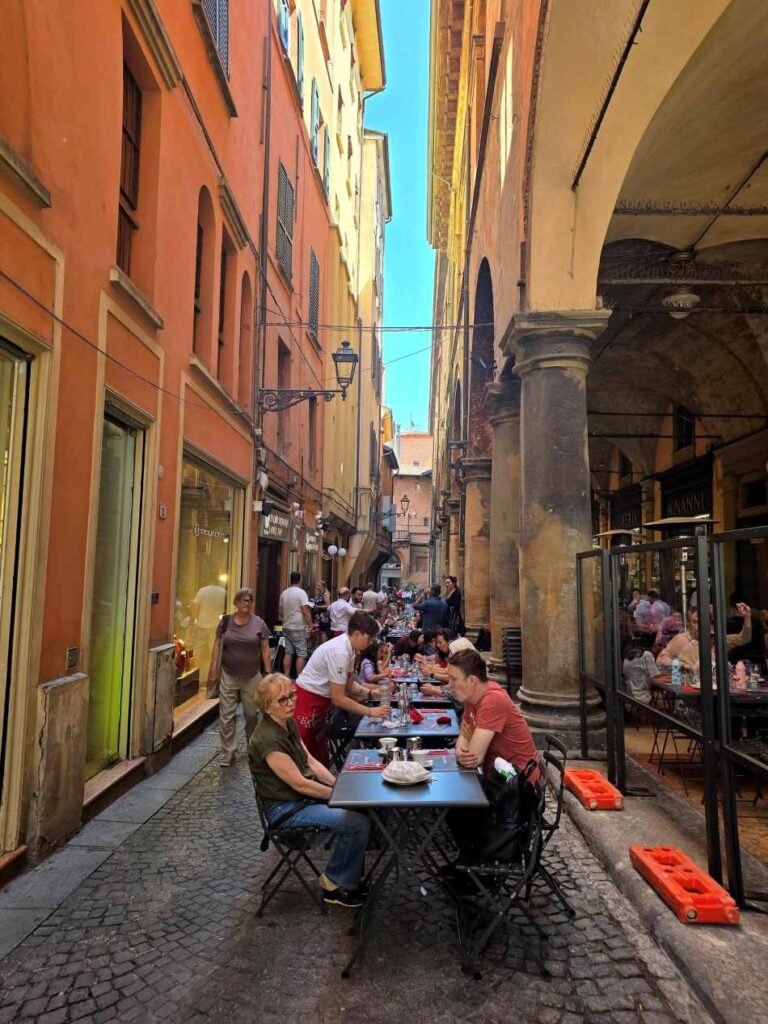
Bologna is called La Grassa — the Fat One — for excellent reason, and eating your way through the city is not a side activity: it is the point. I’ve eaten tagliatelle al ragù in Bologna three times and ordered it again on the fourth visit without a moment’s hesitation. The real Bolognese sauce is nothing like what you’ve had outside Italy — it’s a long-cooked meat ragù, barely any tomato, served on hand-rolled egg pasta so thin it almost dissolves. It is extraordinary.
Beyond ragù: tortellini in brodo (stuffed pasta floating in clear meat broth, which sounds plain and tastes profound), mortadella from the deli counter (try it sliced thick, not thin), freshly-made crescentine (fried flatbreads) stuffed with squacquerone cheese and prosciutto, and Parmigiano Reggiano at different ages from a proper fromagerie. The best Italian food in Italy has a strong argument for living here.
If you want someone to guide you through all of it, these tours are worth booking early: the Bologna Walking Food Tour covers the market stalls and key tastings in a single morning; the Bologna Food Tour from a Local Perspective goes deeper into the neighborhoods and producers most visitors never find; the Do Eat Better Food and Wine Tour pairs local wines with the food in a way that makes the whole Emilian picture click; and the Exclusive Bologna Cooking Class — tagliatelle, ragù, and a Spritz — is the best possible way to spend an evening.
9. Visit Mercato di Mezzo

The Mercato di Mezzo sits in the heart of the Quadrilatero, the historic food and shopping district in the center of Bologna, occupying a medieval building on Via Clavature that has hosted a market in various forms since the Middle Ages. Today it’s a covered market hall with ground-floor stalls selling fresh produce, cheese, cured meats, pasta, wine, and street food, with small restaurants and food counters on the upper levels.
Go before 11 am — by noon, it’s packed with lunch crowds, and the best produce has moved on. I’ve bought mortadella here that I thought about for weeks afterward, and I’ve stood at the counter eating tortellini in brodo out of a plastic cup in a way that felt entirely correct. It’s not a tourist trap; it’s a working food market that happens to be in a beautiful medieval building in one of the world’s great food cities. Bring cash, arrive hungry, and don’t rush.
10. Enjoy a Wine Tasting in Bologna
Emilia-Romagna is one of Italy’s great wine regions, and it’s underappreciated in the way Bologna itself is underappreciated — overshadowed by Tuscany and Piedmont while quietly producing wines of real character. The local Pignoletto — a dry, slightly sparkling white from the Colli Bolognesi hills — is the signature drink of the city, and it goes with everything. There’s also Sangiovese from the Apennine foothills, and the extraordinary aged Aceto Balsamico Tradizionale from nearby Modena.
The Do Eat Better: Bologna Traditional Food and Wine Tour pairs wine tastings with local food in a way that makes the connections between the two clear. Or head further and book the Secrets of Parmigiano Reggiano and Balsamic Vinegar tour for a deeper dive into the region’s artisan food and drink traditions. Among the best traditional Italian desserts you’ll find in Bologna are torta di riso and certosino (a Christmas fruitcake) — try them with a glass of local Albana passito.
11. Visit the Sanctuary of the Madonna di San Luca
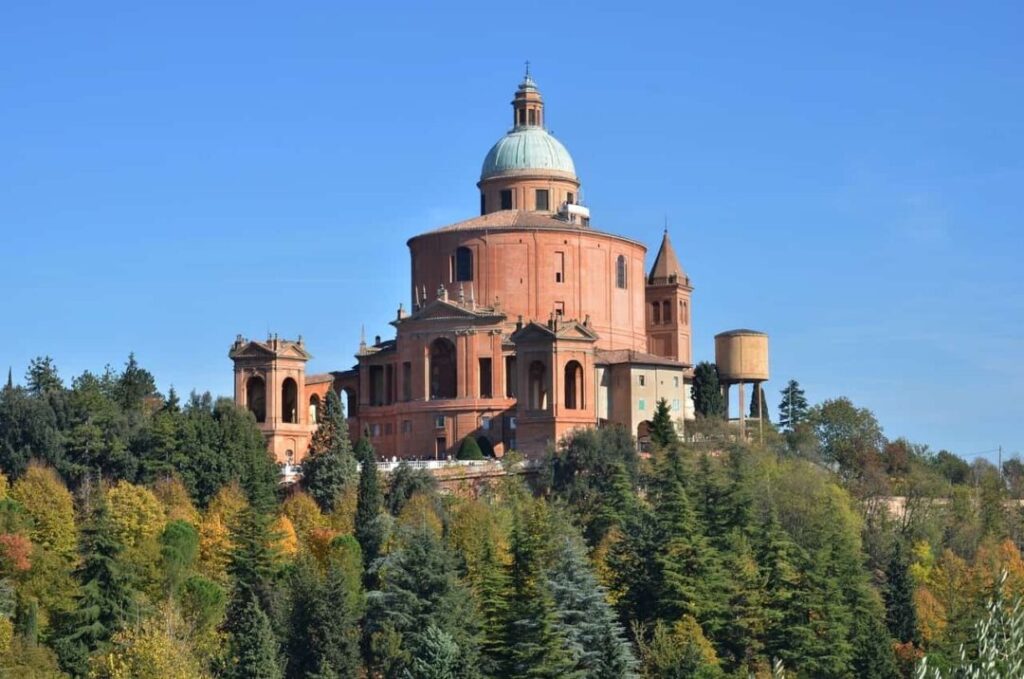
The Sanctuary of the Madonna of San Luca sits on Colle della Guardia, a hill above Bologna, and the walk to reach it is as remarkable as the destination itself. The Portico San Luca — 3.8 km long, 666 arches, built between the 17th and 18th centuries — is the longest porticoed arcade in the world, running from the Porta Saragozza in the city walls all the way to the church door at the top of the hill.
I walked it on a morning in early October, when the air was cool, and most of the arches were empty. The rhythm of arch after arch after arch becomes almost meditative. The sanctuary at the top is a beautiful Baroque church keeping a Byzantine icon of the Madonna that has been venerated in Bologna since the 12th century. The view from the hilltop — across the red city spread below you, with the Apennine foothills beyond — is one of the finest views in Emilia-Romagna. A funicular also runs seasonally if the walk is not for you.
12. Explore MAMbo (Museum of Modern Art of Bologna)
MAMbo — the Museum of Modern Art of Bologna — sits in a converted bread factory (ex Forno del Pane) in the Manifattura delle Arti, a cultural district in the northern part of the historic center. The permanent collection focuses on Italian art from the post-Second World War period onward, with particular depth in the Arte Povera and Concettuale movements that were central to Italian contemporary art from the 1960s onward.
The highlight of the permanent collection is the Giorgio Morandi room. Morandi was born in Bologna in 1890 and spent most of his life here, painting the same small arrangements of bottles and containers over and over again with a concentration and sensitivity that produced some of the most quietly powerful paintings of the 20th century. The room dedicated to him at MAMbo is the best collection of his work in the world. Even if contemporary art isn’t your primary reason for visiting Bologna, this room alone is worth the museum entry. Admission €6.
13. Attend a Local Food Festival

Bologna doesn’t just eat well — it celebrates food with the kind of civic enthusiasm most cities reserve for football or politics. The main annual festivals worth timing your visit around:
Festival del Tortellino (early October): Held in the magnificent Palazzo Re Enzo on Piazza del Nettuno, this celebration of Bologna’s most beloved filled pasta involves live demonstrations, competitions, and eating opportunities that should not be missed.
Festival dei Sapori d’Italia (April): A rotating-theme festival that brings together food specialties from across Italy. The setting — usually in or around the historic center — is part of the pleasure.
Mortadella Please (October): The city turns pink. Mortadella producers open their doors for guided factory visits, there are street tastings throughout the weekend, and a level of organized pork appreciation that I find deeply impressive. If you’re visiting in October, overlap with one of these — it’s worth planning around.
14. Experience an Evening in Piazza Maggiore

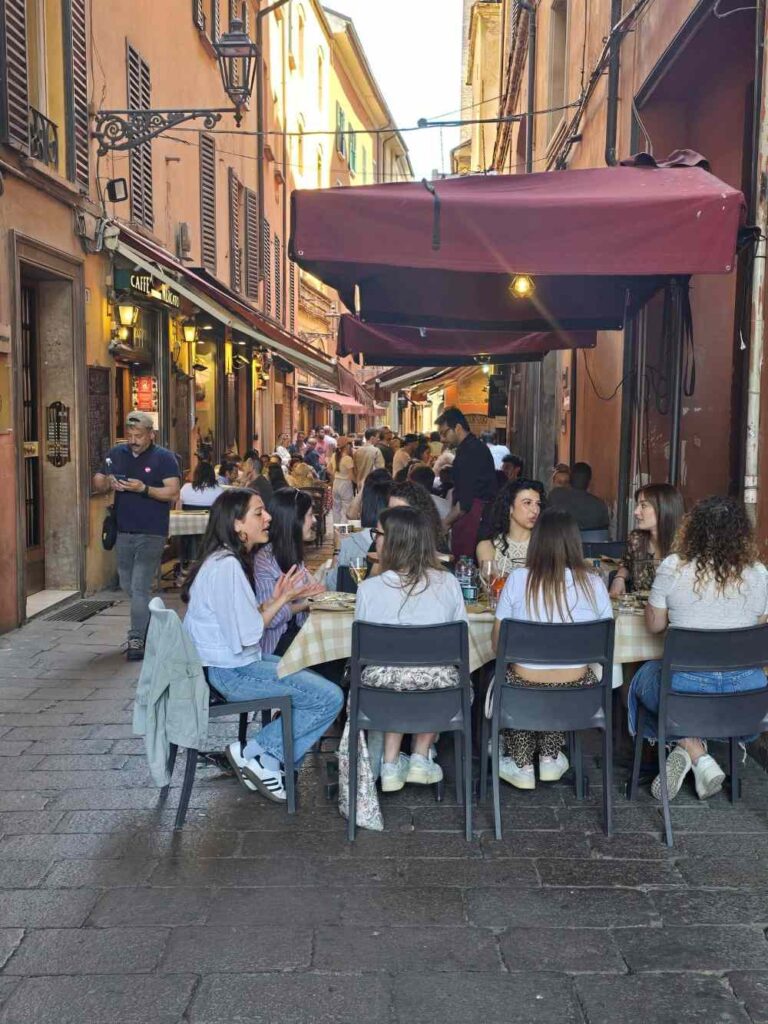
There’s a ritual to evenings in Bologna that takes about five minutes to understand and the rest of your life to recreate at home. Around 6 pm, the city shifts registers. The streets that were full of purposeful movement an hour ago now fill with slower, more enjoyable movement — friends stopping to talk, café terraces filling up, and on Piazza Maggiore, the buildings beginning to glow as the sun drops behind them.
Find a table on the piazza or at one of the bars on the surrounding streets. Order an Aperol Spritz or a glass of local Pignoletto. Watch the Basilica turn from pink to amber to gold. This is one of the great free pleasures of Italian city life, and Bologna does it particularly well. If you’re there in summer, you’ll often find an outdoor film screening setting up on the piazza — the setting for that is genuinely magical (see #12 below).
15. Rent a Vespa and Explore the Surroundings
There’s a specific feeling that comes with moving through Bologna on a Vespa — the porticos passing overhead in rhythm, the piazzas opening up suddenly, the hills visible in the distance — that no other form of transport quite replicates. The city is compact enough to cover on foot, but the surrounding hills and the countryside of Emilia-Romagna are best experienced on two wheels, with the wind doing what it does.
Vespa rentals are available from several operators near the city center; a guided e-bike or scooter tour — like the Private Guided E-bike Tour in Bologna — is a particularly good option if you want to cover more ground without navigating on your own. The hills south of the city, where the Bolognesi have their weekend villas and the wine producers cultivate their slopes, are wonderful Vespa territory.
16. Enjoy the Annual Film Festival if You Visit in the Summer
Sotto le Stelle del Cinema — Under the Stars of Cinema — takes place every summer on Piazza Maggiore, running roughly from mid-June through mid-August. Every night, a different film is screened on an enormous screen erected in the square. Entry is free. The programming mixes classic Italian cinema with international films, silent-era works with contemporary releases, retrospectives with premieres.
The experience of watching a film in this setting — surrounded by medieval and Renaissance buildings, under an open sky, with a few hundred other people who simply wanted to be outside and watch something together — is one I think about regularly. Check the program before your visit (it’s usually announced a few weeks ahead) and plan an evening around a film you want to see. The square opens early for seating; bring a jacket if you’re visiting in June.
Best Day Trips from Bologna
17. Modena
Modena is 30 minutes from Bologna by train, and it earns its own visit. The old city center is magnificent — a UNESCO World Heritage cathedral, a beautiful Piazza Grande, and a density of extraordinary food culture even by Emilian standards. This is the birthplace of both Ferrari and Pavarotti, and also the home of Aceto Balsamico Tradizionale, the real aged balsamic vinegar that has nothing in common with the supermarket product of the same name.
Book the Ferrari, Lamborghini & Pagani Tour from Bologna for a full motor valley experience — the Ferrari Museum in Maranello is extraordinary, and you can sometimes arrange test drives. Or combine the food experience with the Secrets of Parmigiano Reggiano and Balsamic Vinegar tour, which takes you to both a cheese producer and a balsamic acetaia on the same day. Modena is compact enough to walk in an afternoon; combine it with Parma in a single day if you’re ambitious.
18. Florence
Florence is 45 minutes from Bologna on the Frecciarossa — one of the easiest city-to-city connections in Italy and one of the most rewarding. The contrast between the two cities is striking: where Bologna is earthy, lived-in, and slightly chaotic, Florence is immaculate and monumental, the streets arranged like an open-air Renaissance museum.
The must-sees in Florence are the Uffizi Gallery, the Accademia (for Michelangelo’s David), the Duomo and Brunelleschi’s dome, and the Ponte Vecchio. Book tickets for the museums well in advance — they sell out. My guides to two days in Florence and three days in Florence are good starting points for planning the day. If you’ve already done Florence and want variety, check the best day trips from Florence for ideas for the wider Tuscan region.
19. Parma
Parma is under an hour from Bologna by train and delivers an Italian experience that feels both sophisticated and genuinely low-key. The city itself is elegant — wide streets, beautiful piazzas, an extraordinary Baptistery with 13th-century relief sculptures, and one of the finest Correggio fresco cycles in Italy inside the Parma Cathedral. The Palazzo della Pilotta houses an important art gallery and an extraordinary theatre.
But Parma’s great draw is the food. Prosciutto di Parma, Parmigiano Reggiano (many producers are in the surrounding countryside), and the local culatello — a cured pork product of extraordinary refinement. The Italian Food Experience in Bologna: Parmigiano Reggiano Factory, Wine & Vinegar Tasting tour from Bologna is an excellent alternative if you want the cheese and vinegar experience without going all the way to Parma itself.
20. Venice
Venice is 1 hour and 25 minutes from Bologna by high-speed train — close enough for a day trip, far enough to feel like a different world. Where Bologna is warm, earthy, and dense with everyday life, Venice is surreal, beautiful, and permanently theatrical. Crossing the lagoon by vaporetto for the first time remains one of the great experiences in Italian travel, regardless of how many times you’ve done it before.
For planning, my guides to one day in Venice and two days in Venice cover the essentials. The best food in Venice Italy is very different from Bologna’s — leaning toward seafood, cicchetti, and Veneto wines — and it’s worth eating deliberately. Also consider that cities like Padua and Vicenza are on the same line and offer a completely different — and much quieter — northern Italian experience. Don’t miss the best day trips from Venice if you’re spending time in the Veneto region.
Bologna Itinerary

One Day in Bologna
Morning:
- 9:00 am — Begin at Piazza Maggiore. Stand in the square for a moment, get oriented, then enter the Basilica di San Petronio (allow 45 minutes).
- 10:00 am — Walk two minutes to the Fontana di Nettuno on Piazza del Nettuno.
- 10:15 am — Head to the Archiginnasio (10-minute walk), and don’t miss the Anatomical Theatre. Allow 45 minutes.
- 11:15 am — Walk to the Mercato di Mezzo for a market browse and an early snack. Buy something: a slice of mortadella, a small tortellini in brodo.
Midday:
- 12:30 pm — Lunch at one of the trattorias near the market. Order tagliatelle al ragù. There is no wrong choice.
Afternoon:
- 2:00 pm — Walk to the Two Towers. Both are currently closed for restoration until late 2028, but the towers are still unmissable from street level — allow 30 minutes to walk around them and take it all in.
- 3:30 pm — Stroll the porticos toward the Pinacoteca Nazionale — 30–45 minutes is enough for a focused visit.
- 5:00 pm — Return to Piazza Maggiore for aperitivo. Order a Pignoletto or a Spritz. Watch the buildings change color as the sun drops.
- 7:30 pm — Dinner in the Quadrilatero, the grid of medieval streets between the market and the piazza.
Two Days in Bologna
Day 1: As above.
Day 2:
- Morning: Take the Emilian Gastronomic Experience with a Local tour — this covers the food markets, producers, and local knowledge that takes years to accumulate on your own.
- Afternoon: Walk the Portico San Luca (or take the funicular) to the Sanctuary of the Madonna of San Luca. Allow 2.5–3 hours round trip if walking.
- Evening: Book the Exclusive Bologna Cooking Class: Pasta, Tagliatelle, Ragù & Spritz for an evening class — you make dinner and eat it.
Where to Stay in Bologna
Bologna’s hotel rates are considerably lower than Florence or Venice for comparable quality — one of the less-discussed reasons to use it as a base for northern Italy. Here’s how to choose the right area for your trip.
Best Area for First-Time Visitors
Stay in or immediately around the historic center — within walking distance of Piazza Maggiore.
The historic center is compact and almost entirely walkable, and being inside it means you can step out after dinner and find yourself in a medieval piazza without planning it. For first-timers, nothing beats that immediacy.
- Hotel Commercianti (Via de’ Pignattari 11) — occupying a medieval building directly adjacent to San Petronio, with rooms that look over the Basilica. The location is genuinely unbeatable for a first Bologna visit; you’re in the heart of everything from the moment you arrive.
- Hotel Corona d’Oro — a beautiful historic hotel 350 meters from Piazza Maggiore, with elegant rooms, a stunning frescoed breakfast room, and the kind of gracious service that makes a city feel welcoming from day one.
Best Area for Food Lovers
Stay near the Quadrilatero — the medieval market grid between Piazza Maggiore and Via Rizzoli.
The Quadrilatero is Bologna’s food heart: narrow streets lined with salumerias, fromageries, wine bars, and trattorias that have been in the same families for generations. Staying close to it means the Mercato di Mezzo is a two-minute walk and the best dinner options are right outside your door.
- Hotel Metropolitan (Via dell’Orso 6) — a sleek, design-forward hotel in the historic center with a rooftop terrace for aperitivi and a location that puts the Quadrilatero and Piazza Maggiore both within easy walking distance. Well-run, modern, and good value for what it offers.
- I Portici Hotel (Via dell’Indipendenza 69) — a beautiful boutique hotel inside a 19th-century porticoed building, with an excellent restaurant on-site and a location that makes the food markets and trattorias of the center immediately accessible.
Best Area for Budget Travelers
Look at hotels just outside the immediate historic center — five to ten minutes’ walk from Piazza Maggiore — where rates drop noticeably without sacrificing convenience.
- Albergo Panorama (Via Livraghi 1) — a solid, well-located Art Deco budget option right in the historic center, simple and well-kept, with genuinely helpful staff and the kind of central position that makes a real difference when navigating on foot.
- Hotel Accademia (Via delle Belle Arti 6) — a friendly three-star a short walk from the Pinacoteca and the university quarter, clean and comfortable, with easy access to the center and Bologna’s student-driven café scene right on the doorstep.
Best Luxury Hotels in Bologna
Bologna’s top-end hotels are exceptional value compared to equivalent properties in Rome or Florence — and several occupy buildings of genuine historic significance.
- Grand Hotel Majestic già Baglioni (Via dell’Indipendenza 8) — Bologna’s finest hotel, full stop. An 18th-century palazzo with marble columns, antique furniture, period frescoes, and a level of service that feels genuinely old-world without being stuffy. Nominated for the Condé Nast Traveller Readers’ Choice Awards 2026, it has been the city’s most prestigious address for over a century. Splurge here if you can.
- Phi Hotel Bologna (Via della Grada 6) — a boutique hotel that dates back to 1375, originally built as a tavern, now reimagined with brightly colored rooms, contemporary art, and a location next to Piazza Maggiore that’s hard to beat. Quirky, characterful, and considerably more fun than a standard luxury property.
Where to Eat in Bologna


Bologna is Italy’s undisputed food capital — La Grassa didn’t earn that nickname by accident. Eating here is never just sustenance; it’s the point of the day. These are the places I keep coming back to, organized by what you’re looking for.
Best Traditional Restaurants in Bologna
These are the places to go when you want the real thing — handmade pasta, slow-cooked ragù, and rooms full of Bolognesi who have been eating here for decades.
- Trattoria da Me (Via San Felice 50) — one of the most celebrated trattorias in the city, run with genuine care and serving pasta that reminds you why Bologna is famous for this in the first place. The atmosphere is warm and grown-up rather than touristy. Book well in advance — it fills up fast.
- Da Cesari (Via de’ Carbonesi 8): open since 1955, serving traditional Bolognese dishes alongside less common regional preparations — gramigna with sausage ragù, house-made pasta in shapes most restaurants no longer bother with. Locals eat here, and the wine list is serious.
Best Casual Local Eateries in Bologna
Bologna’s student population keeps the casual eating scene excellent and affordable. These are the spots where the food is serious but the setting is not.
- Osteria dell’Orsa (Via Mentana 1) — the quintessential Bologna student osteria, beloved by locals and visitors alike for its great-value tortellini in brodo and easy, convivial atmosphere. Arrive early or expect to queue.
- Sfoglia Rina — a pasta shop and casual eatery that also sells fresh pasta to take away, if you want to bring a piece of Bologna home with you. The lunch counter is excellent and unpretentious.
- La Prosciutteria — a cured meat specialist near the market with outstanding Emilian products.
Best Places for Aperitivo in Bologna
Aperitivo in Bologna runs roughly 6 pm to 8 pm and is one of the great pleasures of the city. The drinks are local — Pignoletto frizzante, Lambrusco di Sorbara, Aperol Spritz — and most bars include food, making it genuinely competitive with a light dinner for value.
- Le Stanze (Via del Borgo di San Pietro 1) — housed in the former private chapel of the Bentivoglio family, with soaring vaulted ceilings and 16th-century frescoes still intact. One of the most visually extraordinary bars in Italy. Order something and sit in it for a while.
- Osteria del Sole (Vicolo Ranocchi 1d) — the oldest bar in Bologna, serving wine continuously since 1465. It sells only wine — no food — but customers are welcome to bring their own from the nearby Quadrilatero market. A €3 glass of house wine and a parcel of mortadella from the stall around the corner is the best budget dinner in the city. Look for the unmarked alley; no sign.
- Tamburini (Via Caprarie 1) — a food shop, restaurant, and wine bar that has been a fixture of the Quadrilatero for decades. The wine bar is ideal for an aperitivo: over 200 labels, traditional atmosphere, and good food. Open until midnight on weekends.
- Bar Senza Nome (Via Belvedere 11b) — the “Bar with No Name,” run by deaf staff, where you order by sign language or written note. Cheap Spritz, great outdoor tables, and a genuinely special atmosphere that’s entirely unlike anywhere else in the city.
Best Food Markets in Bologna
- Mercato di Mezzo / Quadrilatero — the medieval market grid east of Piazza Maggiore is the oldest and most storied food shopping area in the city. The indoor Mercato di Mezzo has stalls selling fresh pasta, mortadella, cheese, and wine; the surrounding streets are lined with salumerias and specialty food shops that have been here for generations. Go before 11 am.
- Mercato delle Erbe (Via Ugo Bassi 25) — a beautiful glass-and-iron covered market from 1910, renovated in 2013, with fresh produce stalls, a fromagerie, a fishmonger, bakeries, and a wine bar. At 6 pm the rear entrance on Via Belvedere opens into a buzzing outdoor aperitivo space with food stalls and bars. One of the best market experiences in northern Italy.
- Mercato Ritrovato (Piazza Cavour, Friday mornings) — a Slow Food farmers’ market that runs every Friday morning, bringing together small producers from across Emilia-Romagna. The place to find artisan cheeses, heritage cured meats, seasonal vegetables, and local wines that rarely make it into shops. Worth rearranging your schedule for.
Food tour that does the research for you:
- Bologna Food Tour from a Local Perspective — the best introduction to the full range of Bolognese food culture in a single morning.
Frequently Asked Questions About Bologna
What is Bologna famous for?
Bologna is famous for its food (birthplace of ragù, mortadella, and home to Parmigiano Reggiano and Prosciutto di Parma producers), its university (the oldest in the world, founded in 1088), its medieval towers, the UNESCO-listed porticos, and Piazza Maggiore.
What Food is Bologna Italy known for?
The most famous dishes from Bologna include tagliatelle al ragù alla Bolognese (the authentic version of what the world calls “Bolognese sauce”), tortellini in brodo, mortadella, and crescentine. The city is also the capital of Emilia-Romagna, Italy’s richest food region. For a broader picture of the best Italian food in Italy, Bologna deserves its own chapter.
How Many Days Should You Spend in Bologna?
Two days is the ideal minimum. Three days is better if you want to include a day trip to Modena or Parma and a cooking class.
What Are the Best Things to Do in Bologna?
The must-sees are Piazza Maggiore, the Basilica di San Petronio, the Two Towers, the Archiginnasio (Anatomical Theatre), the Fontana di Nettuno, the Sanctuary of San Luca, and the food markets. All are in or close to the historic center and easily covered on foot.
Is Bologna Good for a Day Trip from Florence?
Yes — Bologna is just 45 minutes from Florence by Frecciarossa and offers a completely different experience. It makes an excellent day trip if you’re spending two days in Florence or three days in Florence.
When Is the Best Time to Visit Bologna?
April to June and September to October for the best weather and atmosphere. July and August are hot, but have the outdoor cinema on Piazza Maggiore. October is festival season.
Is Bologna Worth Visiting?
Absolutely. Bologna is one of Italy’s finest and most underappreciated cities — it has an extraordinary history, the world’s oldest university, world-class food, and remarkable architecture, all without the crushing crowds of Rome or Venice.
Is Bologna Better as a Day Trip or an Overnight Stay?
Bologna is worth visiting as a day trip, but staying overnight is recommended if you want to experience the city’s food scene, historic atmosphere, and nightlife. Most visitors find that 1–2 days is the ideal amount of time to explore the main attractions, enjoy local cuisine, and wander Bologna’s famous porticoes at a relaxed pace.
My Favorite Experience in Bologna
If I had to choose one memory from my time in Bologna — and I’ve been back several times now — it would be a tagliatelle al ragù that I ate at a small trattoria near the Quadrilatero on my first visit. Nothing about the setting was remarkable: a wooden table, a carafe of Sangiovese, a basket of bread. The pasta arrived, and it looked simple. Then I tasted it.
What struck me was the patience in it — the hours of slow cooking in that sauce, the care in rolling the pasta to exactly the right thickness, the understanding that nothing needed adding because everything was already there. It was a bowl of food that taught me something about Italian cooking that no recipe book had managed to convey: that the best dishes are often the oldest ones, and that their survival across centuries is not inertia but earned authority.
Bologna does that to you. It makes you understand why things are done the way they’re done, and why some things are worth defending.
Final Thoughts
Bologna rewards the traveler who comes with curiosity and appetite — and I mean both literally and figuratively. It’s a city that doesn’t shout or perform, that doesn’t need to convince you of anything, because it’s been quietly excellent for the better part of a thousand years.
The porticos will keep you sheltered. The food will keep you well fed. The history, the art, the medieval towers leaning over narrow streets — all of it is here, all of it is accessible, and almost none of it is as crowded as it deserves to be. Come with time, come hungry, and book a food tour within the first 24 hours. The rest of Bologna will take care of itself.
Planning a longer trip to northern Italy? Don’t miss my guides to one day in Venice, two days in Venice, the best food in Venice Italy, Padua Italy, and Vicenza Italy for the wider Veneto region. If you’re heading south, the best day trips from Rome guide covers options across central Italy.